

Planning for 2027 often starts with a comparison: which leadership development framework fits your programs, how far it scales, and what it costs to roll out. The well-known options are all solid at what they were built for. Where they differ is the layer they work on: observable behavior, competencies, natural strengths, or the way people think.
That layer shapes what your data can tell you and how many programs a framework can support. Thinking sits behind every decision, conversation, and plan, so frameworks that start there tend to carry from leadership development into teams, change, and succession. This comparison looks at the seven frameworks enterprise L&D teams use most, what each one is designed to do, and the criteria worth checking before you commit next year's budget.
Quick guide: 7 popular leadership development frameworks for enterprise L&D
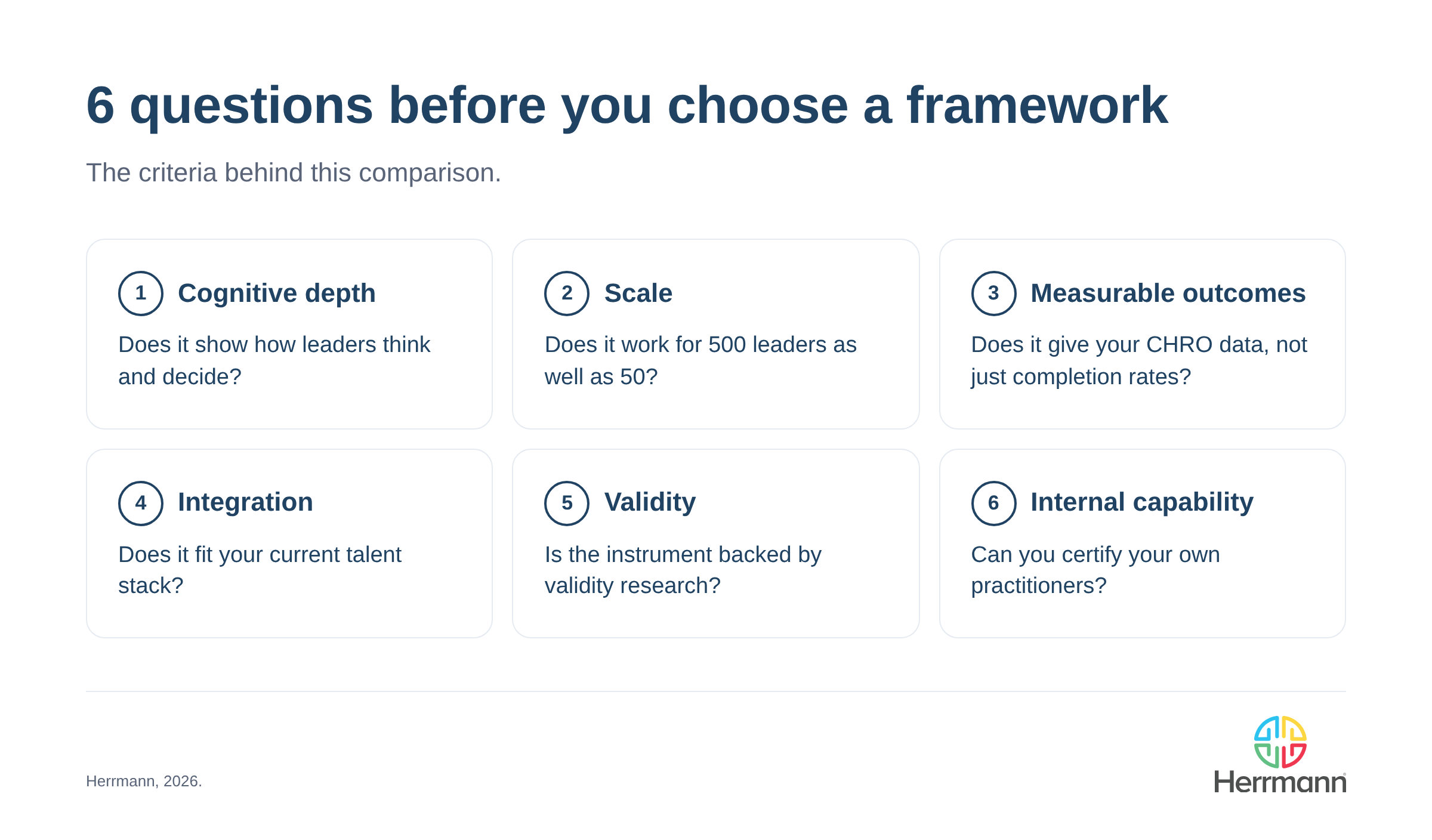
- Herrmann Whole Brain® Thinking: The best cognitive diversity framework for scalable enterprise leadership development
- Situational Leadership (Blanchard): A structured approach to adapting leadership style based on team readiness
- Leadership Practices Inventory (Kouzes & Posner): A behavior-focused model grounded in five observable practices
- Lominger/Learning Agility: A competency-based system used in succession planning
- Adaptive Leadership (Heifetz): A diagnostic model for navigating complex organizational challenges
- Strengths-Based Leadership (Gallup CliftonStrengths): A talent identification tool that maps individual strengths
- Action Learning (Revans): A group-based methodology that pairs real-world problem-solving with reflection
How we chose the best leadership frameworks for enterprise L&D
Enterprise L&D is not a one-size-fits-all function. The frameworks on this list were selected because they address the operational reality of developing hundreds or thousands of leaders across business units, geographies, and role levels.
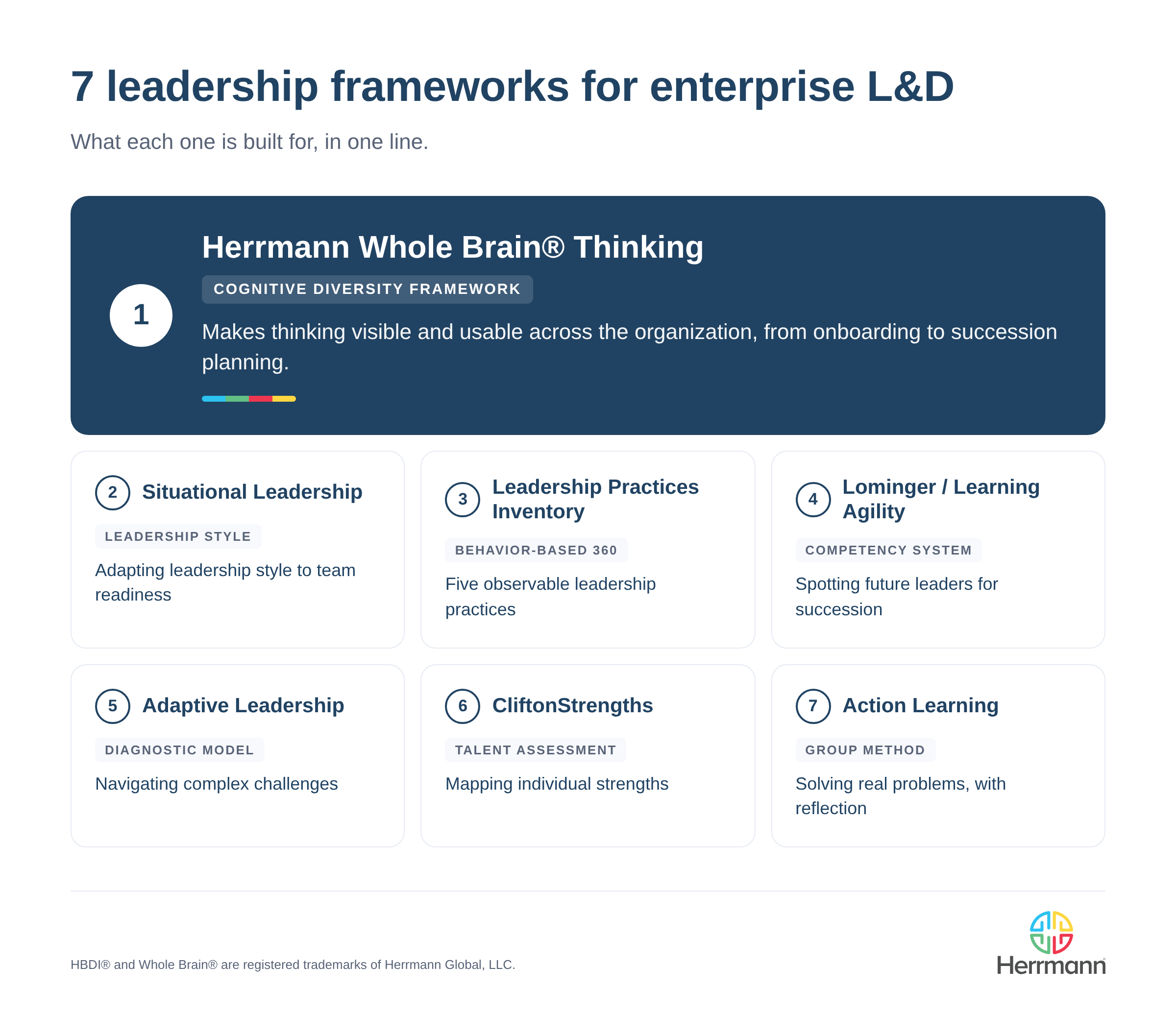
- Cognitive depth: Does the framework go beyond surface behavior to reveal how your leaders process information and make decisions? Deeper insight into thinking preferences leads to more targeted, lasting development.
- Scalability across the enterprise: Can your internal team deploy it consistently to 500 leaders the same way they deploy it to 50, without losing quality or customization?
- Measurable development outcomes: Does the framework provide data you can report to your CHRO, connecting leadership growth to business impact rather than completion rates alone?
- Integration with existing L&D systems: Can it sit alongside your current talent management stack and complement programs you have already invested in?
- Assessment validity: Is the underlying instrument backed by published validity research and a large normative dataset, or is it built on anecdotal models?
- Internal facilitation capability: Can you certify practitioners inside your organization so leadership development becomes an internal muscle, not a recurring consulting engagement?
7 popular leadership development frameworks for enterprise L&D
1. Herrmann Whole Brain® Thinking: Best overall leadership framework for enterprise L&D
Most leadership frameworks tell you what a leader does. Whole Brain® Thinking from Herrmann starts from how a leader thinks, and that distinction shapes everything that follows. The HBDI® (Herrmann Brain Dominance Instrument®) measures thinking preferences against the Whole Brain® Thinking model, across four quadrants: Analytical, Practical, Relational, and Experimental. Rather than sorting people into fixed types, it maps the cognitive preferences that drive decisions, communication patterns, and strategic blind spots.
For enterprise L&D teams, the operational advantage is immediate. When you understand the cognitive footprint of a leadership cohort, you can identify exactly where thinking concentrates and where it doesn't. That data lets you design development programs that build genuine thinking agility rather than reinforcing existing strengths. Herrmann's database of more than 4.5 million HBDI® profiles provides a research foundation that few frameworks can match.
Scalability is built into the model. The Herrmann Platform provides a digital hub for real-time team-building analysis, interactive activities, and performance tracking. Certified Practitioners embed the methodology inside your organization, reducing reliance on external consultants and making Whole Brain® Thinking a permanent organizational capability. From onboarding to succession planning, the framework adapts to each leadership stage.
Herrmann Whole Brain® Thinking features
- HBDI® Assessment: A validated 116-question instrument that maps individual and team thinking preferences, providing a data baseline for every development decision you make.
- Pair and Team Reports: Visual reports that show where thinking preferences cluster across a team, making blind spots visible and giving facilitators clear discussion starting points.
- Whole Brain® Blended Learning: A mix of digital resources and high-energy workshops that embeds a "Thinking Culture" as a permanent organizational muscle, not a one-time event.
- HBDI® Certified Practitioner program: Empowers your internal leaders to own the methodology and scale it independently, building long-term internal capability.
- Enterprise Analytics: Provides reports on thinking preferences over time, letting you track development trends across business units and role levels.
- Microsoft Teams Integration: Brings thinking agility into the daily flow of work, so development is not limited to offsite workshops.

Herrmann Whole Brain® Thinking pros and cons
Pros:
- Measures the thinking layer underneath behavior, a layer that personality-based assessments are not designed to show
- Backed by 45 years of research and a proprietary database of more than 4.5 million profiles, and the subject of hundreds of doctoral dissertations and master's theses
- Certification model creates internal capability, so development efforts scale without recurring external costs
Cons:
- Realizing the full benefit requires organizational commitment to embedding the methodology, rather than treating it as a standalone workshop
- The richness of the four-quadrant model means facilitators benefit from certification training before deploying across large populations
- Organizations already using multiple assessment tools may need to map existing data to the Whole Brain® framework during initial rollout
2. Situational Leadership (Blanchard): A readiness-based model for frontline and mid-level leader development
Situational Leadership, developed by Ken Blanchard and Paul Hersey, provides a structured approach to adapting leadership style based on the development level and readiness of each team member. The model categorizes four leadership styles, from directing to delegating, and gives managers a clear decision path for matching their approach to each direct report's task-specific competence and commitment.
For enterprise L&D teams managing large populations of frontline managers, the model offers a common vocabulary that deploys quickly through training sessions. It works within a clearly defined scope: helping managers adjust their approach in one-on-one and small-team interactions.
Situational Leadership features
- Four-style flexibility model: Categorizes leadership behavior into directing, coaching, supporting, and delegating, giving managers a practical rubric for common workplace interactions.
- Development level assessment: Provides a simple diagnostic for gauging where a direct report sits on competence and commitment, which helps managers avoid one-size-fits-all delegation.
- Modular training design: Available in workshop and digital formats that can be rolled out to multiple sites with consistent curriculum.
Situational Leadership pros and cons
Pros:
- Quick to learn and intuitive for managers who are new to formal leadership development
- Focuses on the day-to-day coaching interactions that directly affect team performance
- Available in multiple languages and supported by a global training network
Cons:
- Does not assess the cognitive or thinking-preference layer, which limits diagnostic depth for complex leadership challenges
- Primarily addresses dyadic manager-employee interactions, leaving broader team dynamics and organizational strategy out of scope
- The model has limited academic validation compared to assessment-backed frameworks like the HBDI®
3. Leadership Practices Inventory (Kouzes & Posner): A behavior-focused model built on five observable practices
The Leadership Practices Inventory (LPI) is built on James Kouzes and Barry Posner's research into what effective leaders do. The framework identifies five practices: Model the Way, Inspire a Shared Vision, Challenge the Process, Enable Others to Act, and Encourage the Heart. Each practice is measured through a 360-degree feedback instrument.
For L&D teams looking for a behavior-based lens, the LPI offers a straightforward assessment that can be used across industries and levels. The model's simplicity makes it particularly useful for organizations introducing formal leadership development for the first time.
Leadership Practices Inventory features
- 360-degree feedback instrument: Gathers perspectives from direct reports, peers, and supervisors, providing a multi-rater view of leadership behavior.
- Five-practice framework: Provides a shared vocabulary for discussing leadership effectiveness, making feedback conversations more specific and structured.
- Workshop-based delivery: Comes with facilitator guides and participant workbooks that allow certified trainers to deliver consistent sessions at scale.
Leadership Practices Inventory pros and cons
Pros:
- Grounded in over 30 years of research and millions of survey responses
- Accessible framework that works across industries, from healthcare to manufacturing
- Provides observable, coachable behaviors rather than abstract competency labels
Cons:
- Measures what leaders do rather than how they think, which can leave underlying development gaps unaddressed
- May not provide enough strategic depth for senior executives with complex cross-functional mandates
- Relies on participant self-report and peer ratings, which can introduce rating bias across cultures
4. Lominger/Learning Agility: A competency-based system used in succession planning
The Lominger framework, now part of Korn Ferry's talent management portfolio, organizes leadership competencies into clusters and measures learning agility, the ability to learn from experience and apply those lessons to new situations. The model gained traction in succession planning processes where organizations need to identify leaders who can adapt as roles and business conditions evolve.
L&D teams responsible for building leadership pipelines often use this model to assess high-potential candidates. Learning agility provides a forward-looking metric that goes beyond current performance to gauge a leader's readiness for more complex roles.
Lominger/Learning Agility features
- Learning agility dimensions: Assesses mental agility, people agility, change agility, and results agility, along with self-awareness, providing a multi-dimensional readiness profile.
- Competency library: Contains a broad set of leadership competencies that can be mapped to role requirements and organizational strategy.
- Succession integration: Designed to feed directly into talent review and succession planning conversations at the executive level.
Lominger/Learning Agility pros and cons
Pros:
- Directly addresses succession planning needs with a future-focused readiness measure
- Comprehensive competency architecture that can be customized per role level
- Widely recognized in HR and talent management circles
Cons:
- Competency-heavy approach can become complex to administer and interpret without dedicated talent analytics support
- Does not measure cognitive preferences, limiting its ability to explain why two leaders with similar competency scores develop at different rates
- Full implementation typically requires significant integration with existing HRIS systems

5. Adaptive Leadership (Heifetz): A diagnostic model for navigating complex organizational challenges
Adaptive Leadership, developed by Ronald Heifetz at Harvard, distinguishes between technical problems (those with known solutions) and adaptive challenges (those requiring people to change their values, beliefs, or behaviors). The framework teaches leaders to diagnose the nature of a challenge before selecting a response, which is particularly relevant in organizations facing transformation, restructuring, or market disruption.
For enterprise L&D teams supporting leaders through major change initiatives, Adaptive Leadership provides a vocabulary for the ambiguity that standard competency models often overlook. The model encourages leaders to give the work back to the people closest to it rather than centralizing all decision-making.
Adaptive Leadership features
- Technical vs. adaptive diagnosis: Helps leaders distinguish between problems that need expertise and problems that need behavioral or cultural shifts, preventing misapplied solutions.
- Observation from the balcony: Teaches leaders to step back from the immediate action to see systemic patterns, which is useful in politically complex organizations.
- Case-in-point pedagogy: Uses live group dynamics as the learning laboratory, giving participants direct experience with adaptive challenges in real time.
Adaptive Leadership pros and cons
Pros:
- Provides a sophisticated diagnostic lens for challenges where standard management approaches fall short
- Supported by Harvard Kennedy School's research and widely taught in public sector and healthcare leadership programs
- Encourages distributed leadership, reducing bottlenecks at the executive level
Cons:
- The framework is conceptual rather than assessment-driven, which can make it difficult to measure development progress at scale
- Requires experienced facilitators who can manage the emotional intensity of case-in-point learning
- Does not include a diagnostic instrument for individual thinking preferences, leaving the cognitive layer of leadership unexamined
6. Strengths-Based Leadership (Gallup CliftonStrengths): A talent identification tool that maps individual strengths
CliftonStrengths, developed by Gallup, identifies an individual's natural patterns of thinking, feeling, and behaving across 34 themes. The underlying philosophy is that leaders achieve more by investing in their strengths rather than trying to fix weaknesses. For L&D teams, the assessment provides a profile that helps leaders understand what energizes them and where they are likely to contribute most naturally.
The model has widespread adoption across enterprise organizations, partly because the assessment is quick to administer and easy for participants to understand. Gallup's research base on engagement and performance provides supporting data that connects strengths awareness to team outcomes.
CliftonStrengths features
- 34 strength themes: Identifies patterns like Strategic, Empathy, and Achiever, giving leaders a vocabulary for their natural tendencies.
- Team composition reports: Aggregate individual profiles to show where a team's strengths concentrate and where gaps exist.
- Manager and team editions: Provide role-specific insights for team leaders, including coaching suggestions tailored to each direct report's profile.
CliftonStrengths pros and cons
Pros:
- Quick administration time and accessible language make it easy to deploy across large populations
- Backed by Gallup's extensive engagement research, which connects individual strengths to team-level outcomes
- Works well as an entry-level self-awareness tool for emerging leaders
Cons:
- Focuses on identifying natural tendencies rather than building the thinking agility needed to lead through unfamiliar situations
- The strength-only framing can make it difficult to surface development areas that leaders genuinely need to address
- Does not provide a structural framework for how different thinking preferences interact on a team, which limits its use in team-level diagnostics
7. Action Learning (Revans): A group-based methodology that pairs real-world problem-solving with reflection
Action Learning, rooted in Reg Revans' research, is built on the principle that leaders learn most effectively by working on real organizational problems in small groups, with structured reflection built into the process. The methodology asks participants to question assumptions, share perspectives, and commit to action between sessions.
For enterprise L&D teams, Action Learning provides a format that can be layered on top of any leadership content. It works especially well for cross-functional leadership programs where participants bring different business contexts to the table and learn through the contrast.
Action Learning features
- Real-problem orientation: Participants work on actual business challenges they are responsible for, which increases transfer of learning back to the workplace.
- Structured reflection: Facilitated reflection sessions after each problem-solving cycle help participants identify patterns in their leadership approach.
- Cross-functional groups: Assembling participants from different functions creates a built-in diversity of perspective that accelerates learning.
Action Learning pros and cons
Pros:
- Directly connects leadership development to business outcomes by working on real organizational problems
- Flexible enough to complement other frameworks, including assessment-based models like the HBDI®
- Builds a peer network among participants that often persists beyond the program
Cons:
- Requires skilled facilitation to keep groups productive and prevent dominant voices from controlling the process
- Does not include a diagnostic assessment, so development is driven by group observation rather than validated data
- Success depends heavily on participant commitment and organizational follow-through after the program ends
Comparison table: The best leadership frameworks for enterprise L&D
| Framework | Validated Assessment Instrument | Internal Certification Available | Enterprise Analytics & Reporting |
|---|---|---|---|
| Herrmann Whole Brain® Thinking | ✓ | ✓ | ✓ |
| Situational Leadership | ✗ | ✓ | ✗ |
| Leadership Practices Inventory | ✓ | ✓ | ✗ |
| Lominger/Learning Agility | ✓ | ✗ | ✓ |
| Adaptive Leadership | ✗ | ✗ | ✗ |
| CliftonStrengths | ✓ | ✓ | ✗ |
| Action Learning | ✗ | ✓ | ✗ |
How do thinking frameworks differ from personality assessments in leadership development?
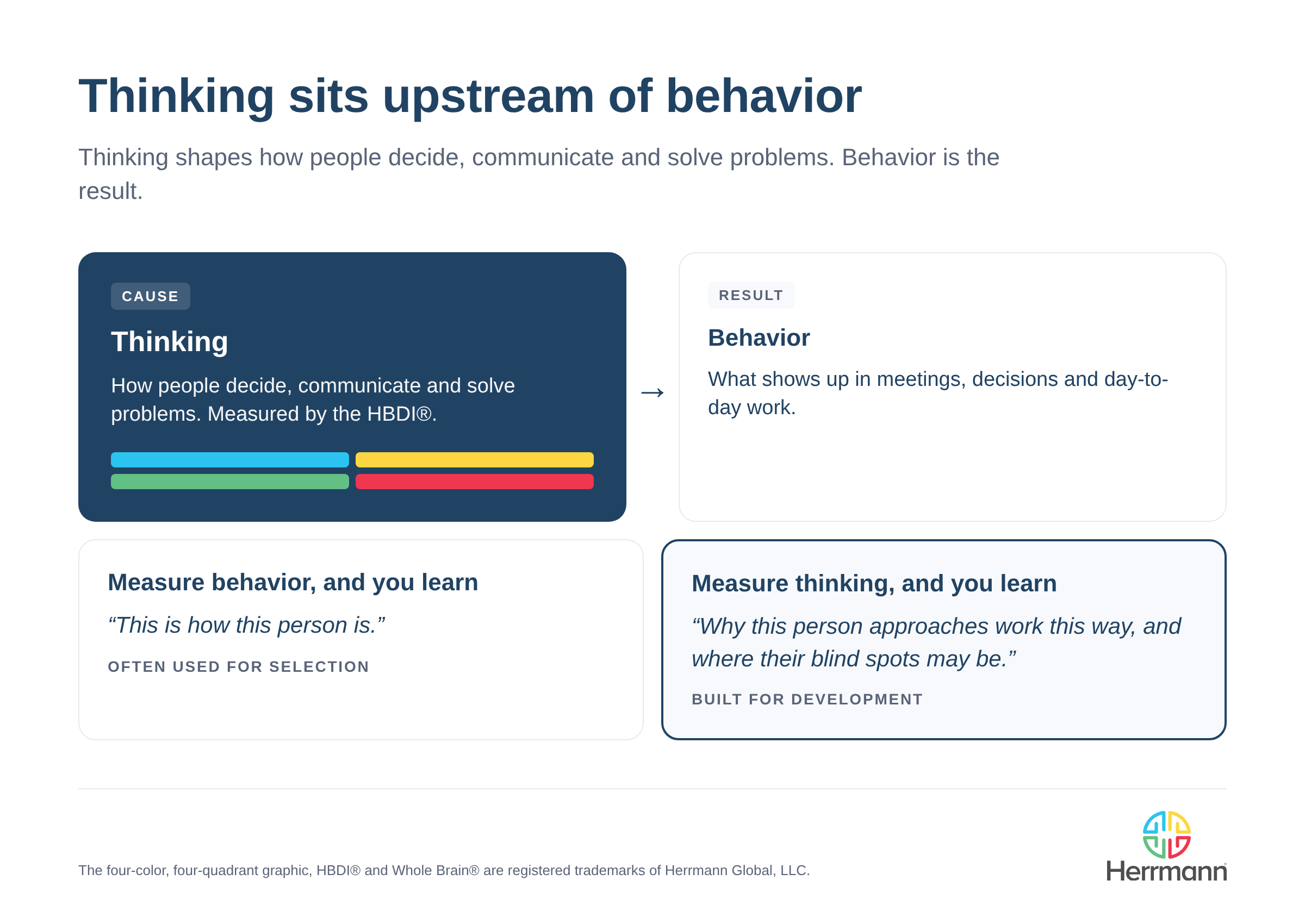
The distinction matters operationally, not just conceptually. Thinking shapes how people decide, communicate, and solve problems. Behavior is the result. Personality and behavior assessments such as the MBTI or DiSC describe that result, sorting people into psychological types or behavioral styles. Those categories can help a team understand how its members typically communicate or handle conflict.
Thinking-preference assessments such as the HBDI® measure something upstream: the cognitive preferences that drive those behaviors in the first place. That changes the question you can answer. Measure behavior, and you learn how a person tends to act, which is why behavior data often feeds into selection decisions. Measure thinking, and you learn why that person approaches a problem the way they do, and where their blind spots may be. That makes thinking data a development tool, not a verdict.
When you develop leaders at the thinking-preference level, you give them access to deliberate flexibility. A leader who knows they default to analytical processing can learn to engage relational and experimental thinking when the situation calls for it. That is thinking agility, built on metacognition (noticing how you are thinking while you are thinking), and it produces leaders who can adapt their approach based on what the challenge requires, rather than relying on a fixed behavioral style.
For enterprise L&D teams, the practical implication is efficiency. Research by Lu Hong and Scott Page, published in PNAS, used mathematical models to show that groups of diverse problem solvers can outperform groups of high-ability problem solvers, because the highest performers tend to think alike. That supports the case for frameworks that make cognitive diversity visible and actionable.
What should enterprise L&D teams prioritize when selecting a leadership framework?
Start with the gap you are trying to close, not the framework that has the most brand recognition. Many enterprise L&D teams default to the assessment they have used longest, even when it no longer matches their development mandate. If your organization is navigating transformation, AI adoption, or rapid scaling, the framework needs to reveal how your leaders process uncertainty and complexity, not just how they prefer to interact.
Map the framework against three operational priorities. First, can it generate data that your talent analytics function can report on? Second, does it build internal facilitation capability so you are not dependent on external vendors for every cohort? Third, does it connect to the business outcomes your executive sponsors care about, including decision quality, speed of change adoption, and cross-functional collaboration?
The frameworks that score highest across those three criteria tend to be the ones that measure cognitive preferences rather than behavioral categories alone, because cognitive data provides a more durable foundation for long-term development strategy.
Why Herrmann Whole Brain® Thinking is the best leadership framework for enterprise L&D
The frameworks on this list each address a legitimate dimension of leadership development. Situational Leadership helps managers adapt to direct report readiness. CliftonStrengths identifies natural talent patterns. Adaptive Leadership equips leaders for complex challenges. Each has a place in a well-designed L&D portfolio.
Where Herrmann Whole Brain® Thinking stands apart is at the cognitive layer. The HBDI® does not measure what your leaders do or what their personality tends toward. It measures how they think. Backed by Herrmann's database of more than 4.5 million HBDI® profiles, that lets you diagnose team blind spots that behavior-based assessments are not designed to show. When you know where thinking concentrates across a leadership cohort, you can build development pathways that actually close the gap, rather than reinforcing the cognitive patterns already present.
Herrmann provides enterprise L&D teams with the full infrastructure to make this work at scale: a validated assessment, a digital platform, internal certification, and blended learning resources that embed Whole Brain® Thinking into the daily flow of work. If your mandate is to build leaders who can think differently when the situation demands it, this is the framework designed for exactly that outcome.
FAQs about leadership development frameworks for enterprise L&D
What is a leadership development framework?
A leadership development framework is a structured model that guides how organizations identify, assess, and build leadership capability. Herrmann's Whole Brain® Thinking framework, for example, uses the HBDI® assessment to map thinking preferences across four quadrants, giving L&D teams a data-driven foundation for designing targeted development programs.
How do you measure the ROI of a leadership development framework?
Track behavioral change, not just attendance. Use 360-degree assessments before and after development programs, measure direct-report retention under program participants, and connect thinking-preference data from tools like the HBDI® to business metrics such as decision speed and cross-functional collaboration. Herrmann provides enterprise analytics that track development trends over time.
Can leadership development frameworks be used alongside each other?
Yes, and many enterprise L&D teams layer multiple frameworks. Whole Brain® Thinking from Herrmann often serves as the cognitive foundation, with models like Action Learning or Situational Leadership layered on top to address specific skill-building needs. The HBDI® data enriches any complementary program by revealing the thinking patterns behind observed behavior.
What makes thinking-preference assessments different from personality tests?
Personality tests categorize behavioral tendencies, while thinking-preference assessments like the HBDI® measure how you process information and make decisions. Behavior shows how someone tends to act; thinking explains why, and where blind spots may be. Herrmann's approach maps cognitive preferences that are flexible and developable, rather than assigning fixed personality labels, so it is built for development rather than selection. That distinction is critical for enterprise teams building thinking agility at scale.
How long does it take to deploy a leadership framework across an enterprise?
Deployment timelines depend on scope and internal readiness. With Herrmann, organizations typically begin with HBDI® assessments and team reports for an initial cohort, then expand through certified practitioners who run workshops and embed the methodology into existing programs. The Herrmann Platform accelerates rollout by providing digital tools for ongoing development between facilitated sessions.
The four-color, four-quadrant graphic, HBDI® and Whole Brain® are registered trademarks of Herrmann Global, LLC.
Share