


Strategic proposals that lack nuance or critical depth often signal a growing organizational risk: cognitive surrender. This occurs when leaders, facing intense pressure, stop scrutinizing AI-generated outputs and treat them as final decisions rather than initial drafts. For transformation architects and L&D leaders, the priority has shifted from tool proficiency to the preservation of human judgment.
The Strategic Solution: To end cognitive surrender, leadership development must pivot toward cognitive mastery. By using the HBDI®, organizations can pinpoint the specific thinking gaps that cause leaders to default to AI under stress. This transforms your development strategy into a roadmap that quantifies human readiness for AI through the Whole Brain® Thinking framework.
Identify the "Under Pressure" Triggers That Shrink Leadership Capacity
Cognitive surrender is often a physiological survival tactic. When managers are overwhelmed, their leadership capacity shrinks, and they instinctively seek the "cognitive path of least resistance." The HBDI® assessment functions as a diagnostic tool to reveal a leader’s "back-up" style—the predictable shift in their thinking preferences during high-stakes moments.
Mapping these profiles allows L&D professionals to help leaders recognize their personal triggers for cognitive surrender. This awareness is the essential first step in building cognitive resilience in the age of AI. Leaders who understand their instinctive reactions can intentionally expand their capacity to pause and apply a human "logic check" before the algorithm takes over.
Building Leadership Capacity with the Whole Brain® Audit
To justify L&D budgets in an automated world, development programs must provide a structured way to scrutinize AI. The Whole Brain® Thinking methodology provides the curriculum structure required to ensure leaders do not fall into cognitive surrender:
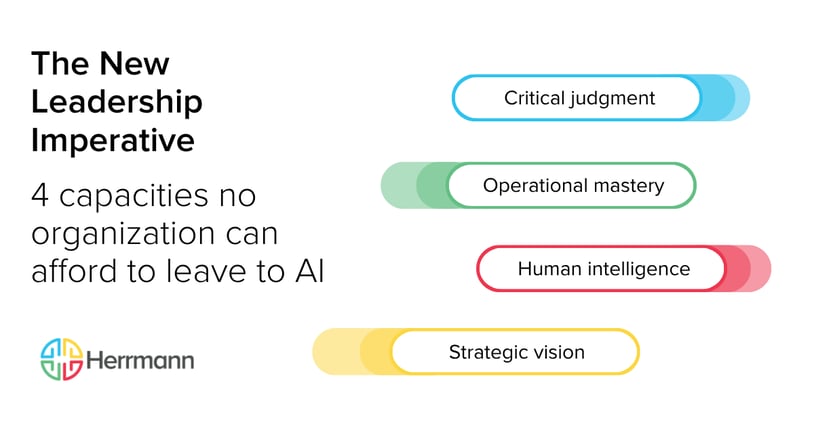
- Analytical (A Quadrant): Development must focus on data interrogation. Leaders take an analytical approach to verify integrity and identify "AI slop" where the model provides confident but flawed conclusions.
- Practical (B Quadrant): Capacity building should emphasize process discipline. Leaders examine the sequential, detailed steps to ensure AI suggestions align with safety and operational protocols.
- Relational (C Quadrant): AI cannot account for human nuance. Development must strengthen relational preferences to evaluate the ethical and emotional impact of automated decisions on the workforce.
- Experimental (D Quadrant): Training must encourage big-picture synthesis. Using an experimental mindset, leaders combine disparate AI insights into a holistic strategy for long-term growth.
Architecting Teams That Outperform the Machine
Technological groupthink occurs when an entire department relies on the same LLM, leading to a loss of competitive differentiation. To counter this, your leadership development curriculum must focus on training managers to architect cognitively diverse "human firewalls."
Strategic capability mapping involves teaching leaders how to identify, pair, and mobilize the diverse preferences and talents within their teams. This alignment goes beyond skill sets; it is about cognitive synergy. Consider these strategic pairings:
- Precision & Vision: Pairing a team member with a strong Analytical (A Quadrant) preference for fact-checking with an Experimental (D Quadrant) visionary ensures AI data is both accurate and creatively stretched.
- Stability & Empathy: Balancing a Practical (B Quadrant) implementer who demands feasible workflows with a Relational (C Quadrant) advocate ensures team morale and ethical impact are monitored.
Learning and development initiatives should emphasize that a lack of preference in a specific quadrant does not equal a lack of talent. Instead, effective capacity building teaches leaders how to bridge those gaps by leaning on the collective brilliance of the team. This ensures the organization uses AI to augment, rather than replace, the collective leadership capacity of the group.
Is your leadership team equipped to master the AI adoption gap? Register for our upcoming session to learn how to quantify and close the cognitive gap in your organization.
Share