


Your executive team has the talent, the experience, and the strategic intent. So why do decision sessions still stall?
Usually it goes like this: one voice dominates, another goes quiet, and the group falls back on the same way of thinking it always does. That’s rarely a skill problem. It’s a design problem, because the session fits how some people process information and leaves the rest of the room out.
Herrmann has spent decades mapping how people prefer to think, with more than 4.5 million HBDI® profiles behind a validated instrument. Research on cognitively diverse teams points the same way: in a 2017 Harvard Business Review study, Reynolds and Lewis found that teams with more diverse ways of thinking tended to do better when the situation was new and uncertain, which is where many executive decisions sit.
This guide walks you through seven steps to build executive decision sessions that cut friction across different thinking styles, using structured participation, shared working agreements, and Whole Brain® Thinking.
Quick Guide: How to Run Executive Decision Sessions in 7 Easy Steps
- Map the room’s thinking preferences. Look at each participant’s HBDI® profile so you can see where friction is likely to show up.
- Set shared working agreements before the agenda. Agree on communication norms, decision rights, and escalation paths before the first topic.
- Give everyone quiet time before the discussion. Let each person form their own view before anyone speaks.
- Assign rotating thinking roles. Ask each leader to champion a thinking lens other than the one they reach for first.
- Use a 1-2-4-All participation sequence. Move from solo to pair to small group to full room so every voice enters the conversation.
- Use AI as a challenger. Ask an AI tool to push back on the group’s reasoning before the final call.
- Close with a Whole Brain® Decision Check. Test the final decision against all four quadrants before you commit.
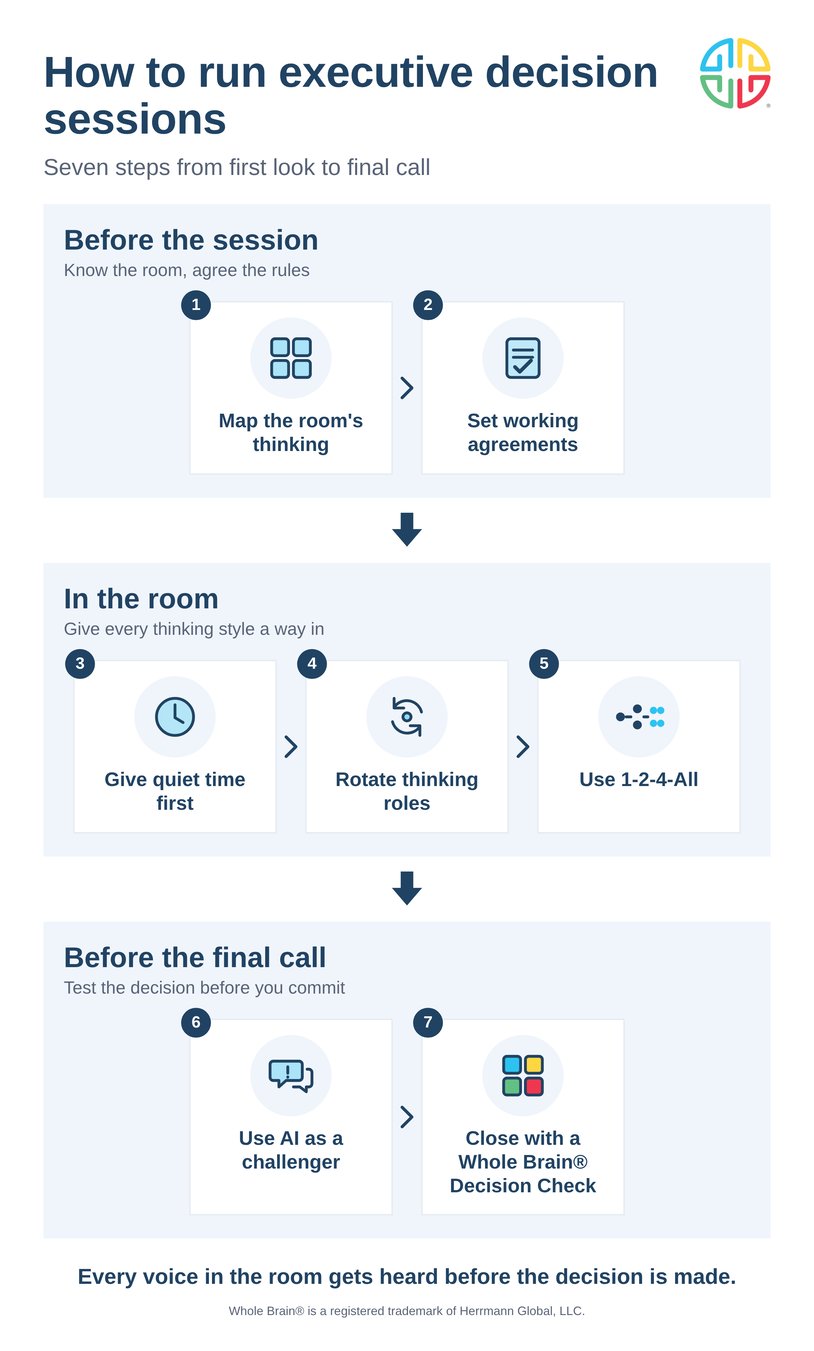
How to Design Executive Decision Sessions That Reduce Friction
1. Map the Room's Thinking Preferences
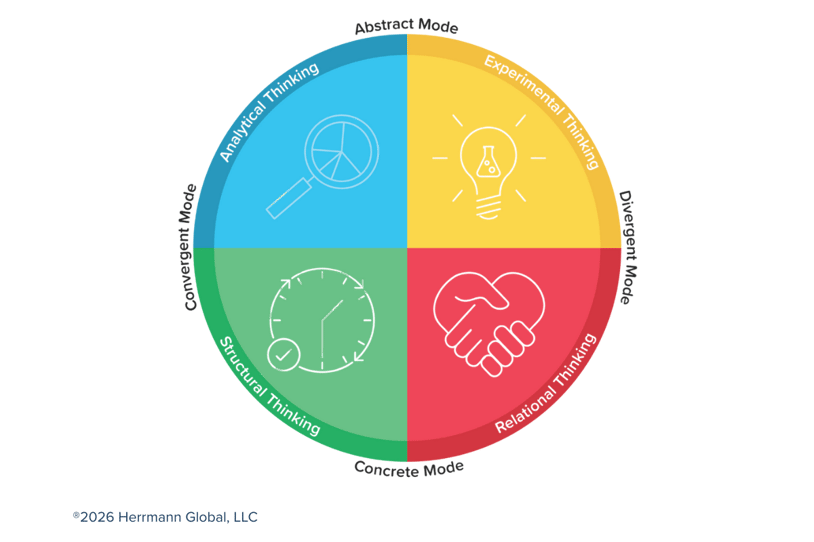
Before you set the agenda, find out who’s in the room. The Herrmann Brain Dominance Instrument (HBDI®) maps each person’s preferences across four quadrants: Analytical (A), Practical (B), Relational (C), and Experimental (D).
A room with a strong Analytical lean will ask for data and rigor. A room that leans Experimental will head for the big picture and may have little patience for detailed process. Neither pattern is wrong. The friction starts when one quadrant’s language and pace take over and the others disengage.
Pull up the team’s composite HBDI® profile before the session and look at where the group clusters. The quadrants that sit quiet are the ones whose questions tend to go unasked unless the session is designed to bring them in.
Share a one-page summary of the team’s cognitive diversity map with everyone ahead of time. When people see the data, the conversation can shift from “you never listen” to “we don’t have much Relational thinking in this room, so let’s make sure we cover it.”
2. Set Shared Working Agreements Before the Agenda
Working agreements are the ground rules that make structured participation possible. Without them, senior leaders slip back into familiar power dynamics: the loudest voice wins, and everyone else goes along or quietly steps back.
Three areas matter most. Communication norms say how the group will signal disagreement without making it personal. Decision rights make clear who has the final say and how much consensus the group needs. Escalation paths set out what happens when the group can’t align.
Draft them together before the session. Ask each leader to write one agreement they think the group needs, then collect and prioritize them. The exercise brings up the unspoken tensions that tend to derail executive conversations.
Agreements won’t make conflict disappear. They give it a place to go, so it doesn’t pile up under the surface. Herrmann’s podcast on team working agreements has more examples of how to build these norms into your regular routines.
3. Structure Individual Reflection Before Group Discussion
Some leaders need a minute to form a view, while others think out loud. In a fast discussion, the quick talkers set the direction, and the group hears the fastest answers, not necessarily the best-informed ones.
So build a two-minute silent pause into every decision point, and ask each person to write down their position before anyone speaks. When the first speaker sets the frame, everyone after them tends to adjust toward it. Writing first means each leader walks in with a view of their own.
Herrmann’s Whole Brain® Thinking approach builds this step into facilitated team effectiveness sessions, because it turns cognitive diversity from a nice idea into something the group actually uses.

4. Assign Rotating Thinking Roles by Quadrant
Groups often skip a thinking lens simply because nobody in the room reaches for it first. A decision can then be strong on analysis and thin on implementation, or full of vision and disconnected from the people who have to carry it out.
Rotating roles counter that. In each session, one leader takes the Analytical lens (What does the data say?), one the Practical lens (What’s the implementation plan?), one the Relational lens (Who’s affected, and how?), and one the Experimental lens (What alternatives haven’t we considered?).
Rotate the roles from session to session. When a leader with a strong Analytical preference is asked to champion the Relational view, they build thinking agility: the ability to flex across quadrants on purpose. Over time that cuts friction, because each leader gets more comfortable with perspectives that once felt unfamiliar.
5. Use a 1-2-4-All Participation Sequence
Henri Lipmanowicz and Keith McCandless developed 1-2-4-All as part of Liberating Structures, and it suits groups with a mix of thinking preferences. It runs in four rounds: individual reflection (1 minute), pairs (2 minutes), groups of four (5 minutes), and the full group (7 minutes).
Each round gives a different kind of thinker a way in. Leaders who like to think alone get the first round. Those who think best in conversation get the pairs. Those who build ideas together get the foursomes.
By the time the full room comes together, every thinking preference has had a chance to contribute on its own terms. For executive decision sessions, this replaces the usual open-floor debate, which rewards speed over depth.
6. Use AI as a Neutral Challenger
Do you get the honest feedback you need in a decision session? If you do, you’re lucky. If you don’t, you’re in good company: in an explenatory study, 34 of 40 employees said there’d been a time they felt unable to raise something important with their boss.
AI looks like an easy way around that, but it comes with a catch. In a Stanford study published in Science, 11 leading AI models sided with users about 50% more often than people did, and the users came away more sure they were right. Left alone, AI tends to agree with you.
So set it up to push back. Write your own position down first, then ask the AI for the three strongest arguments against it. That’s the habit Herrmann CEO Karim Nehdi digs into in the free live session “What Nobody Tells the Boss (But AI Might)” on November 16 at Noon ET. It turns AI into a thinking mirror and not an echo chamber, and everyone who registers gets the recording.
In your own session, run the group’s draft decision through the same challenge before the final vote. Share the counterarguments with the team and talk about which ones are worth acting on.
7. Close with a Whole Brain® Decision Check
Before committing to a final decision, run it through a four-quadrant audit. This is the step that catches the blind spots the rest of the session may have missed. Herrmann's Whole Brain® Thinking framework provides a structured format for this check.
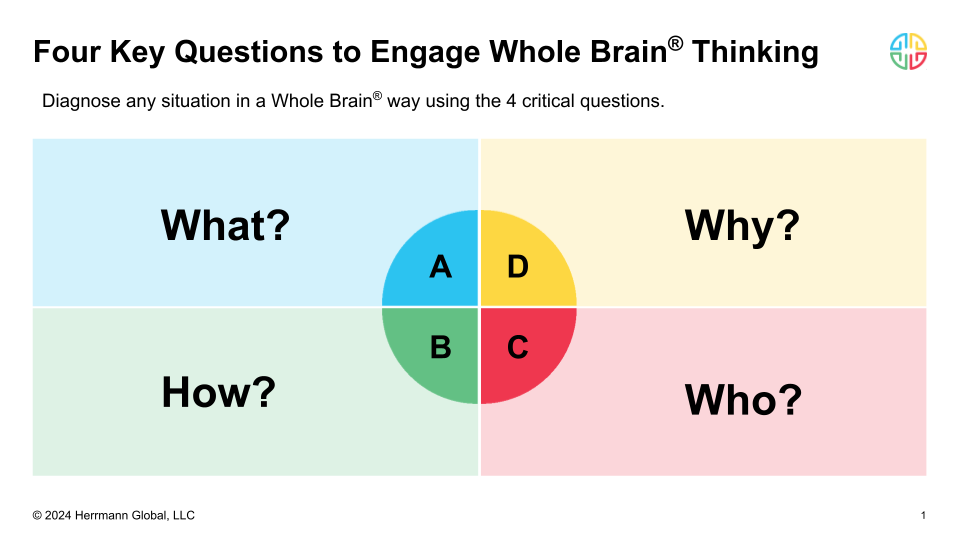
Ask the group four questions, one per quadrant:
- Analytical (A): What does the evidence support, and what risk has the data not addressed?
- Practical (B): Is there a clear implementation plan with owners, timelines, and checkpoints?
- Relational (C): Have we considered the impact on the people who must execute this, and do they have reason to support it?
- Experimental (D): Have we explored alternatives, and does this decision leave room to adapt if conditions change?
If any quadrant produces a weak or missing answer, pause before committing. That gap is the most likely source of execution failure, stakeholder resistance, or strategic blind spot.
Herrmann's database of more than 4.5 million thinking-preference profiles consistently shows that decisions examined through all four lenses produce stronger implementation outcomes than decisions filtered through one or two.
Why Do Executive Teams Default to One Thinking Style in Decisions?
Executive teams tend to pick up the preferences of their most senior or most vocal members. Over time, the team starts filtering out contributions that don’t fit that pattern.
Analytical-leaning teams may brush off relational input as “soft,” and Experimental-leaning teams may call process concerns “bureaucratic.” The pattern feeds itself. Leaders whose preferences match the group’s get more airtime, more agreement, and more say in the final call.
Leaders whose preferences differ may learn to hold back, or to translate their ideas into the group’s dominant language, which can strip out what made those ideas valuable. That’s why alignment in leadership takes more than surface-level agreement.
Herrmann’s approach to cognitive diversity on teams starts there. When the HBDI® team profile makes the group’s thinking distribution visible, the team can see its own lean as a fact about the group, not a judgment about any one person.
How Can Leaders Get Honest Feedback When Their Team Holds Back?
Holding back is common, and it’s rarely about the person asking. Speaking up to the boss feels risky, and research on power suggests that when people feel powerful, they take other people’s points of view less naturally. Nobody has to mean anything by it. It can simply come with the role.
Three structural habits help close the gap. First, collect anonymous input before the session: ask each leader to write down their view of the options in an unattributed format before the group meets. Second, build in structured dissent: assign one person in each session to make the strongest case against the leading option, whatever their own view. Third, use AI as a challenger, with a deliberate prompt that surfaces the counterarguments the group might hesitate to voice.
That third habit connects to a wider shift in how AI-based Whole Brain® tools support team decisions. AI doesn’t worry about upsetting the CEO, and that’s useful. But it tends to agree with whoever’s asking, so you have to ask it to disagree.
How Herrmann Helps You Run Low-Friction Executive Decision Sessions
Herrmann gives you a research-backed system for designing executive sessions that work for every thinking preference in the room. The HBDI® assessment maps each leader's cognitive preferences across the four quadrants, giving your team a shared language for the differences that previously caused friction.
The Herrmann Platform provides real-time team-building analysis and interactive activities that make Whole Brain® Thinking operational in the flow of work. Certified HBDI® Practitioners can facilitate executive decision sessions using the framework in this guide, adapting each step to the team's specific cognitive footprint.
For leaders ready to explore how AI can complement human thinking in executive contexts, Herrmann CEO Karim Nehdi's free live session, "What Nobody Tells the Boss (But AI Might)" (November 16, Noon ET), demonstrates the practical habit of committing to your own answer before asking AI to challenge it.
Explore HBDI® Certification to bring these methods inside your organization permanently.
FAQs About Executive Decision Sessions
How long should an executive decision session last?
It depends on the decision, but protect the first rounds. A silent writing pause and a 1-2-4-All round (about 15 minutes) come before open discussion, and cutting them to save time brings back the problem they solve.
What is a working agreement in a team context?
A working agreement is a behavioral norm the team commits to before a session begins. It covers communication protocols, decision rights, and escalation paths. Effective working agreements channel disagreement into productive structure rather than allowing it to surface as interpersonal friction.
Can AI replace a human facilitator in decision sessions?
No. AI is a useful challenger: it can surface counterarguments and test the group’s reasoning. But it can’t read the room, manage interpersonal dynamics, or adjust the pace to the mood. It works best alongside a facilitator who knows the team’s thinking preferences.
How does Herrmann's HBDI® differ from personality assessments?
The HBDI® measures thinking preferences, which can be developed and flexed, and not fixed personality traits. A preference shows where your attention goes first, not what you’re capable of. That’s why leaders can build thinking agility and learn to work across all four quadrants.
What is the biggest risk in executive decision sessions?
The biggest risk is cognitive homogeneity: the entire group processes the decision through the same one or two thinking quadrants. Herrmann's Whole Brain® Thinking framework helps you detect this pattern in advance through the team's composite HBDI® profile and design the session to compensate for it.
How many people should participate in an executive decision session?
1-2-4-All works from four people up, and its pair and foursome rounds keep a larger group from becoming a few loud voices. Beyond that, let the decision decide: include the people who need to own it.
Share