


AI tools are everywhere. Your teams have licenses, your leadership has signed off, and your dashboards show steady login rates. But BCG's 2025 research found that 60% of companies globally generate no material value from AI despite substantial investment.
The gap between deployment and impact keeps widening. The root cause sits squarely in L&D and HR's domain. It's not a technology problem. It's a thinking problem. Herrmann maps this mismatch using Whole Brain® Thinking and the HBDI®, giving L&D leaders a diagnostic framework for human-centered AI adoption.
This guide walks you through why most AI rollouts underperform, how thinking preferences shape adoption readiness, and what your team can do to close the cognitive gap.
Key Takeaways: A Beginner's Guide to Human-Centered AI Adoption
- AI adoption stalls because rollouts address technical skills while ignoring how people actually process and apply new tools.
- Large language models default to analytical output, creating a cognitive glass ceiling for non-analytical thinkers across your organization.
- Herrmann's Whole Brain® Thinking framework maps four thinking preferences so L&D can design adoption programs for every cognitive style.
- Resistance to AI signals a gap in your communication approach, not a deficiency in your workforce's capability or willingness.
- A structured 30-day adoption roadmap built on cognitive diagnosis moves teams from passive tool use to genuine workflow change.
Why Most AI Rollouts Fail to Deliver Value
Most organizations measure AI adoption by tracking logins, tool usage rates, and time spent in applications. BCG's 2025 AI adoption research confirmed that more than 85% of employees remain stuck at early adoption stages.
These employees use AI as a search engine or basic task assistant rather than a genuine collaborator in core work. The real metric that matters is adoption quality, not adoption rate.
When employees use AI only for peripheral tasks, the organization captures a fraction of its potential value. The shift to meaningful adoption requires changing how people think about AI's role in their work. That shift falls directly on L&D and HR.
Before you redesign your training program, name the specific failure mode your organization faces. Is usage high but impact low? Are certain teams thriving while others abandon their tools? The answers point to a cognitive mismatch.
What Is the Cognitive Glass Ceiling in AI Adoption?
Herrmann's database of more than 4.5 million thinking-preference profiles reveals a pattern that explains much of this stalling. Large language models' default output style matches the cognitive profile of highly analytical roles at over 90% overlap.
AI's native "thinking" mirrors the preferences of people who naturally work with data, logic, and sequential processes. For team members who lead with interpersonal connection, intuitive synthesis, or practical execution, AI output can feel foreign.
This is what Herrmann calls the cognitive glass ceiling: a structural barrier where AI's analytical default creates a disconnect with much of your workforce. It's not a flaw in AI or in your people. It's a design mismatch that L&D can address by understanding cognitive diversity across your teams.
How Whole Brain® Thinking Maps Your Team's AI Readiness
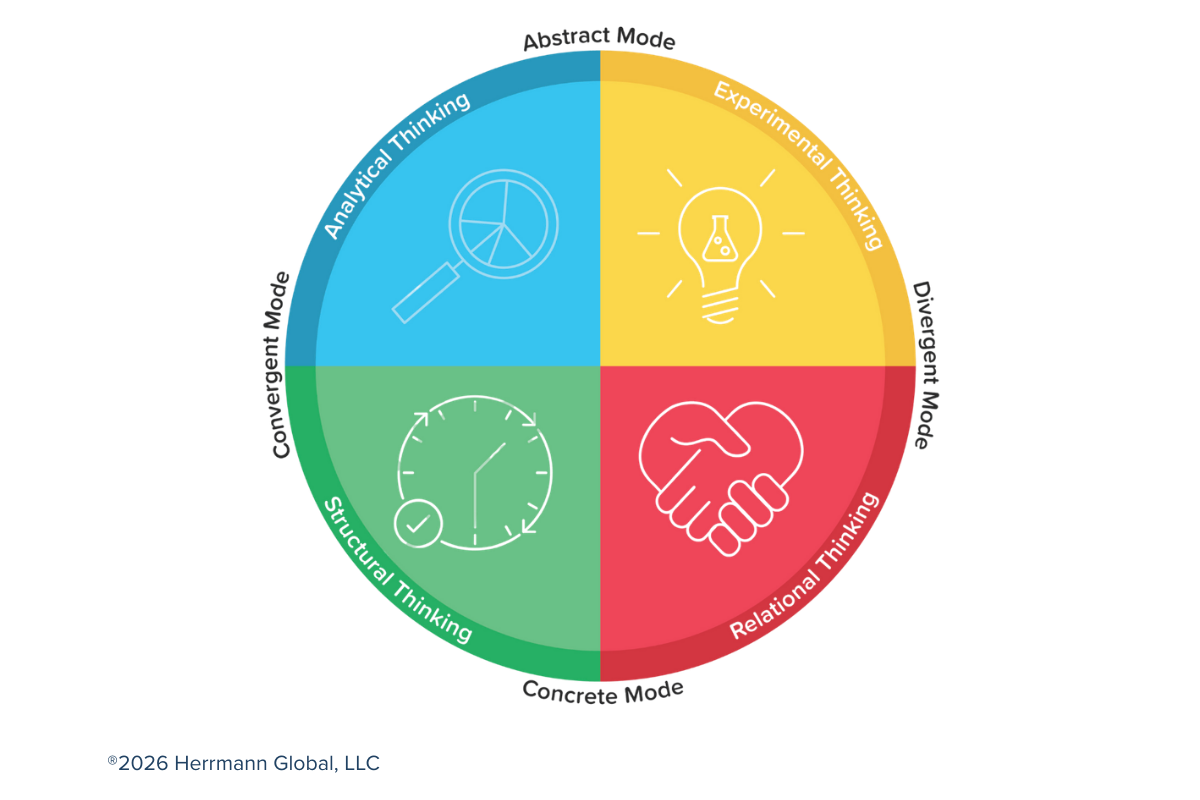
Whole Brain® Thinking organizes cognitive preferences into four quadrants. Each quadrant represents a distinct mode of processing information, making decisions, and engaging with new tools. Understanding all four gives you a diagnostic map for AI adoption that resonates with every person on your team.
The Four Thinking Preferences and Their AI Implications
Analytical (A Quadrant): Logical, quantitative, and fact-based. This is AI's native frequency. Analytical thinkers adopt AI tools quickly because the output mirrors their cognitive patterns. They serve as natural validators, checking AI-generated data for accuracy.
Practical (B Quadrant): Organized, sequential, and plan-driven. Practical thinkers need AI embedded into structured workflows and standard operating procedures. They adopt well when AI becomes the default method for a specific, repeatable task.
Relational (C Quadrant): Interpersonal, feeling-based, and empathy-driven. Relational thinkers are most affected by the cognitive glass ceiling. They need psychological safety and reassurance that AI extends human connection rather than replacing it.
Experimental (D Quadrant): Intuitive, future-focused, and synthesis-driven. Experimental thinkers push beyond using AI for speed to invent entirely new value models. Without this quadrant's input, your AI adoption stays incremental.
The HBDI® (Herrmann Brain Dominance Instrument) measures where your team's thinking preferences concentrate and where the gaps are. That data becomes the foundation for every training design decision.
Why L&D Owns the AI Adoption Problem
Successful AI adoption is roughly 10% technical skill and 90% organizational change. Most rollout budgets spend the majority on the 10%: teaching people how to write prompts and navigate interfaces.
The 90% that determines whether adoption holds involves trust, communication, workflow redesign, and cognitive readiness. All of that sits in L&D and HR's domain.
When L&D treats AI adoption as a training checkbox, the predictable result is what Herrmann's playbook calls "evaporation." People complete the course, use the tool for a week, then revert to their previous workflows. Sustainable adoption requires L&D to function as the architect of organizational change.
Diagnosis question: "When your team stops using an AI tool after initial training, which cognitive perspective was missing from the rollout?" If the answer points to missing trust-building, absent workflow integration, or no reimagination opportunities, you've found your intervention point.
The AI Adoption Failure Matrix: Four Predictable Breakdowns
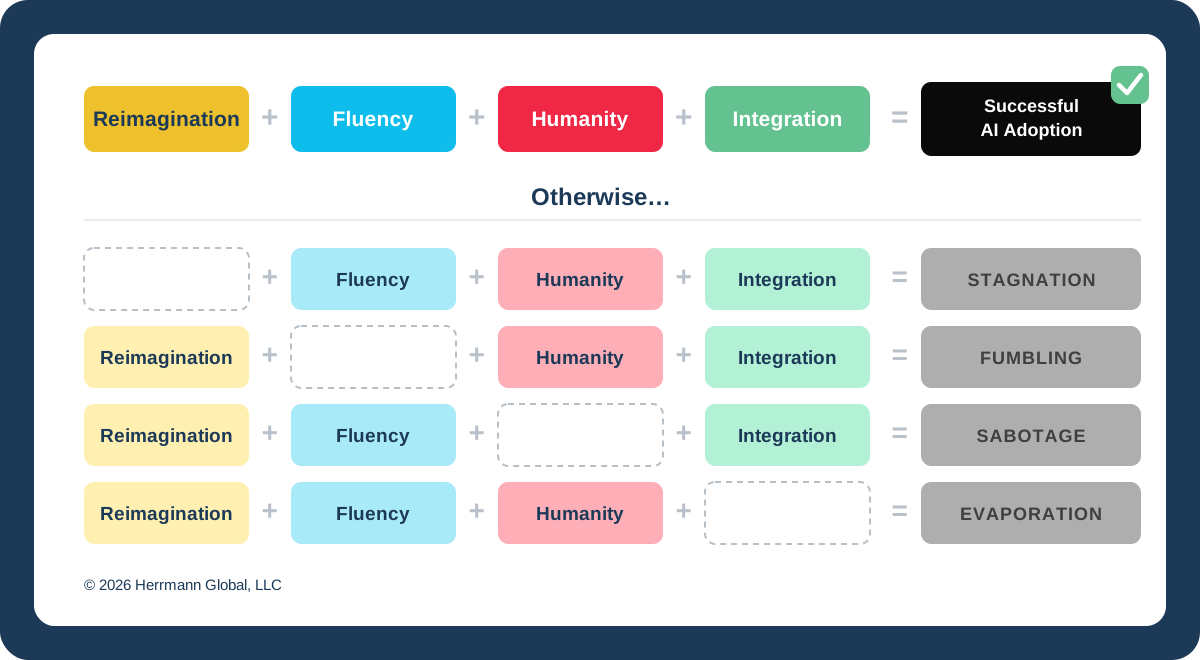
When any one of the four cognitive perspectives is neglected during an AI rollout, the adoption effort stalls in a predictable way. Herrmann's Failure Matrix maps each gap to its specific failure mode.
Fumbling: When Analytical Fluency Is Missing
Signal: Teams accept AI output without checking it for accuracy, leading to errors in reports and analysis.
Cause: The rollout skipped critical thinking and data validation training.
Fix: Introduce "hallucination labs" where teams use analytical logic to audit AI content, building confidence through discernment rather than blind acceptance.
Evaporation: When Practical Integration Is Missing
Signal: Usage spikes during training weeks and drops off rapidly afterward.
Cause: AI was introduced as an optional experiment rather than embedded into daily workflows.
Fix: Select one high-value task where AI is now the default method. Rewrite the SOP. Close the back door to the manual process.
Sabotage: When Relational Humanity Is Missing
Signal: Active resistance, workarounds, or passive non-compliance from team members who feel threatened.
Cause: The rollout prioritized technical mechanics over emotional safety and trust.
Fix: Host vulnerability workshops where employees voice fears without judgment. Position AI as a cognitive extender that frees time for the human work only people can do.
Stagnation: When Experimental Vision Is Missing
Signal: Teams use AI to do old work faster but never invent new approaches or question existing processes.
Cause: The rollout focused exclusively on efficiency gains without encouraging creative reimagination.
Fix: Challenge teams to propose three radical ways AI could change how their function operates. Reward the quality of new ideas, not just speed improvements.
A 30-Day Adoption Roadmap for L&D and HR Teams
This four-week structure treats AI adoption as a staged product launch. Each week builds on the previous one, moving from diagnosis through trust-building, skill development, and workflow hardening.
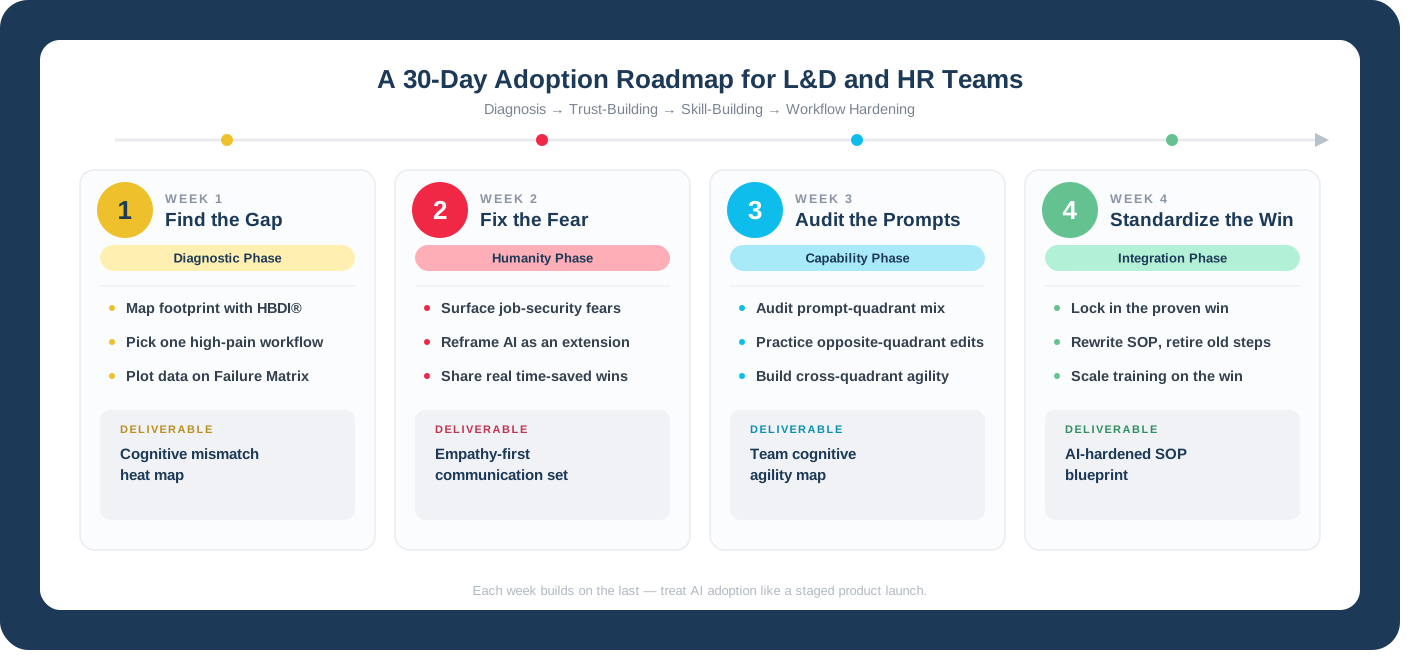
Week 1: Find the Gap (Diagnostic Phase)
Start by mapping your pilot group's collective thinking footprint. Use an assessment tool like the HBDI® to see where cognitive preferences cluster and where they're sparse.
If you're rolling out analytical AI tools to teams with strong relational or experimental preferences, that mismatch needs to be designed for. Select one high-pain workflow where AI can demonstrably reduce effort. This becomes your testing ground.
Review current adoption data: compare login frequency against actual value extraction. Map the results onto the Failure Matrix. Are you seeing fumbling, evaporation, sabotage, or stagnation?
Deliverable: A cognitive mismatch heat map that shows exactly why previous efforts fell short and where intervention needs to begin.
Week 2: Fix the Fear (Humanity Phase)
Before any technical training, address the emotional reality of AI adoption. Host a session where team members voice concerns about job security, skill relevance, and how their roles are changing.
Draft internal messaging using a relational lens: frame AI as an extension of human thinking, not a competitor for anyone's seat. Show concrete examples where AI handled repetitive analytical work, freeing time for coaching and creative problem-solving.
Deliverable: An empathy-first communication set that addresses human value before technical mechanics.
Week 3: Audit the Prompts (Capability Phase)
Move into cognitive fluency building. Review how your team interacts with AI tools. If 80% of prompts are analytical, mandate that the next round uses a different cognitive lens.
Practice "opposite quadrant" rewriting. Take a logic-heavy AI output and rewrite it for emotional resonance (Relational). Take a status report and turn it into a future-vision document (Experimental). Take an abstract strategy and break it into an execution plan (Practical).
This cross-quadrant prompting builds the cognitive agility your team needs to get full value from AI tools.
Deliverable: A team cognitive agility map showing each group's "safe zone" and stretch targets for prompting across all four quadrants.
Week 4: Standardize the Win (Integration Phase)
Select the one task where your pilot group has proven clear value with AI. Rewrite the official SOP to make AI the default method. Retire the old manual steps entirely.
Scale by training the next wave of users only on this specific, hardened win. When people start defending their AI-enhanced processes against going back to the old way, you've reached irreversible adoption.
Deliverable: Your organization's first AI-hardened SOP blueprint, ready for enterprise-wide scaling.
The Whole Brain® Prompt Toolkit for AI Communication
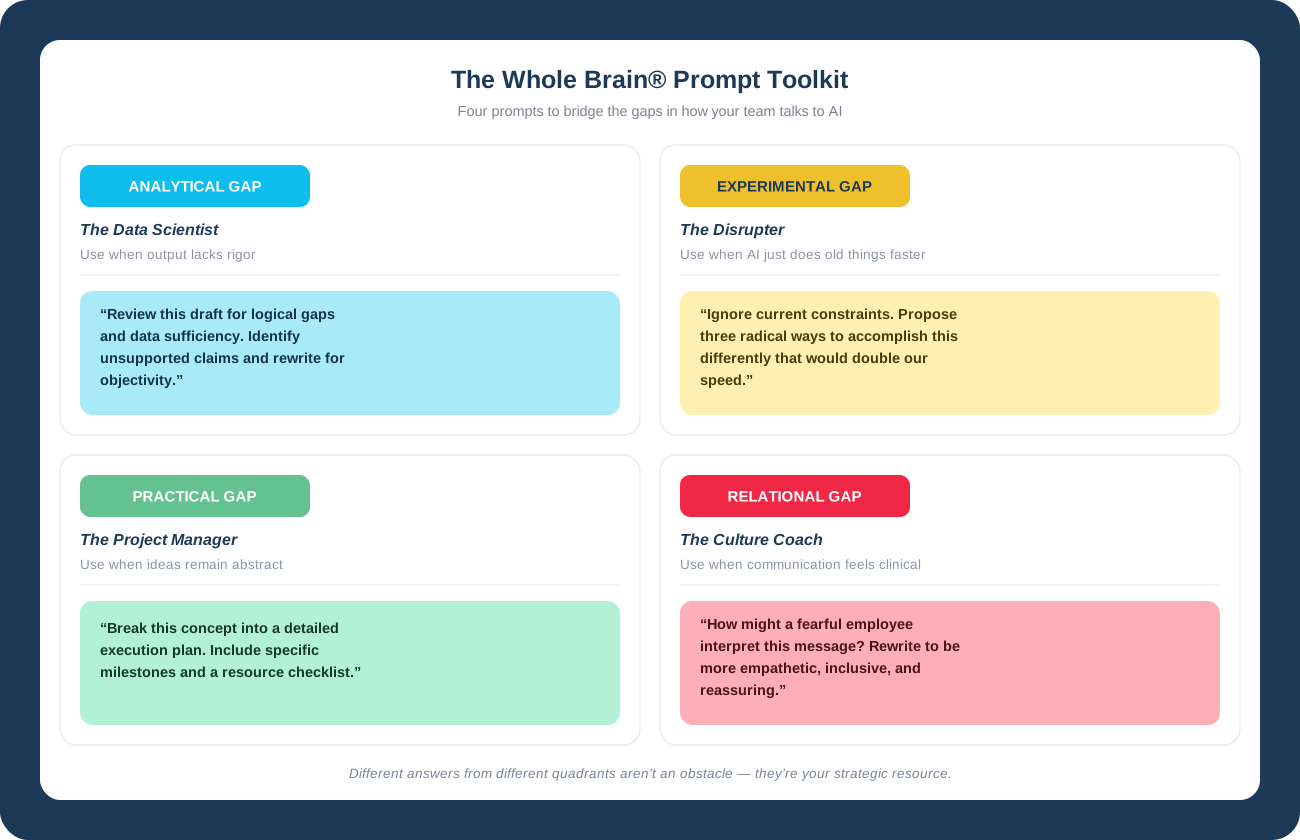
One of the most practical tools for bridging thinking styles is a prompt toolkit organized by cognitive quadrant. Each prompt template closes a specific gap, helping your team approach AI from the perspective they're least comfortable with.
How to Use Prompts to Bridge Cognitive Gaps
Analytical gap prompt (The Data Scientist): "Review this draft for logical gaps and data sufficiency. Identify unsupported claims and rewrite for objectivity." Use this when output lacks rigor.
Practical gap prompt (The Project Manager): "Break this concept into a detailed execution plan. Include specific milestones and a resource checklist." Use this when ideas remain abstract.
Relational gap prompt (The Culture Coach): "How might a fearful employee interpret this message? Rewrite to be more empathetic, inclusive, and reassuring." Use this when communications feel clinical.
Experimental gap prompt (The Disrupter): "Ignore current constraints. Propose three radical ways to accomplish this differently that would double our speed." Use this when AI usage is stuck in "do old things faster" mode.
Different answers from different quadrants aren't an obstacle. They're your strategic resource. Encourage your teams to prompt from multiple cognitive perspectives on purpose.
How HR Can Measure AI Adoption Quality
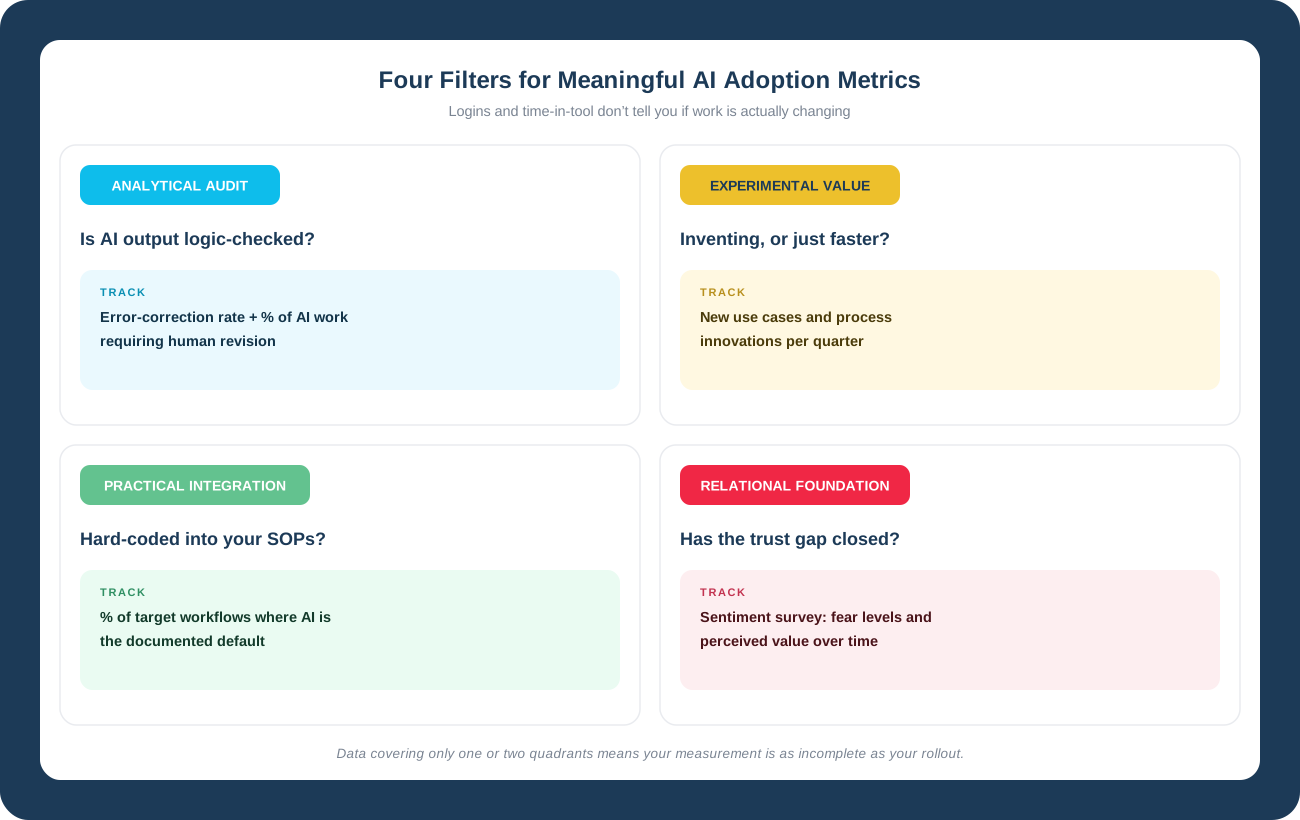
Standard AI adoption dashboards track logins and time-in-tool. These metrics tell you nothing about whether AI is changing how work gets done. Herrmann's approach to AI adoption methodology uses four filters drawn from the Whole Brain® model.
Four Filters for Meaningful AI Adoption Metrics
Analytical audit: Is AI output being logic-checked? Are ROI metrics established? Track error-correction rates and the percentage of AI-generated work that requires human revision.
Practical integration: Is AI usage hard-coded into official SOPs? Measure the percentage of target workflows where AI is the documented default method.
Relational foundation: Has the trust gap been addressed? Survey employee sentiment specifically about AI's role in their work, tracking fear levels and perceived value over time.
Experimental value: Are teams generating new approaches, or just doing existing work faster? Count new use cases and process innovations that emerged from AI adoption.
Before you sign off on your next AI adoption review, test your metrics against all four filters. If your data covers only one or two quadrants, your measurement is as incomplete as your rollout.
Common Mistakes L&D Teams Make in AI Rollouts
After working with organizations across industries on change and innovation, several patterns emerge in how AI adoption efforts break down. Naming these mistakes plainly helps you diagnose your current approach.
Treating AI Training as a One-Time Event
A single workshop doesn't change behavior. Adoption requires ongoing reinforcement, coaching, and workflow adjustment over weeks. If your program ends when the training does, you'll see evaporation.
Ignoring the Manager's Role as Multiplier
BCG's research shows that employee-centric organizations are about seven times more likely to reach AI maturity. Frontline managers shape whether adoption holds day to day.
When managers visibly use AI tools, give teams permission to experiment, and integrate AI learning into existing team rhythms, adoption rates climb significantly.
Applying One Communication Style to All Teams
A technical rollout announcement that excites your analytical teams may alienate your relational teams. Each cognitive preference needs a different message: data and ROI for Analytical thinkers, step-by-step process for Practical, reassurance for Relational, future vision for Experimental.
Measuring Activity Instead of Behavior Change
Login rates and prompt counts measure surface activity. Real adoption shows up in changed workflows and retired manual processes. Shift your metrics from activity tracking to workflow-level evidence of permanent change.
How to Build Psychological Safety for AI Adoption
Resistance to AI is rarely about defiance. More often, it reflects a disconnect between what leadership communicates and what employees actually experience.
The Relational quadrant's needs are the most commonly overlooked in technical rollouts, yet they hold the key to whether adoption sticks. Psychological safety means creating an environment where employees can voice fears and experiment without penalty.
Practical moves for building this safety: host "hopes and fears" sessions before any tool training. Create an internal AI partner manifesto that states how AI will and will not affect roles. Showcase use cases where AI freed time for coaching, creative thinking, and relationship building.
The Strategic Checkpoint Before Enterprise Rollout
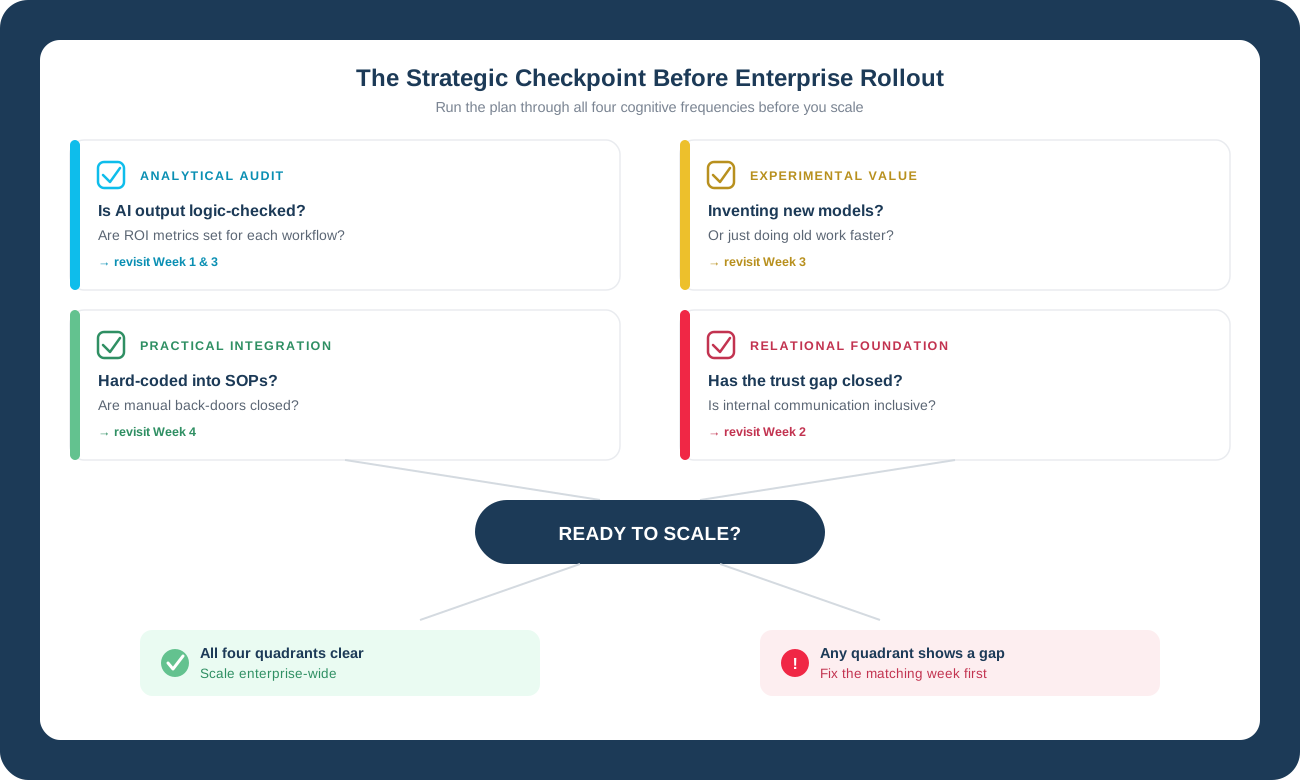
Before moving from pilot to full organizational rollout, run your adoption plan through all four cognitive frequencies. This final checkpoint ensures you haven't left a critical perspective unaddressed.
Analytical audit: Is AI output logic-checked? Are the ROI metrics established for each target workflow?
Practical integration: Is AI usage hard-coded into official SOPs? Are manual back-doors closed?
Relational foundation: Has the trust gap been addressed? Is your internal communication inclusive?
Experimental value: Are teams inventing new models, or simply doing old work faster?
If any quadrant shows a gap, go back to the corresponding week in the 30-day roadmap and address it before scaling. Fixing a cognitive gap at enterprise scale costs exponentially more than addressing it during the pilot.
In Conclusion: Making AI Adoption a Human-Led Initiative
The gap between AI deployment and AI impact is a cognitive problem. And cognitive problems have cognitive solutions. L&D and HR teams are uniquely positioned to close this gap because they own the levers that matter: communication design, trust-building, and learning architecture.
Whole Brain® Thinking gives you the diagnostic map. The HBDI® gives you the data. The 30-day roadmap gives you the structure. What separates organizations that capture real value from AI from those that just track logins is whether L&D treated adoption as a cognitive design challenge.
Want to see how your team's thinking preferences shape AI readiness? Start by mapping your collective cognitive footprint with the HBDI®. That map becomes the foundation for adoption that holds. From compliance to creativity. From logins to real impact. From tools sitting idle to work fundamentally redesigned.
.webp?width=1366&height=768&name=AI%20Transformation%20Header%20Image%20(1).webp)
FAQs About Human-Centered AI Adoption
What does human-centered AI adoption mean?
Human-centered AI adoption prioritizes how people think and process change alongside technical rollouts. Herrmann's Whole Brain® Thinking framework structures this approach by mapping cognitive preferences so training addresses all four thinking styles, not just the analytical one AI defaults to.
Why do AI programs fail despite high usage rates?
High usage rates often mask shallow adoption. Employees use AI for peripheral tasks without integrating the technology into core work. The gap between usage and impact signals that the rollout addressed tool access but not the cognitive shifts needed for genuine workflow change.
How does the HBDI help with AI adoption?
The HBDI® maps your team's collective thinking preferences, revealing where strengths cluster and where gaps exist. Herrmann's HBDI® data helps L&D design AI programs that speak to every thinking style: analytical validators, practical implementers, relational trust-builders, and experimental innovators.
What role should L&D play in AI adoption?
L&D should function as the architect of organizational change for AI, not just the deliverer of technical training. Herrmann's approach positions L&D as the strategic function that determines whether AI investment translates into business impact by diagnosing cognitive readiness and building psychological safety.
How can HR measure whether AI adoption is working?
Move beyond login counts and time-in-tool metrics. Herrmann's Whole Brain® approach recommends measuring across four dimensions: analytical accuracy, practical integration, relational trust, and experimental value. These four filters give you a complete picture of adoption quality.
What is the cognitive glass ceiling in AI?
The cognitive glass ceiling is Herrmann's term for the barrier that appears when AI's analytical default conflicts with how most employees think. Herrmann's research on more than 4.5 million HBDI® profiles shows that LLM output patterns match highly analytical cognitive profiles at over 90% overlap.
Share