




What makes teams effective and successful?
Better thinking.

The Success Formula 

Results x Efficiency x Trust x Agility = Team Effectiveness


Successful teams balance four critical factors: they deliver results, operate with efficiency, build genuine trust, and maintain agility to adapt—and when any one factor is missing, performance collapses. In our study of 1,188 teams, we found that high performers master trust and structure first, then add analytical rigor and strategic experimentation to separate themselves from average teams.

What happens if a team misses one factor?

Herrmann Team Effectiveness Missing Results

Missing Results

Priya's marketing team had the highest morale scores in the company—but they finished the year 20% over budget and missed their lead generation targets by 40%. They were so busy "liking" each other, they never defined what winning actually looked like.

Herrmann Team Effectiveness Missing Structure

Missing Efficiency

Tom's team held world-changing patents and a bold vision, but they drowned in chaos. They missed production deadlines because they spent four hours debating logo colors instead of finalizing the supply chain scaffolding.

Herrmann Team Effectiveness Missing Trust

Missing Trust

Chen's development squad was a machine of pure logic that hit every sprint with 99.9% accuracy—until a million-dollar deployment crashed. Three engineers had seen the bug weeks earlier but didn't feel safe enough to speak up and stop the process.

Herrmann Team Effectiveness Missing Ideas

Missing Agility

Elena's operations group was the gold standard of process excellence with a 10-year track record—but they just spent six months perfecting a 12-step manual for legacy technology the market abandoned for AI last month.

Cracking the Code for High-Performing Teams.
It's not magic. It's math.


Results x Efficiency x Trust x Agility = Effectiveness

The multiplicative rule of failure. 

Highly effective teams don’t happen by accident. Team performance is compounding, not cumulative—like a strategy that breaks when one critical assumption fails. When even one essential element is missing, overall effectiveness drops sharply.

Missed deadlines, underwhelming work, or too much time spent on simple tasks are often symptoms of deeper issues in trust, adaptability, and execution—rooted in poor self-awareness and misunderstanding across the team. Herrmann’s Team Effectiveness Solution helps teams close these gaps by building practical problem-solving, communication, decision-making, and innovation skills through Whole Brain® Thinking applied to everyday work.

Risks of Ineffective Teams

Sales_Header_Teams_Final

The "Zero" Factor

A single missing capability cancels out all other strengths

Sales_Header_Organizations_FInal

Effectiveness Gap

Many teams are lopsided strong preferences in one quadrant, but critically weak in another.

 

Sales_Header_Leaders_Final

For Leadership

Equip leaders with the ability to recognize thinking preferences, make clearer decisions, and engage people effectively.
We Studied 1,188 Teams to Find What Separates Good from Great. Here's How to Build Yours.

1. Build Foundations

Focus: Trust & Efficiency. The data is clear: structure and trust showed the strongest correlations with team effectiveness. Teams can't skip the basics. Without psychological safety and reliable processes, everything else falls apart.

2. Achieve Alignment

Focus: Shared Reality. High-performing teams had 52% smaller gaps between their ideal and current reality than average teams. When everyone agrees on current reality, alignment happens naturally. When they don't, everything fractures.

3. Add Analytical Rigor

Focus: Results and Agility. Once the foundation is solid, high-performing teams separate themselves through analytical rigor and strategic experimentation. They measure what matters and adapt faster than everyone else.

4. Fill the Gaps

Focus: Team Development. Successful teams use Whole Brain® Thinking to turn insight into growth. By understanding how their team thinks collectively, they design targeted development that stretches capabilities across all four thinking styles—building the cognitive agility needed to sustain high performance.

Three Tools. One Integrated System.

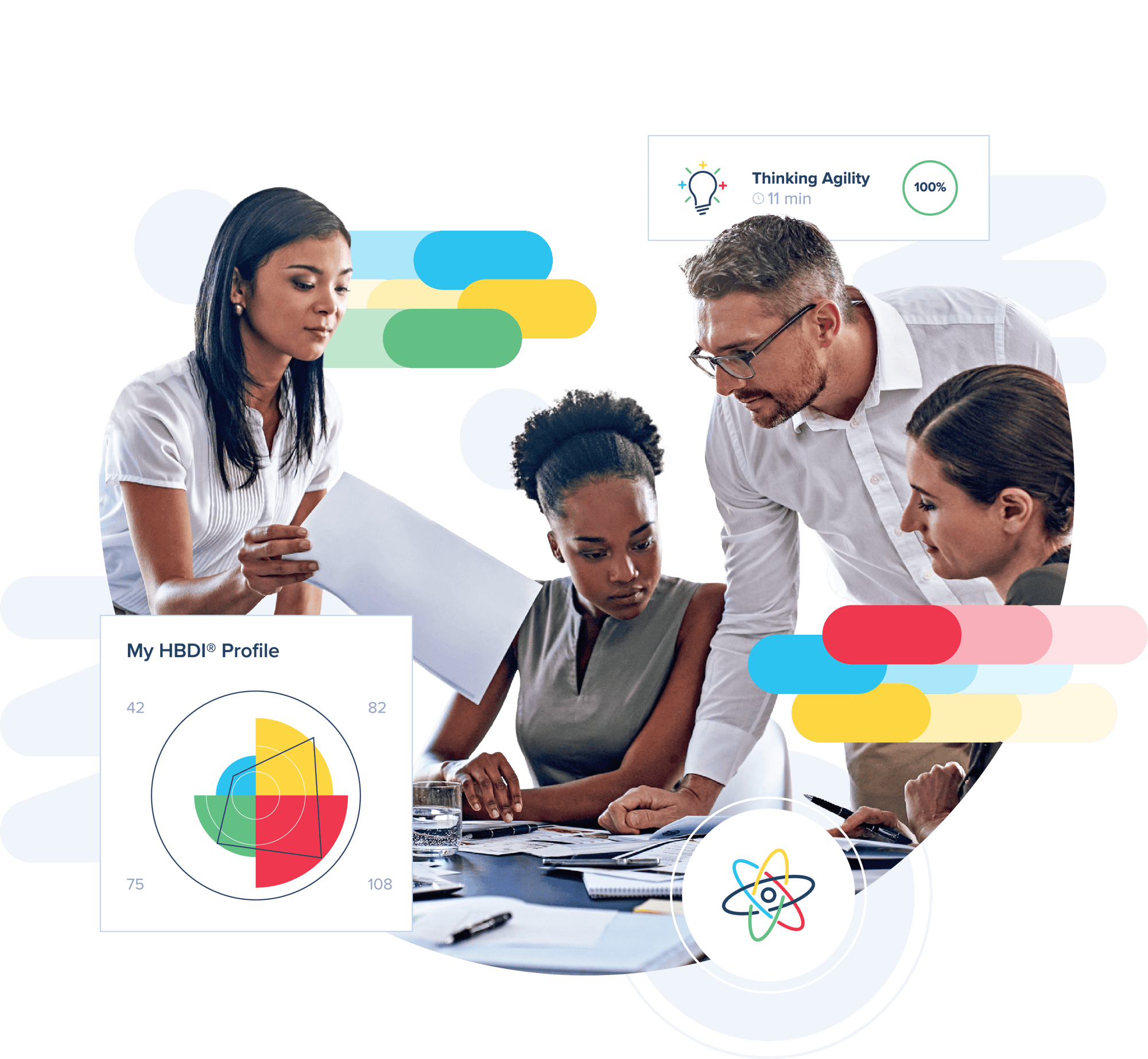
HBDI® Profile

Insights. Understand how you think individually and how your team thinks collectively. Reveal cognitive patterns and identify blindspots before they become performance blockers.

Team Effectiveness Dashboard

Action Items. See exactly what your team needs to work on. Measure the gap between where you are and where you need to be, then get clear priorities for closing it.

Signals

Status Updates. Track how your team is doing in real-time. Get cognitive nudges embedded in your daily workflow that keep everyone aligned and moving forward.

Hero visual_png_09-08

Complete the Equation

Get started with Whole Brain Thinking and the HBDI® to identify your missing ingredient and take action

High performance starts with awareness. When you understand how thinking styles show up across your team, the path forward becomes clear. Take the HBDI® and start your Whole Brain® Thinking journey today.