


Corporate roles now evolve faster than the people hired to fill them. The competencies that define a position in January are often obsolete by December. In this environment, competitive advantage no longer belongs to the organizations whose people know the most, but to those who can pivot how they think when conditions shift.
That capacity is cognitive agility: the ability to move fluidly between distinct modes of thinking and maintain sound decision-making under pressure. Building it has become a primary mandate for modern organizational development.
However, the framework you choose to develop this trait sets the ceiling on what you can achieve. Select the wrong model, and you do not just misallocate budget, you misread the exact development gap you intended to close.
What cognitive agility is, and the one distinction that matters
Most assessments tell you who someone is or how they behave. Cognitive agility asks a more useful question for development:
How does this person think, and how quickly can they pivot when the situation demands it?
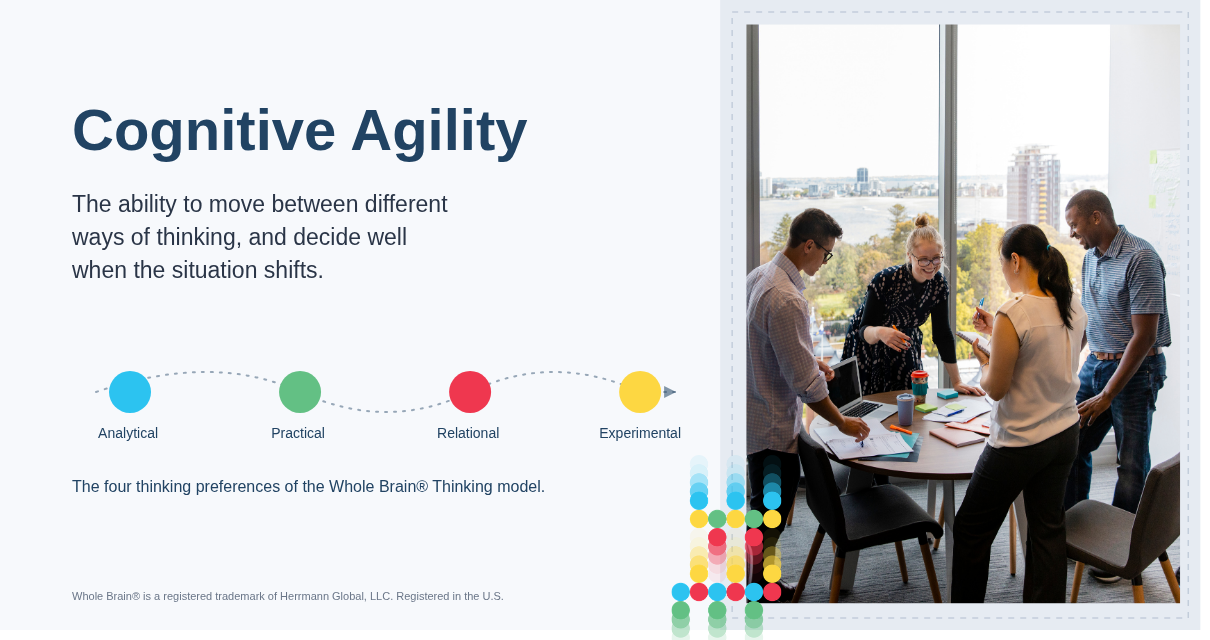
The Whole Brain® Thinking model gives that question a frame. Grounded in decades of research, it divides thinking, metaphorically, into four preferences: analytical, practical, relational, and experimental. Most people lean toward one, two, or even three of them, while drawing on the others takes more effort. The HBDI® (Herrmann Brain Dominance Instrument®) is the instrument that measures those preferences, mapping how strongly an individual leans toward each across the Whole Brain® Thinking model.
To build true agility, you have to understand the difference between preference and capability:
- Preferences are stable. Everyone can think in a certain way when required. What differs is where your energy goes by default, and how much a less natural mode costs you.
- Agility is about range. It is not about fixing a preference. It is about awareness: knowing which thinking modes you naturally skip, seeing what you miss as a result, and flexing into that missing mode when the stakes are high.
This gap stays hidden until pressure exposes it. Under stress, the brain narrows and default patterns take over, right when a complex challenge calls for more than one way of thinking. A tool that only sorts leaders into a fixed "type" leaves them stranded. You need an instrument that reveals their range, and exactly where that range thins out under pressure.
The layers a good model can measure
Popular diagnostic tools are not rivals; they simply answer different questions. To choose well, look at the layer each one actually measures, and the framework it measures against.
| Assessment layer | What it measures | Popular frameworks |
|---|---|---|
| Personality and type | Who someone tends to be across situations. | Big Five, MBTI, CliftonStrengths |
| Behavioral style | How someone acts, communicates, and comes across. | DISC |
| Selection and risk | Fit and derailment risk for high-stakes hiring. | Hogan |
| Cognitive preference | How someone thinks, processes information, and flexes. | HBDI®, on the Whole Brain® Thinking model |
Strategic insight: surface behaviors and personality traits are valuable data points, but they all trace back to how a person thinks underneath. Only the cognitive layer reads that directly.
How the models compare and pair
Should your development program run on a single model or several? It depends on your goals, but pairing is usually more effective than replacing. If you are weighing options, it helps to see how the HBDI® stacks up against the other assessments side by side.
If you already use a behavioral tool like DISC to tune surface communication, there is no need to throw it out. Adding a cognitive instrument like the HBDI® simply unlocks the layer underneath. You aren't dismissing the behavioral view, you are adding the cognitive foundation it was never built to show.
When to use what: a quick decision guide
To cut through marketing promises, weigh your program against these core needs:
- Flexing communication across diverse teams. HBDI®, to map how minds take in information differently. Pair with DISC for surface-style execution.
- Finding where leadership range fails under stress. HBDI®, to pinpoint exactly where thinking narrows as the stakes rise. Pair with CliftonStrengths or MBTI for stable-trait mapping.
- Solving chronic team misalignment and blind spots. HBDI®, to audit the collective thinking mix of the team and see where its shared range runs thin.
- Scaling a shared language across the organization. HBDI®, which reads the same from an individual contributor to an entire global enterprise using one framework.
Because the HBDI® focuses on growth and development rather than selection or labeling, it sits alongside the tools your organization already has in the building rather than competing with them.
See cognitive agility in action
Nowhere is cognitive range tested harder than in executive leadership. The higher your leaders rise, the less scripted their challenges become, which is why the strongest leadership development strategies build for range rather than a single default style.
Want to see what building this range looks like in practice? Watch the executive session below on rewiring leadership. It shows how to help leaders stretch their thinking under pressure, and why today's toughest leadership challenges are cognitive, not technological.
Share