

Many organizations invest in developing leaders. Fewer know if it actually works. They track attendance, maybe send a post-training survey, and call it a win. But that kind of data doesn’t show whether people are leading more effectively. It doesn’t capture how they think, how they act under pressure, or how they influence the teams around them.
Effective leadership isn’t one-dimensional, and it doesn’t show up in a single metric. It looks like sharper decision-making. Clearer communication. Follow-through. Innovation. Progress on the things that matter most to the business.
Whole Brain® Thinking makes those outcomes easier to see. It offers a practical lens for measuring how leaders think and operate across analytical, practical, relational, and experimental dimensions. Each one shapes how leaders show up, and each one leaves a measurable trail.
The problem isn’t that leadership can’t be measured. It’s that most teams aren’t measuring the right things.
A Whole Brain® Model for Leadership Development
 Leadership manifests in diverse ways. Some leaders excel through data-driven decision-making, others through meticulous execution, empathetic team-building, or visionary innovation. Recognizing and valuing these varied approaches is essential for a holistic understanding of leadership effectiveness.
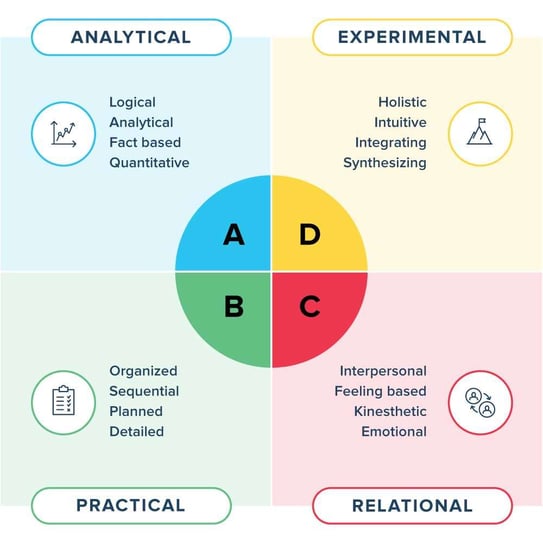
Whole Brain® Thinking offers a comprehensive framework to appreciate these differences. It's a foundation for effective leadership development strategies that work across cognitive styles. It categorizes thinking preferences into four quadrants:
- Analytical (Blue): Logical, data-oriented, and fact-based thinking.
- Practical (Green): Organized, sequential, detail-oriented thinking.
- Relational (Red): Emotional, interpersonal, and empathetic thinking.
- Experimental (Yellow): Holistic, intuitive, imaginative thinking.
By assessing leaders through this lens, organizations can identify strengths and areas for growth, ensuring a balanced leadership approach that aligns with diverse business needs.
What Gets Measured Depends on How You Think
Leadership development programs should lead to more than completions and certificates. They should measure the impact of leadership development on team members and business outcomes.
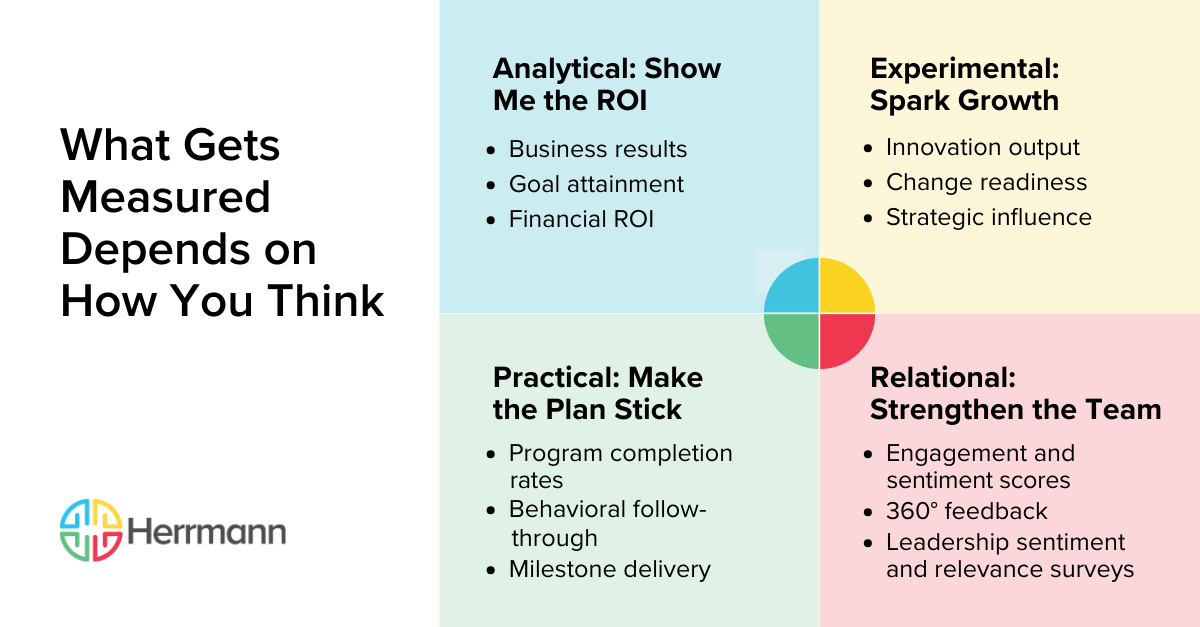
Each thinking style points to a different way development can create value and contributes to long term success. The following leadership KPI examples combine both qualitative insights and quantitative metrics for leadership development programs.
Analytical: Show Me the ROI (Leadership Metrics Examples and KPIs)
Analytical thinkers want evidence. They look for patterns in data, and they value clear proof that something is working.
- Business results: Track performance metrics influenced by leadership: revenue growth, cost savings, profit per employee.
- Goal attainment: Evaluate whether leaders are achieving strategic objectives post-program.
- Return on investment (ROI): Compare program costs to measurable gains, like increased productivity or reduced turnover.
What success looks like: The program leads to measurable business improvements and you can draw a clear line from development to results.
Practical: Make the Plan Stick
Practical thinkers focus on execution. They want to know that plans were followed, systems were adopted, and leaders are applying what they learned.
- Project completion rates: Measure how many participants finished learning paths, workshops, or coaching tracks.
- Behavioral follow-through: Track the number of leaders who put new skills into practice via performance reviews, manager feedback, or self-assessments.
- Milestone delivery: Evaluate implementation success for leadership initiatives, system changes, or rollout timelines.
- Behavioral observations: Look for evidence of new behaviors: improved communication, more effective feedback, better delegation.
What success looks like: Leaders are using what they learned, consistently. Development doesn’t stay theoretical. It becomes operational.
Relational: Strengthen the Team
Relational thinkers care about trust, cohesion, and emotional intelligence. They see success in how leadership affects how people feel, how they function, and how well they work together.
- Engagement and sentiment scores: Measure team-level trust, belonging, and motivation after leaders complete development.
- 360° feedback: Collect direct-report input on empathy, communication, and leadership presence.
- Retention and internal mobility: Track whether teams led by program participants show improved retention or higher rates of promotion from within.
- Leadership sentiment and relevance surveys: Ask participants how relevant the program was to their role.
- Program satisfaction and advocacy: Track likelihood to recommend.
What success looks like: Leaders are creating healthier teams, building stronger relationships, and contributing to a more engaged culture.
Experimental: Spark Growth
Experimental thinkers value vision, adaptability, and bold thinking. They want to know if the program inspired new ways of working.
- Innovation output: Measure new ideas launched, pilots tested, or strategies shifted post-program.
- Change readiness: Track how leaders and their teams respond to disruption or transformation.
- Strategic influence: Evaluate how many participants are contributing to future-looking conversations and business model innovation.
What success looks like: Leaders are thinking bigger, responding faster, and helping the organization evolve.
A Holistic Model of Measuring Leadership Effectiveness
The most effective leadership development strategies don’t just build capability in one quadrant. They incorporate key performance indicators (KPIs) aligned to each thinking style to help teams make informed decisions, track continued improvement, and drive strategic planning.
These metrics ensure your leadership development program reflects both individual growth and organizational priorities. They stretch leaders across all four quadrants and measure success in the same way. That kind of intentional measurement is what the most effective leadership development strategies rely on to align investment with impact.
When your evaluation strategy reflects the full spectrum of thinking, you get a clearer picture of what’s working, where to improve, and how to grow the kind of leaders your business actually needs.
Build a Whole Brain® Leadership Report Using Key Metrics
Reporting on leadership development can be one of the most stressful parts of the job for HR and L&D professionals. You’re not just sharing numbers; you’re making the case that your organization is investing its budget and its people’s time wisely. And you’re doing it in front of an audience that sees value through very different lenses.
Whole Brain® Thinking can also be helpful here by giving you a framework to organize insights in a way that resonates with analytical minds seeking ROI, practical leaders who want evidence of action, relational peers who care about team dynamics, and experimental thinkers looking for transformational progress.
Analytical: Make the Data Make Sense
Analytical thinkers need accuracy and business logic.
- Build scorecards that connect leadership development to hard business outcomes: retention, revenue, productivity, cost savings.
- Use clear success criteria and track deltas over time.
- Highlight where leadership behavior change shows up in measurable ways using performance metrics and data collection methods that reflect the impact of leadership development on team performance.
Deliverable: A concise KPI dashboard tied to business performance.
Practical: Track What Actually Happens
Practical thinkers want to know the plan was followed and what got done.
- Measure completions, milestone adherence, and applied learning.
- Track follow-through in performance reviews and feedback logs.
- Ensure the metrics you’re using are easy to collect, repeat, and scale.
Deliverable: A clean operational report of who participated, what they did, and where the gaps are.
Relational: Bring in the Human Story
Relational thinkers need to hear how the leadership development program is landing with people.
- Incorporate 360-degree feedback, pulse survey insights, and coaching notes.
- Highlight team-level changes: engagement, collaboration, retention.
- Share quotes, anecdotes, or themes from participant interviews.
Deliverable: A qualitative summary of what changed at the interpersonal and team level.
Experimental: Surface Strategic Insights
Experimental thinkers want to see the big picture.
- Map development trends to org-wide strategy and innovation goals.
- Highlight cross-functional contributions, idea generation, or future-looking behavior.
- Use the report to provoke curiosity, not just confirm assumptions.
Deliverable: A synthesis report with insights for shaping the next phase of leadership strategy.
Why Whole Brain® Thinking Elevates Leadership Development
Whole Brain® Thinking is more than a way to understand individual preferences; it’s a tool for developing high-performing teams. When you know how someone thinks, you can coach more intentionally, build more balanced teams, and align leadership behaviors to outcomes that matter.
Personalize Coaching
Thinking preference data can make development more personal and more effective. The HBDI® assessment helps leaders see their blind spots, stretch beyond their defaults, and approach challenges from new angles.
Use HBDI® results to:
- Tailor coaching strategies to how leaders prefer to think
- Guide conversations that stretch leaders across underused quadrants
- Track growth in cognitive agility over time.
In IBM’s global leadership ramp-up, 96% of participants said the program content was relevant to their current or future leadership roles, a strong foundation for coaching conversations that stick. When leaders see themselves reflected in the content, they’re more likely to apply what they’ve learned in the moments that matter.
Build Stronger Leadership Teams
Leadership isn’t a solo act. The most effective teams blend different ways of thinking, and Whole Brain® Thinking helps you design for that intentionally.
Use team-level thinking data to:
- Visualize the thinking composition of your leadership cohort.
- Identify gaps or over-dominance in certain styles.
- Build more cognitively diverse, high-performing teams.
In Upright’s leadership transformation, measurable results included enhanced communication, stronger self-awareness, and reduced conflict. Participants didn’t just complete a program. They built trust across styles and showed up differently for their teams.
Measure What Matters for Your Leadership Program
Leadership development isn't just about checking boxes. It’s about tangible change, and that change starts with how people think.
The Whole Brain® Thinking model gives us a powerful way to see that change in action. By looking at analytical rigor, practical follow-through, relational impact, and experimental drive, we get beyond surface-level metrics and into the heart of what makes a leader effective.
Take the HBDI® with your team and unlock new insights to help your organization flourish.
Share