


Leadership development programs have never received more investment. Organizations worldwide pour resources into workshops, coaching programs, and executive retreats designed to build stronger leaders. Yet something keeps failing. Program after program delivers short-term enthusiasm followed by a quiet return to old patterns. The missing piece isn't motivation or budget. It's personalized leadership development that accounts for how each leader actually thinks.
This guide walks you through exactly how to build leadership development programs that fit the leaders you have. You'll learn why generic training programs fall short, how thinking styles assessments change the equation, and what personalization looks like in practice for HR and L&D teams.
Key Takeaways: How to Personalize Leadership Development
- Generic leadership training overlooks how individuals naturally think, limiting real behavior change.
- Thinking styles assessments reveal cognitive preferences that shape how leaders learn and lead.
- Herrmann's HBDI® assessment maps thinking across four quadrants to create targeted development paths.
- Personalized programs address specific strengths and blind spots rather than forcing one-size-fits-all content.
- Cognitive diversity on leadership teams drives better decisions when different perspectives are integrated deliberately.
Why Generic Leadership Training Programs Fall Short
Most leadership development programs operate on a flawed premise. They assume that what works for one leader will work for another. They package skills like communication, delegation, and strategic thinking into standardized curricula and expect everyone to absorb them the same way.
The results tell a different story. Research published in the Journal of Applied Psychology found that leadership training design and delivery methods significantly impact outcomes, with personalization being a key factor in sustained behavior change.
When a highly analytical leader receives the same empathy training as someone naturally attuned to relationships, both walk away with different takeaways and different gaps. The analytical leader may understand the concept intellectually while missing the emotional frequency it requires. The relational leader may already practice it intuitively but miss the structural elements that make empathy actionable in complex situations.
The Identity Gap in Leadership Development
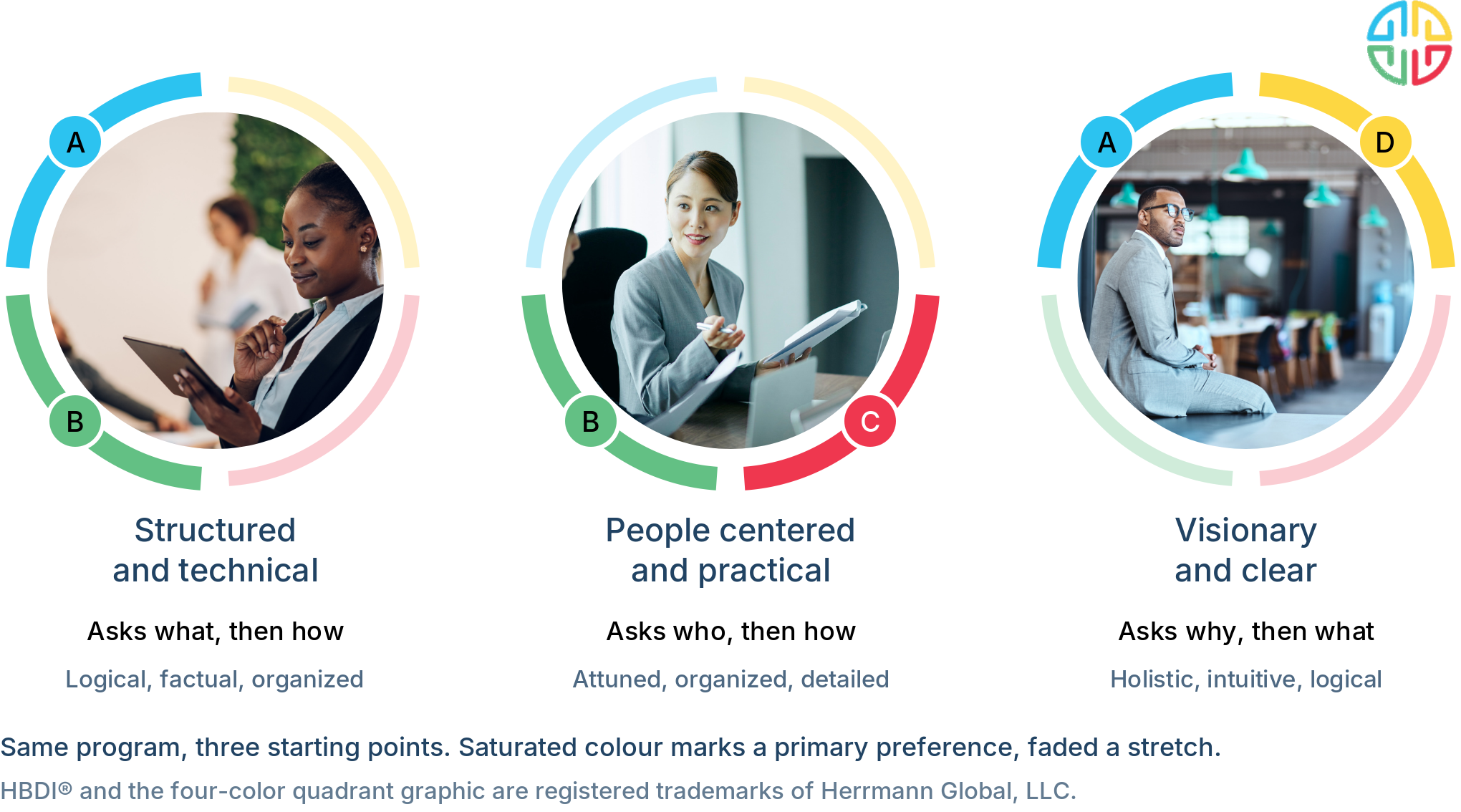
Standard programs often address behaviors without addressing the thinking patterns that drive them. A leader who defaults to micromanagement isn't going to stop because a workshop told them delegation is important. They need to understand why their mind reaches for control in the first place.
This identity gap explains why so many programs produce what one leadership journal called "leadership theater." Leaders learn the language of good leadership without changing the cognitive patterns underneath. They quote the right frameworks and reference the right models while reverting to their defaults the moment real pressure arrives.
What Thinking Styles Assessments Reveal About Leaders
Thinking styles assessments measure something fundamentally different from personality tests or skills inventories. They reveal cognitive preferences, the default pathways a leader's mind takes when processing information, solving problems, and making decisions.
These preferences aren't good or bad. They're patterns that shape how leaders naturally approach their work. An effective leadership development strategy uses this information to meet each leader where they are.
How Cognitive Preferences Shape Leadership Behavior
Consider a leader who naturally gravitates toward data and logical analysis. When facing a team conflict, their instinct is to gather facts, identify the root cause, and propose a logical solution. This approach works well for operational problems but can miss the emotional dimensions that fuel interpersonal friction.
Another leader might approach the same conflict through relationships first. They sense the tension, read the room, and focus on restoring trust before addressing the practical issues. This approach excels at maintaining team cohesion but sometimes delays the hard conversations needed to resolve underlying problems.
Neither approach is wrong. Both have strengths and limitations. The goal of personalized development isn't to change a leader's thinking style. It's to help them understand their defaults and expand their range.
The Science Behind the Whole Brain® Thinking Model
The Whole Brain® Thinking model developed by Herrmann provides a practical framework for understanding cognitive preferences in leadership. The model divides thinking into four interconnected quadrants that capture how people prefer to process information.
Understanding the Four Quadrants
The HBDI® assessment measures preferences across four thinking styles:
Analytical (A Quadrant): Logical, data-driven, fact-based thinking. Leaders with strong analytical preferences excel at financial analysis, strategic evaluation, and evidence-based decision making.
Practical (B Quadrant): Organized, sequential, detail-oriented thinking. Leaders with strong practical preferences excel at implementation, process design, and operational follow-through.
Relational (C Quadrant): Interpersonal, empathetic, emotionally attuned thinking. Leaders with strong relational preferences excel at team building, conflict resolution, and culture development.
Experimental (D Quadrant): Holistic, intuitive, imaginative thinking. Leaders with strong experimental preferences excel at innovation, strategic visioning, and creative problem solving.
Why This Framework Matters for Development
Most leaders have primary preferences in one or two quadrants. They naturally spend more cognitive energy there and develop stronger capabilities in those areas. Their less-preferred quadrants don't represent weaknesses. They represent perspectives that require more deliberate attention.
Herrmann's HBDI® helps leaders see this landscape clearly. With data from more than 4 million profiles globally, it reveals patterns that inform how coaching should be tailored, what development activities will resonate, and where blind spots might emerge under pressure.
How to Use Thinking Styles Data in Leadership Programs
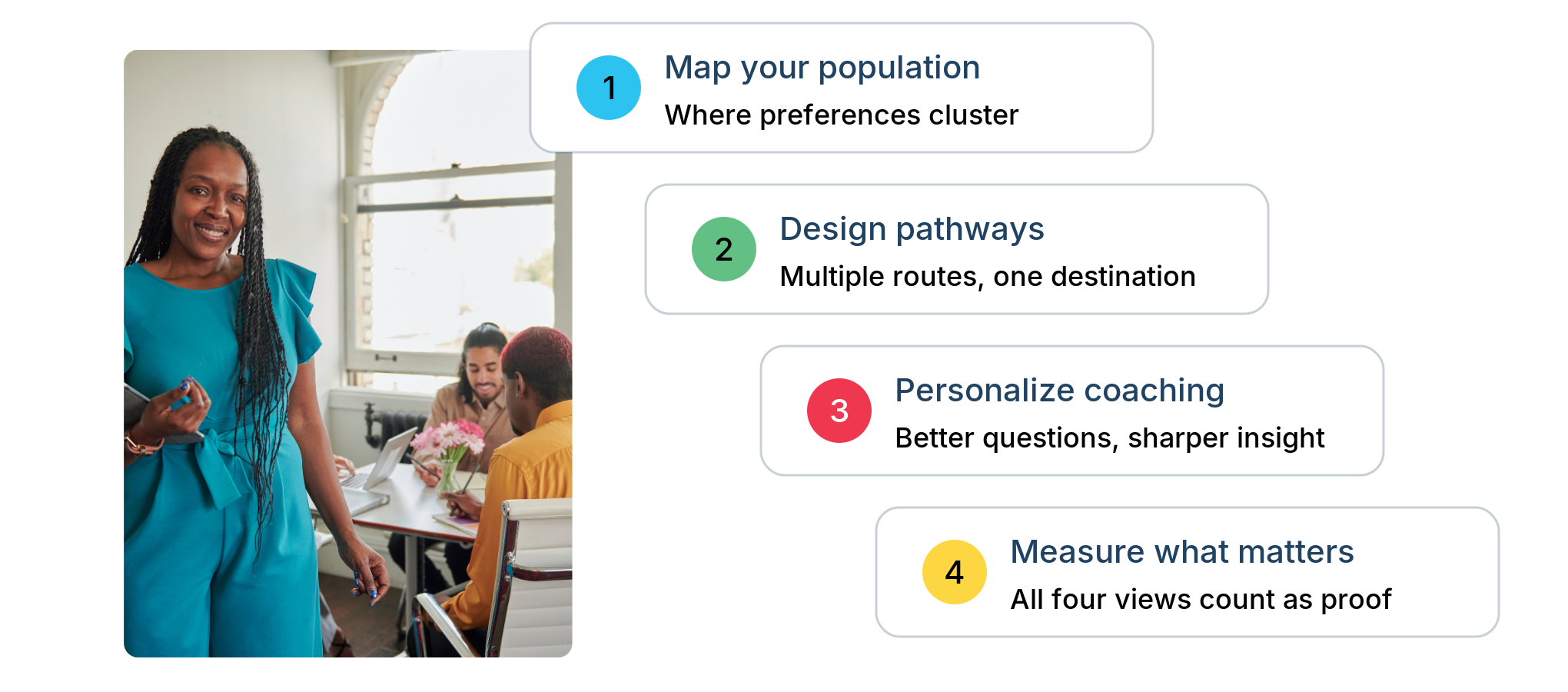
Collecting thinking styles data is only the first step. The real value comes from integrating it into every aspect of your leadership development approach.
Step 1: Map Your Leadership Population
Start by assessing the cognitive landscape of your current and emerging leaders. Where do preferences cluster? Where are there gaps? This map informs cohort design, coaching assignments, and program priorities.
If your leadership bench skews heavily analytical, your programs might need to emphasize relational skills and creative thinking. If it skews heavily relational, you might need more focus on analytical rigor and operational discipline.
Step 2: Design Development Pathways
Create multiple pathways through your leadership curriculum based on thinking preferences. An analytical leader developing emotional intelligence might start with research on the topic, move to structured frameworks, and then apply those frameworks in facilitated conversations.
A relational leader developing strategic analysis skills might start with understanding the human impact of better strategy, move to collaborative analysis exercises, and then build toward independent analytical work.
Step 3: Personalize Coaching Conversations
Generic coaching prompts produce generic insights. Thinking styles data enables coaches to ask better questions. For an analytical leader struggling with delegation, the conversation might explore what data would make them feel confident enough to let go. For a practical leader struggling with innovation, it might explore what process could make experimentation feel less risky.
Step 4: Measure What Matters
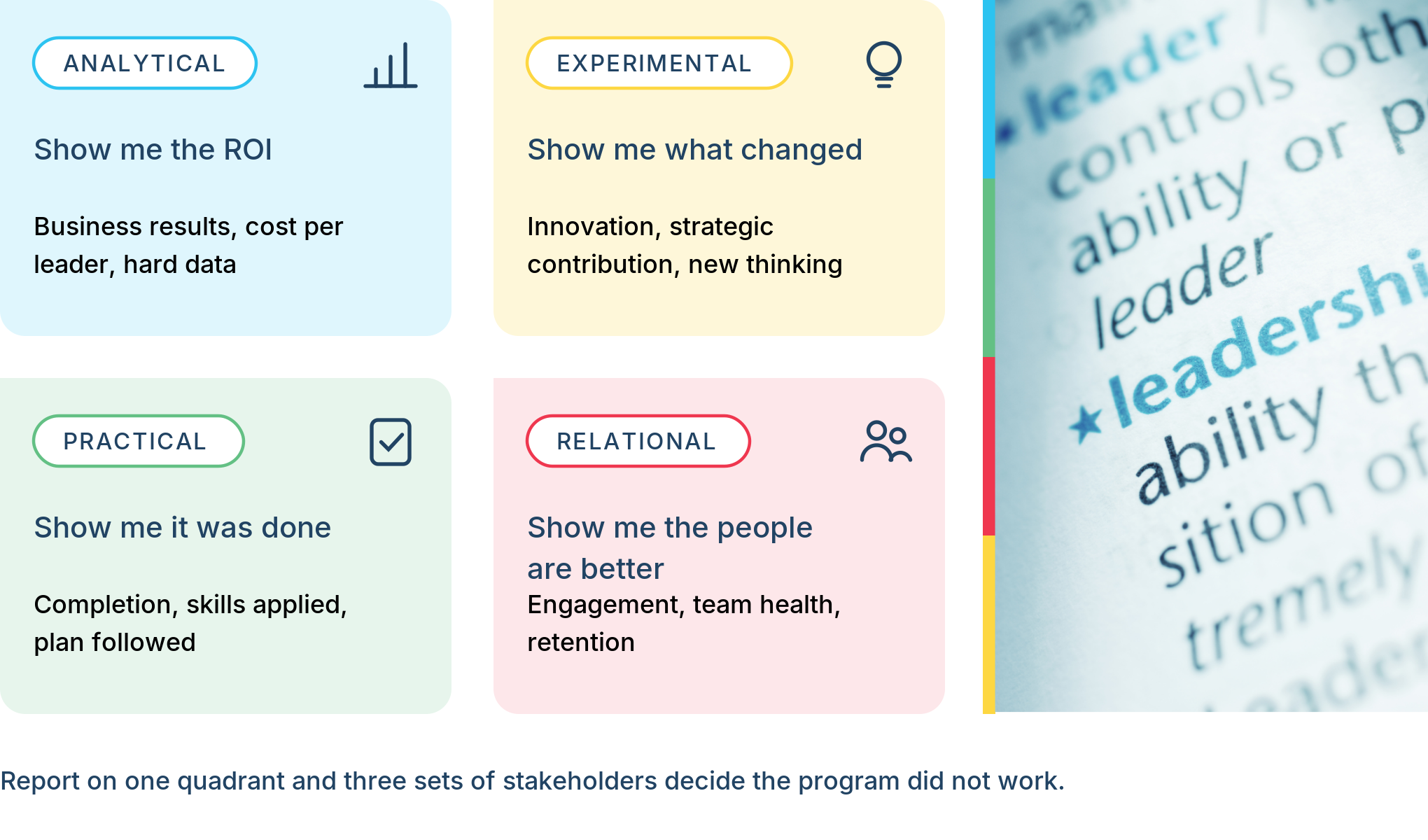
Different thinking styles point to different success metrics. Analytical leaders want to see ROI data on their development investment. Practical leaders want to know the plan was followed and skills were applied. Relational leaders want to hear how the program affected team dynamics. Experimental leaders want to see strategic impact and innovation outcomes.
A complete measurement approach addresses all four perspectives. This framework helps L&D teams measure leadership effectiveness in ways that resonate across the organization.
Building Cognitive Diversity on Leadership Teams
Individual development matters. Team composition matters even more. Research shows that cognitively diverse teams outperform homogeneous ones on complex problems, but only when that diversity is managed well.
The Integration Challenge
Cognitive diversity creates value only when different perspectives are heard and integrated. A team with strong analytical and relational members can make better decisions than either type alone, provided someone ensures both perspectives shape the final choice.
Too often, the loudest voice or highest-ranking voice wins regardless of cognitive contribution. The analytical member's caution gets dismissed as pessimism. The relational member's concerns about team morale get labeled as soft. The experimental member's creative idea gets shelved because there's no time.
Leaders who understand how to build high-performing teams recognize that integration is active work. It means deliberately surfacing perspectives that might otherwise be lost.
Designing for Team Balance
When building leadership teams, consider the thinking profile alongside traditional factors like experience and domain expertise. A team of five strong analytical thinkers might excel at financial modeling but struggle to read the room during a difficult organizational change.
This doesn't mean every team needs perfect quadrant balance. It means every team needs awareness of what perspectives are represented and what might be missing.
Implementing Personalized Leadership Development in Your Organization
Moving from generic to personalized leadership development requires changes in how you design, deliver, and measure programs.
Getting Started with Assessment
Begin by introducing thinking styles assessment to your current leadership population. Position it as a tool for self-awareness, not evaluation. Leaders who understand their own preferences become better at recognizing and valuing different perspectives in others.
Herrmann's HBDI® assessment takes approximately 20 minutes to complete and provides detailed profile data that informs development planning. The assessment doesn't measure capability or predict performance. It surfaces preferences that shape how each leader naturally approaches their work.
Training Your Development Team
Your L&D team and executive coaches need to understand the Whole Brain® Thinking framework deeply enough to use it in program design and individual coaching. Herrmann's certification programs prepare internal practitioners to apply the methodology independently.
Certified practitioners can interpret HBDI® profiles, facilitate team sessions, and build customized development activities that address specific thinking preferences.
Redesigning Existing Programs
You don't need to rebuild your leadership curriculum from scratch. Start by auditing current programs through a thinking styles lens. Which quadrants does each module naturally appeal to? Where are the gaps?
A strategic planning workshop might excel at analytical and practical content while underweighting the relational and experimental dimensions. Adding discussion on stakeholder impact and creative alternatives addresses those gaps without requiring a complete redesign.
Common Mistakes in Personalized Leadership Development
Personalization done poorly can create new problems. Watch for these common mistakes.
Labeling Instead of Learning
Thinking styles data should expand awareness, not create boxes. Telling a leader they're "analytical" and leaving it there reduces a complex person to a single dimension. The goal is understanding preferences, not assigning identities.
Every leader can access all four thinking styles. Preferences describe where attention naturally goes first, not where it can go. Development expands the range of styles a leader can draw on deliberately.
Avoiding Stretch Experiences
Personalization doesn't mean only teaching leaders through their preferred style. An analytical leader still needs to develop relational capabilities, even if the path to get there differs from what works for someone naturally relational.
The best development programs meet leaders where they are and then stretch them toward broader capability. They personalize the approach while keeping the destination ambitious.
Ignoring Team Dynamics
Individual development programs that ignore team context miss half the picture. A leader might grow substantially in coaching but struggle to apply new skills in a team environment where different cognitive styles create friction.
Include team-level work that helps leaders understand how their preferences interact with colleagues. This context makes individual development more practical and immediately applicable.
The Future of Leadership Development
The shift toward personalized leadership development reflects broader changes in how organizations think about talent. Generic approaches assume people are interchangeable. Personalized approaches recognize that individual differences drive organizational capability.
From Programs to Platforms
Technology enables personalization at scale. The Herrmann Platform provides ongoing access to thinking styles data, team analytics, and development resources that adapt to individual needs over time.
This platform approach treats leadership development as a continuous journey rather than a series of disconnected events. Leaders can revisit their profile data, explore team dynamics, and access targeted resources whenever development needs arise.
Integration with Daily Work
The most effective development happens in the flow of work, not in separate training events. When leaders have thinking styles awareness, they can apply it to real situations: preparing for a difficult conversation, planning a team meeting, approaching a strategic decision.
This integration makes development practical rather than theoretical. It builds capability through application rather than instruction alone.
In Conclusion: Making Leadership Development Personal and Practical
Generic leadership training has reached its limits. Organizations investing in development deserve better returns than temporary enthusiasm and unchanged behavior. Personalized approaches that account for how leaders actually think deliver those returns.
Thinking styles assessments like the HBDI® reveal the cognitive preferences that shape leadership behavior. That information enables development programs designed for the leaders you have rather than an imagined average. It enables coaching conversations that address real obstacles rather than generic advice. It enables alignment in leadership teams built on understanding rather than friction.
The path forward isn't more training. It's better-matched training. Development that meets each leader where they are and stretches them toward where the organization needs them to go.
Share