


The strategy meeting ends, the leader closes her laptop, and the team files out. Within an hour, three of the people who just nodded yes are briefing their reports on different versions of what was decided. One is telling finance the organization is doubling down on its flagship market. Another is telling operations they finally have permission to invest in a new region. A third is signaling a hiring slowdown that nobody else in the room thinks was actually decided. Each of them is sincere, each of them was at the meeting, and yet they each walked out with a different version of the same decision.
This is how misalignment actually shows up in a leadership team. There isn't always loud disagreement, an obvious escalation, or a clear moment where someone said no. The disagreement is quiet, the room feels settled, and the cost only becomes visible weeks later, when the organization has been moving in four directions at once and nobody can name the moment the wires crossed.
Donald Sull's research at MIT Sloan put a number on the gap. In a study of 124 organizations, only 28% of senior executives could list three of their company's five top strategic priorities. These weren't middle managers being polled; they were the leaders accountable for delivering the strategy. The same body of work found that strategic convergence drops sharply once you move past the very top of a company, from 51% agreement on objectives inside the C-suite to 22% one level down. Sull's piece, No One Knows Your Strategy — Not Even Your Top Leaders, is the cleanest summary of what the data shows.
Faced with that gap, most leaders default to communication. They send another memo, hold another town hall, repeat the priorities until they stick. The trouble is that the underlying problem isn't really about whether people heard the words. The same words mean different things in different heads, and no amount of repetition fixes that.
Why "we all agreed" rarely means alignment in leadership
When four people on a leadership team listen to the same sentence about doubling down on a flagship market, they are processing four different decisions.
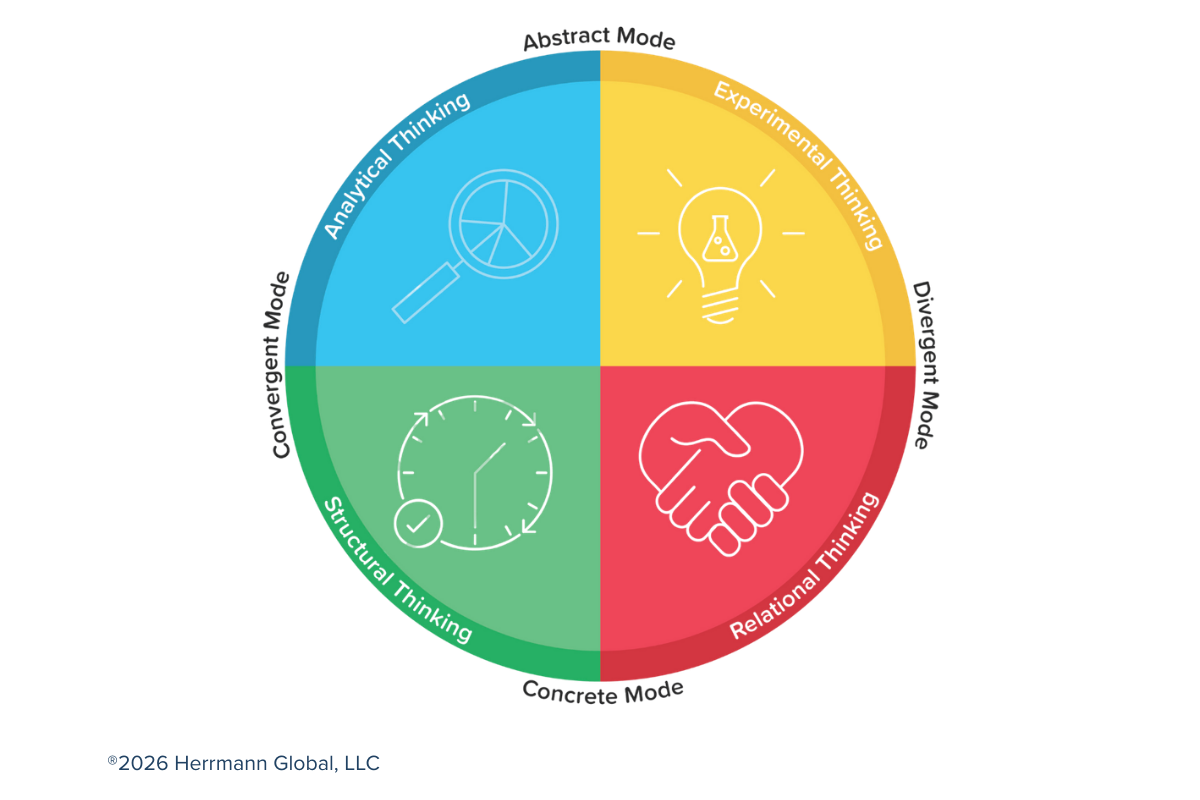
The analytical leader hears a quantitative bet, and immediately starts pricing it out: margin profile, payback period, the implied shift in revenue mix.
For the operations leader, it lands as an execution challenge. Capacity, staffing, what has to come off the roadmap to make room.
The relationships-oriented leader hears a people decision, and starts working through how the team will react, what happens to the customers and partners built up over years, and who needs to be told what by when.
For the big-picture leader, the same sentence lands as a positioning move: the market story, the five-year identity, the doors this decision opens or closes.
Each interpretation is valid, and each one becomes the thing that leader carries out of the room and acts on. What looked like agreement was a shared sentence resting on top of four different decisions.
There's a name for the pattern, and there's more than four decades of research behind it. Ned Herrmann started mapping these cognitive differences during his work at General Electric in the late 1970s, and the Whole Brain® framework that grew out of that research has been refined and tested with leadership teams ever since. Today it is trusted by many of the world's largest organizations, from global pharmaceutical companies and government agencies to multinationals across the Fortune 100, precisely because it gives leaders a shared vocabulary for the translation work this kind of moment demands. A decision that lands cleanly with one type of thinker can come across as something completely different to the person sitting next to them, and unless someone surfaces that gap deliberately, it tends to widen over time.
What strong leadership teams do differently to drive alignment
The teams that hold alignment through execution share a habit: instead of repeating decisions more often, they translate them more carefully. Three behaviors do most of the work.
Restate the decision in four registers before anyone leaves the room. A leader who has just made a call should walk the team through what it means analytically (which numbers move and by when), operationally (what gets built, stopped, or staffed), relationally (who is affected, what they need to hear, and from whom), and strategically (why this puts the organization in a better position twelve months from now). The exercise feels redundant, which is why most teams skip it, and it is also the single highest-leverage thing a leader can do at the end of a strategy meeting. Divergent interpretations surface while everyone is still in the room to correct them.
Close every decision with a round of "what will you do Monday." Go around the table and have each person say out loud what they will do differently next week as a result of the conversation. Mismatches show up immediately, well before anyone has spent a week on the wrong work.
Audit a week later. Pull three leaders into separate conversations and ask each to describe, in their own words, the priority you set, the trade-off you accepted, and the bet you explicitly did not make. Convergence across the three accounts is a signal the decision held. Divergence is a useful signal that you need another hour together before the work moves further.
An alignment in leadership test for your next meeting
Most leadership teams overestimate how aligned they are, because the room feels aligned in the moment. Nobody objects, nobody escalates, the body language is right. The test that matters comes afterward, in what people actually do.
After your next strategy session, before anyone follows up by email, try this. Ask each of your direct reports separately: In one sentence, what did we decide, and what will you change because of it? Compare the answers.
If they line up, you have alignment. If they don't, you have a useful problem on your hands, and one that is far easier to address while it is visible than when it is quietly redirecting the organization for the next quarter.
That work is harder than it sounds, and it is what separates a team that says it is aligned from a team that actually is.
Share