


Great leaders know how to inspire and motivate their teams as a collective while bringing out each team member's individual strengths. But what leadership style drives that outcome? Less than you might expect. It has more to do with the specifics of you, your team, and the working environment you're operating in than with naming a single best leadership style. The real test is whether you can read those specifics and shift your approach when conditions change. Whole Brain® Thinking helps you do exactly that.
Consider what people say they want from those who lead them. In a survey by the Niagara Institute, nearly 47% named democratic leadership as their preference. But wanting a style and practicing it are two different things. You don't have to lead democratically to lead by example, share a decision, or give people the freedom to create and decide for themselves, the three strengths respondents valued most. Knowing which leadership styles tend to work is useful. It's also only where the real work begins.
So what actually makes leadership effective? Why do leadership styles matter without ever being absolute? And how well do you really read the team in front of you? Learn more about defining effective leadership, why leadership styles are important but not absolute, and how Whole Brain® Thinking can help you become a more effective team leader.
What Is a Leadership Style? (And Why There's No Single Best One)
Leadership is a complex activity, requiring a combination of skills, experience, and adaptability based on circumstances and the people involved. At its core, effective leadership is about guiding and motivating individuals, teams, and organizations to achieve goals.
Picture the ideal leader. Most of us reach for an archetype, a single image of how a great leader looks, thinks, speaks, and behaves. Yet the most effective leaders rarely work from one fixed approach. They read the situation first, then adjust to fit what the team in front of them actually needs.
Effective leadership is driven by self-awareness and understanding. Leaders must recognize their strengths and weaknesses before they can help others. They must also be perceptive of the environment and their employees' strengths, weaknesses, and needs. These leaders must be able to diagnose the challenges, lay a course toward goals, and motivate others to come along with them.
Effective workplace leaders contribute to increased productivity, efficiency, morale, loyalty, and innovation. Managers are the biggest factor affecting employee performance, according to Gallup, and the success of your organization likely depends on whether you can attract, develop, and retain strong managers.
Businesses are continuously changing, and so are the expectations of employees. Not every employee responds positively to the same types of feedback, direction, or motivation. Thus no one leadership style is likely to be effective for every employee, or every leader.
What Are the Best Leadership Styles? 8 Common Types Compared
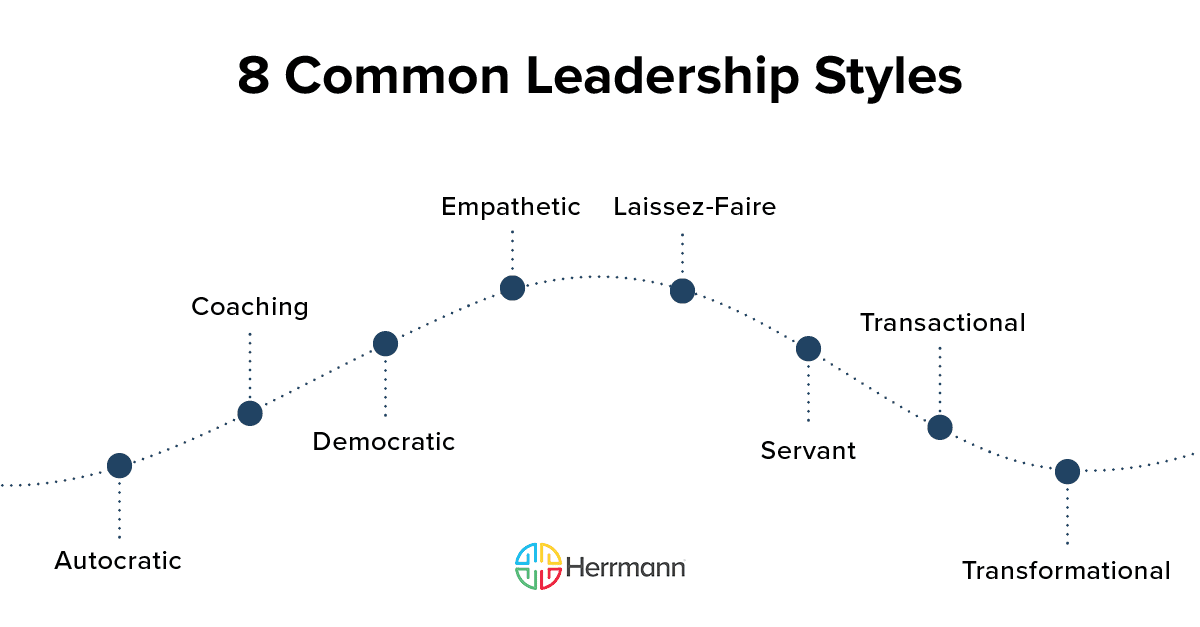
There are many different leadership styles, each with its own strengths and weaknesses. Below are eight of the most common, what each one does best, and when to use it, so you can match the right approach to your team and the moment.
Autocratic Leadership
Autocratic leaders dictate what their team should do, both in terms of tasks and philosophy. They make decisions solely based on personal authority and experience. This approach can deliver effective leadership during a crisis when decisive, quick actions are required. Autocratic leadership can also be effective, for example, when the leader is the subject matter expert and needs to give direct orders. However, this approach over time can lead to employees feeling undervalued and underappreciated, especially when their expertise isn't recognized or considered. When does being decisive start to keep people quiet?
Coaching Leadership
Coaching leaders take a mentorship approach, offering guidance instead of giving explicit direction. They focus on empowering team members to find their own solutions rather than telling them what to do. This style works best when you're developing talent over time, onboarding new hires, or growing high-potential people into bigger roles, holding them accountable for progress while building their skills.
This approach requires close relationships, regular communication between leader and employee, and an emphasis on skill-building. With large teams, this approach can become more difficult if the leader is trying to coach many people at once individually.
Democratic Leadership
Democratic leaders allow team members input on major decisions while still maintaining control over final decisions. The goal is to create an environment where ideas are exchanged freely and everyone has a voice. This type of leadership style, also called participative leadership, works well for decisions that aren't time-sensitive and where there's leeway to experiment. Lean on it too heavily, though, and decisions can stall when the moment actually calls for a fast, clear call. When is consensus worth the wait?
Empathetic Leadership
Empathetic leaders focus on understanding each person's needs and point of view before making decisions. While facts and data are still part of the process, these leaders emphasize the impact on their people. They build strong relationships with their team members and strive for a workplace where everyone is listened to, respected, and appreciated. It pays off most when trust, morale, and retention are on the line. The risk is letting concern for how people feel soften a hard call that still needs to be made.
Laissez-Faire Leadership
Laissez-faire leadership provides minimal guidance and direction. These leaders choose to allow maximum freedom for employees whenever possible. This style of leadership is based on the belief that workers are motivated when they can take initiative and make their own decisions.
As such, laissez-faire leaders act as facilitators, providing resources, guidance, and support while leaving most decision-making to employees. It works best with experienced, self-directed people who know exactly what they're doing. Give the same latitude to a newer team and the absence of direction can start to feel like neglect. How much freedom is your team actually ready for?
Servant Leadership
Servant leadership, created by Robert K. Greenleaf, combines a natural desire to serve others with deliberate choices that serve people's highest needs. These leaders put their team's interests ahead of their own desires. This type works well when building trust within a group, as servant leaders can quickly illustrate their commitment to individuals and the team, not just their own interests. Pushed too far, though, the focus on serving everyone else can crowd out the leader's own priorities and the targets the team is there to hit.
Transactional Leadership
Transactional leadership uses sticks and carrots to motivate team members. The focus is on setting clear goals and providing instructions on how to reach them. Transactional leaders usually offer incentives for reaching those goals while laying out the consequences for failure. This style works well when dealing with tasks that require structure, routine, and stability. However, it's not always conducive to building trusting relationships or helping people feel like they're part of a close-knit team.
Transformational Leadership
Transformational leaders inspire their teams through a shared vision and helping each person understand how they fit into it. These leaders inspire loyalty by being positive role models who demonstrate respect for individual contributions while pushing each person toward higher levels of workplace excellence.
Transformational leadership works well when trying to create an environment of creativity, innovation, and collaboration, as it encourages people to think outside the box while still working together toward common goals. The catch is follow-through: a big vision without attention to day-to-day detail can leave people inspired but unsure what to actually do on Monday morning.
How Whole Brain® Thinking Helps You Choose Between Leadership Styles
Inclusive leadership starts with you. No matter which style you prefer, you need to understand how you think, how your team thinks, and how those similarities and differences can be put to work for better thinking, collaboration, and business results.
The Whole Brain® Thinking Model and Herrmann Brain Dominance Instrument® (HBDI®) assessment can help leaders think more deeply about their leadership style and how to best use it for the team's benefit.
Whole Brain® Thinking is a framework backed by over 40 years of experience that identifies how people think and what works best with their preferences. The HBDI® assessment divides people's thinking preferences into four quadrants: Analytical (Blue), Practical (Green), Relational (Red), and Experimental (Yellow). While everyone has a higher preference for one or two quadrants, everyone can and does access all four quadrants daily. Importantly, no quadrant or combination of quadrants is superior to another.
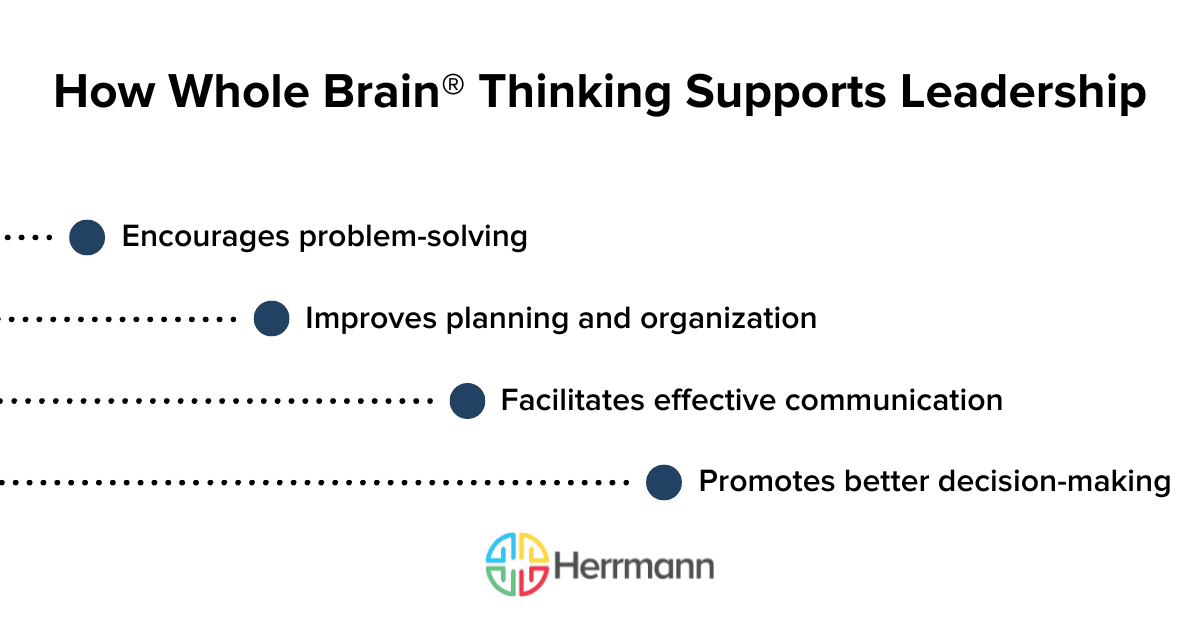
So where does this show up in the day-to-day of leading? Consider four places it changes how you work.
Problem-Solving
Whole Brain® Thinking helps leaders lead their teams through structured problem-solving exercises that examine problems in various ways. For example, you might walk through a problem with these questions:
- What? This analytical (Blue) approach ascertains the facts and conditions.
- How? This practical (Green) question tries to organize the problem, including what processes are involved and what steps should be taken (or have been).
- Who? This relational (Red) question doesn't just seek to catalog who's involved. It considers how each person or job role is affected by the problem and by possible remedies.
- Why? This experimental (Yellow) approach attempts to figure out the cause(s) of the problem, and how it might be redefined to find creative solutions.
Improved Planning and Organization
One of the biggest challenges for many leaders is keeping teams organized, especially when planning complex initiatives. Understanding your team's thinking preferences can help you craft well-rounded planning documents that account for key details while also connecting with people's preferences.
For example, if you're designing standard operating procedures (SOPs) for your team, you'll need to list steps and actions to take, as well as systems, processes, or tools to use. Practical (Green) thinking of this kind is essential. But go further by indicating why these SOPs are being created (Yellow) and how you'll measure success and key results (Blue).
Additionally, while these SOPs will indicate who does what, they go beyond faceless roles. Indicate the positive effects the employees in these job roles (Red) will gain by following these procedures. Those gains could be increased productivity, less frustration, better communication, or countless other possibilities.
Effective Communication
Communication is all about gaining a shared understanding. Whole Brain® Thinking helps your team embrace differences in thinking preferences to develop common understanding and a shared language that facilitates honest, open, and constructive communication.
One example of how leaders can reinforce better communication is by understanding how their people receive information best. While much information must be written down, visuals or audio can help many people retain key information better.
Better Decision-Making
Understanding your team's thinking preferences can help you make better decisions that are more likely to align with business goals. By being aware of your team's strengths, weaknesses, and thinking preferences, you can tailor decision-making processes to ensure the best possible outcomes and most efficient working methods.
Cirque du Soleil used Whole Brain® Thinking to unlock the range of thinking preferences within the organization, without sacrificing the flat leadership structure it valued so deeply.
"I would ask, 'What would make your team smarter? Stronger?' The answers are always in their diversity of thought," says consultant Danièle Bienvenue. "And so Whole Brain® Thinking became a pillar, a lighthouse constantly reminding us of this knowledge about members of the team. We focused on how we can use these insights to make better decisions."
Choosing the Right Leadership Style for Your Team
There's no one-size-fits-all answer here, and that's the point. The leaders who get this right pay close attention to what their people need and what they do well, then adjust their style to match. When you lead from a real understanding of how your team thinks, you bring people closer, draw out more of their potential, and get better results from the work.
Discover how to draw on your team's cognitive preferences and build a leadership development strategy that fits how your leaders actually think.
Going Deeper: Building Leadership Capability for a World That Won't Wait
Want to build that range deliberately? Only 29% of leaders feel ready for what's next. Join Ann Herrmann-Nehdi live on June 29 for a free session on where leadership programs fall short and three moves you can make now. Save your seat
.png?width=6912&height=3456&name=Leadership%20Under%20Pressure%20Mastering%20Change%2c%20Complexity%2c%20and%20Uncertainty%20(1).png)
Share