


Think about the leaders you're responsible for. When a plan they trusted comes apart overnight, do they adapt, or reach for the playbook that just failed? When more is coming at them than anyone could absorb, can they still make a clear call?
If those are getting harder to answer with a yes, you're looking at BANI: futurist Jamais Cascio's name for a world that's brittle, anxious, non-linear, and incomprehensible. Systems hold until they shatter. Cause and effect come uncoupled. Information outruns anyone's ability to make sense of it. We're living through a Great Rewiring, and the leadership instincts built for a steadier world no longer fit.
And the leaders meant to navigate it aren't ready. In DDI's Global Leadership Forecast 2025, 83% of HR teams expect a surge in the leadership skills they'll need, while only 22% are actively building them. That gap isn't about effort. Most programs were built to develop a kind of leader a BANI world no longer rewards.
So what should leadership development build now? The honest answer is range. Each BANI pressure calls for a different response: resilience for the brittle, steadiness for the anxious, improvisation for the non-linear, and holding several readings at once for the incomprehensible. Together that's close to the full span of how people think, asked of one leader, often in the same hour. Yet under pressure the brain narrows to its most practiced style, right when the situation needs more than one. So the capability to develop first is the one beneath the rest: seeing how you think, and flexing across the whole range on purpose. That is where Whole Brain® Thinking comes in, a simple map of four thinking styles that makes your range visible so you can build it and flex it. What follows takes the four BANI pressures one at a time.
Strategic agility is a thinking skill you can build
The leaders who handle this well think more flexibly. Like a tennis pro who reads the ball instead of pre-picking the shot, they adjust to what the moment actually needs. Herrmann calls that thinking agility, the ability to shift beyond your natural preferences, noticing when a moment calls for analysis though your instinct is to reassure, or for empathy though your instinct is to optimize, and shifting on purpose.
What makes the shift possible is metacognition: noticing how you're thinking while you're thinking, so you can catch an over-reliance on a favorite style and adjust. It's trainable. The problem is rarely preference itself; it's leaning on one so hard the others go unused.
A working map of how leaders think
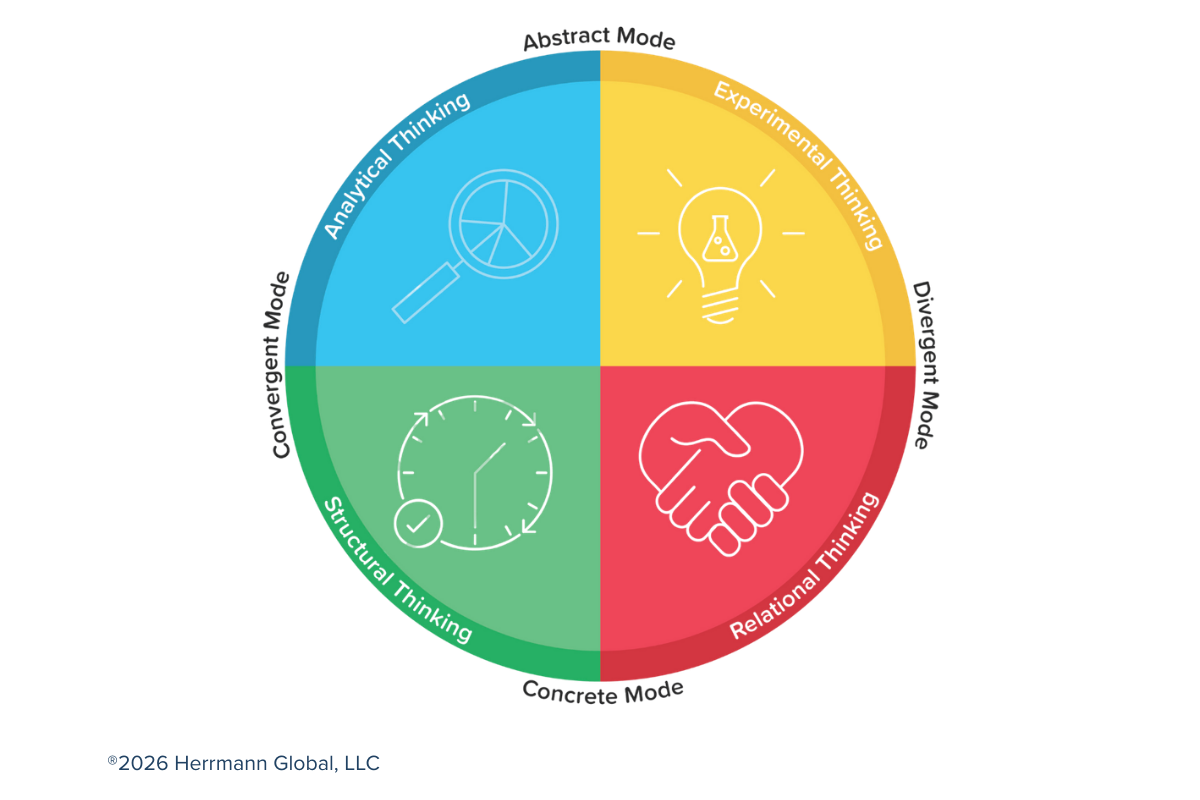
That's what Whole Brain® Thinking maps: four thinking styles tied to how the brain prefers to work, made visible through the HBDI® assessment so a leader sees which styles they lean on and which they skip.
- Analytical asks what the data says.
- Practical asks how the work gets done, and where the plan breaks.
- Relational asks who's affected and how trust holds.
- Experimental asks why it matters and what it could open up.
Treat it as a map of how you think, one you can flex, rather than a fixed label. A hard call needs all four at once: the evidence, a workable plan, an honest read of the people, and a sense of where it leads. A leader stuck in one style delivers a quarter of what the moment asks.
How to build agility in a BANI world
Brittle: route your thinking
Brittle conditions punish single-style reactions, so use the four styles as a routing tool. Before reacting, run the problem through each: what does the data say, what's the plan and where does it break, who's affected and how does trust survive, what could this open up. You'll have a natural starting point; the discipline is visiting the other three on purpose, especially the one that feels hardest to reach. That effortful switch is the muscle.
Anxious: orchestrate the team's intelligence
Anxiety erodes trust, and most work now runs through teams. The shift is from the hero who holds the answers to the orchestrator, the person who best orchestrates the intelligence of the room. Two moves make that real. First, difference isn't the problem, unused difference is, so the orchestrator's job is to turn difference into shared thinking. Second, cognitive safety sits beneath psychological safety: the first is permission to speak up, the second is permission to think differently. Without it, the team's range never reaches the table. Leaders who host conflict about ideas, without letting it sour into conflict about ego, keep the full range available.
Non-linear: build learnership
When the world is non-linear, expertise decays before the next planning cycle. The answer is learnership, the ability to learn, unlearn, and relearn in the flow of work: continuous, embedded development over annual events, prizing the leader who learns fastest over the one most certain of what they already know. This is where the DDI data gets concrete. Organizations using five or more development approaches are 4.9 times more likely to report improved leadership capability. Cohorts, reflection, feedback, and safe-to-fail practice are what make it hold.
Incomprehensible: develop human and AI judgment together
AI lands as a leadership challenge before it's a technology rollout, because AI mirrors how you think. It hands your strongest preferences back to you stronger, which feels like brilliance, and your weakest ones back with the same confidence, which is where the risk hides, in the style you find draining and delegate fastest. Whole Brain® Thinking makes it a delegation question. The question shifts from whether to use AI to where, and through which lens: AI for analytical pattern-finding and practical drafting, humans for relational trust and meaning, real partnership for experimental synthesis.
Where to start
.png?width=6912&height=3456&name=Leadership%20Under%20Pressure%20Mastering%20Change%2c%20Complexity%2c%20and%20Uncertainty%20(1).png)
Strategic agility is a capability you design for across all four responses, held together by orchestration: orchestrate, don't control. But you can't build what you can't see, so start with diagnosis. The Whole Brain® Leadership Audit shows where a program overbuilds its favored styles and underbuilds the ones a BANI world demands, and the HBDI® gives leaders the map underneath. The same question applies to your own practice: which style do you route around when the pressure is on?
Ann Herrmann-Nehdi, Herrmann's Chief Thought Leader, hosts a free expert session on rewiring leadership for the AI era on June 29. Register here.
Share