

Groupthink is the tendency for a team to converge on a single conclusion without examining alternatives, driven not by individual timidity but by a collective narrowing of perspective. When the people in a room share similar thinking preferences, whole categories of information can go unraised. The agreement feels confident. The confidence is real. The range of thinking behind it is not.
Herrmann's Whole Brain® Thinking framework offers a way to diagnose where that narrowing happens and what to do about it.
Why Smart Teams Still Fall Into Groupthink
Most explanations for groupthink focus on social pressure: nobody wants to be the dissenter. That dynamic is real, and psychological safety matters. But it accounts for only part of the problem.
The less visible cause is cognitive. When a team's thinking preferences cluster in one or two areas of the Whole Brain® Thinking model, certain questions never occur to anyone in the room. A warm, well-organized team that leans practical and relational, for example, can agree quickly and carry out the plan smoothly without once asking what the evidence says or whether the whole direction is the right one.
That is not a courage failure. It is a coverage failure. The missing perspective was never represented, so no one needed to suppress it. According to Herrmann's research with more than 4.5 million HBDI® profiles, most teams show distinct concentration patterns, and those patterns can point to where blind spots form.
This guide stays narrow: how to catch groupthink in a specific decision. For the wider case for cognitive diversity on teams, see What Is Cognitive Diversity on Teams.
Signs of Groupthink by Thinking Preference
The Whole Brain® Thinking model maps four thinking preferences: Analytical (A), Practical (B), Relational (C), and Experimental (D). Each preference, when underrepresented on a team, can leave a predictable gap. Here is what to watch for.
When Analytical Thinking (A) Is Underrepresented
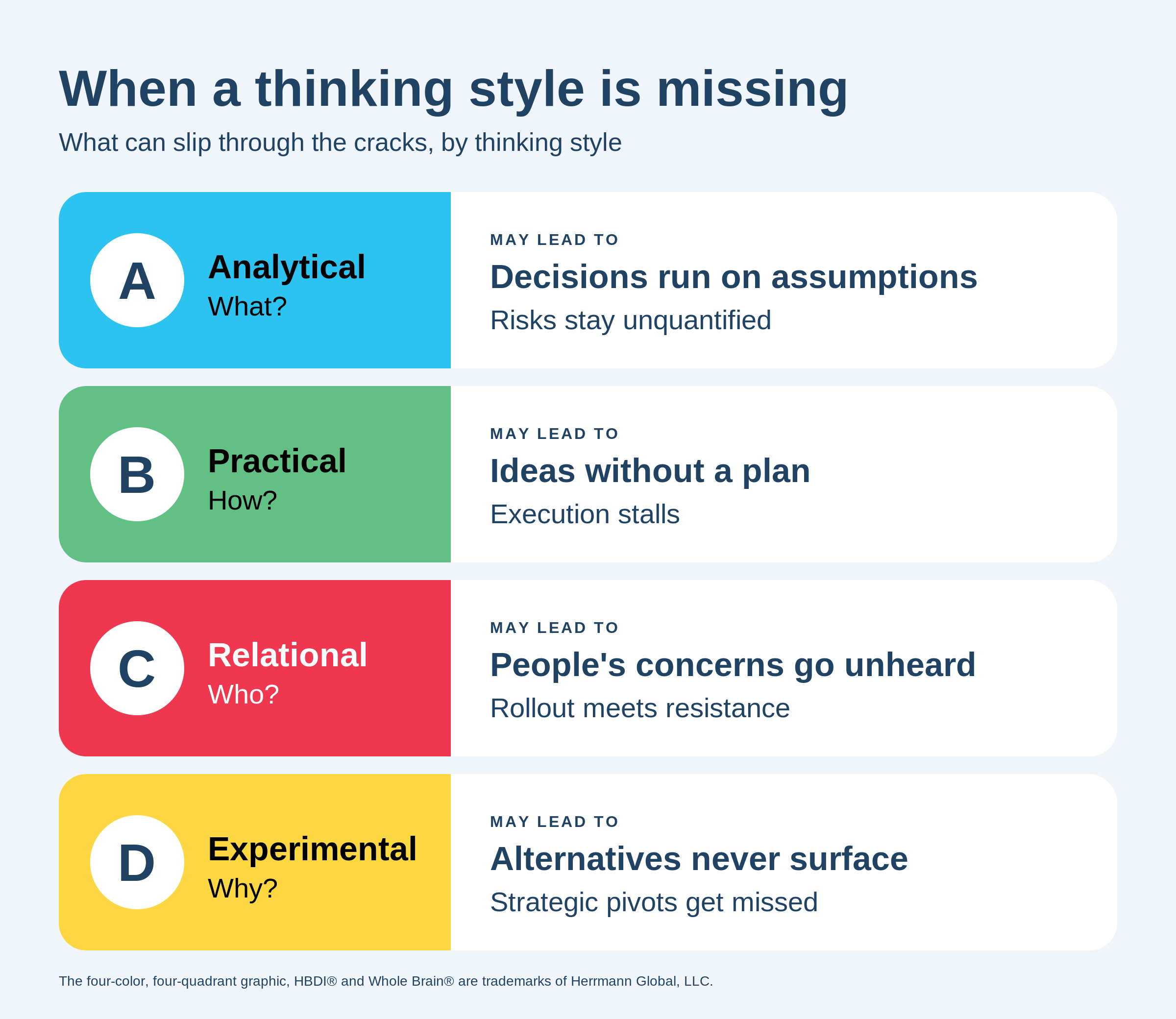
Decisions may proceed on assumptions that no one challenged with data. The team can feel momentum and conviction while lacking the evidence to justify either. Proposals gain approval based on enthusiasm rather than quantitative scrutiny, and risks stay unquantified until they materialize.
When Practical Thinking (B) Is Underrepresented
Ideas may multiply without a workable implementation plan. The group can generate creative strategies that stall at execution because nobody mapped the steps, timelines, or resource requirements.
When Relational Thinking (C) Is Underrepresented
The team may finalize plans without considering the people who will be affected. Stakeholder concerns, cultural dynamics, and trust factors can go unexamined, leading to resistance during rollout that the team did not anticipate.
When Experimental Thinking (D) Is Underrepresented
The team may optimize existing processes while missing strategic pivots entirely. Alternatives outside the current frame can go unexplored because the conversation stays fixed on what has already been tried. Long-term vision and unconventional possibilities may never enter the discussion.
The Four-Question Pass: A Practical Groupthink Check
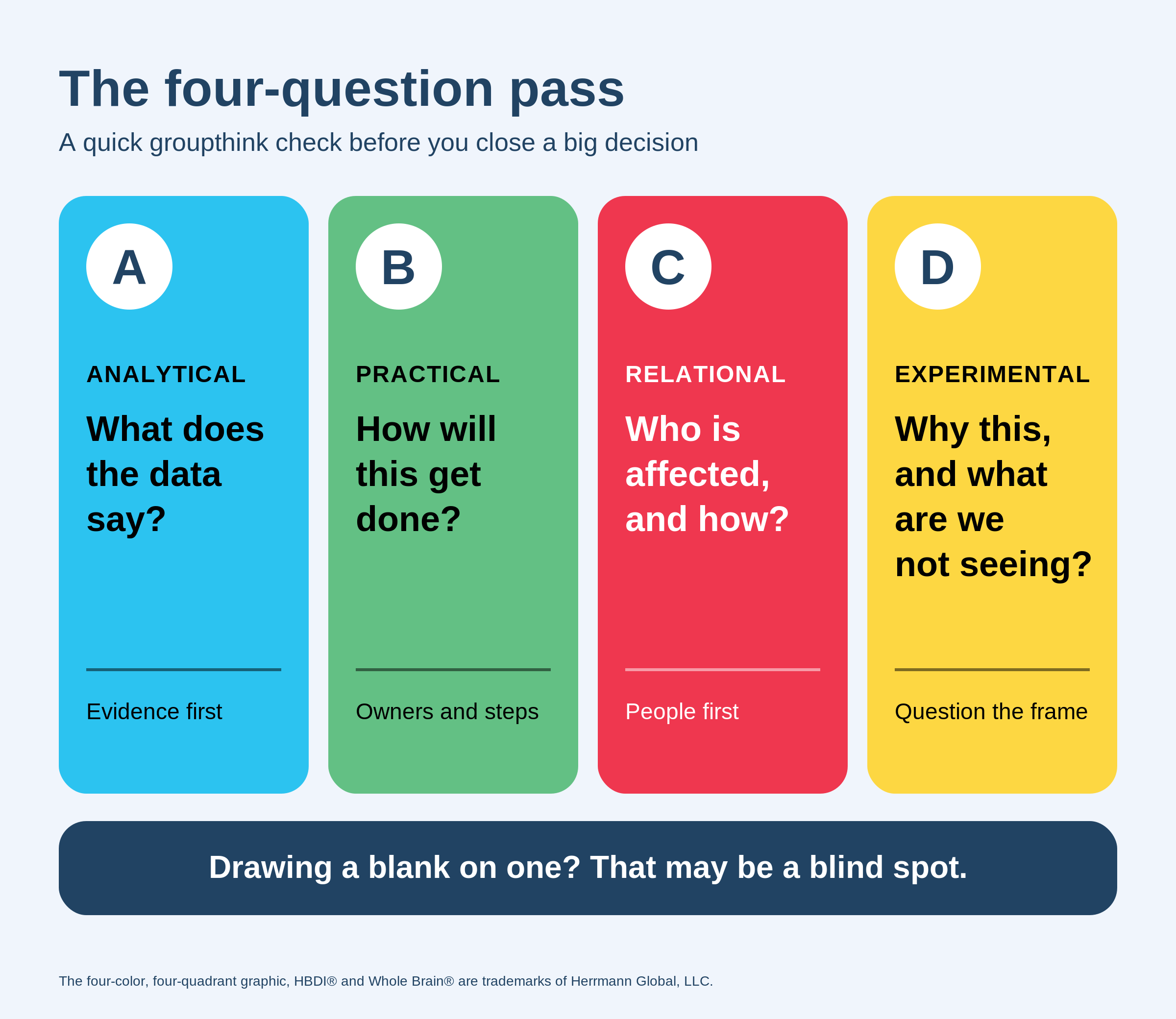
Before closing a significant decision, ask four questions out loud, each mapped to a Whole Brain® Thinking preference. If any question draws a blank, the decision may have a blind spot worth examining.
- What does the data say? (Analytical, A) Verify that the conclusion rests on evidence, not assumption. If the team cannot point to specific data supporting the direction, the analytical perspective may be absent.
- How will this get done? (Practical, B) Confirm that a concrete plan exists. If steps, owners, and timelines remain vague, the practical perspective may need attention.
- Who is affected, and how? (Relational, C) Identify the stakeholders, teams, and individuals who will experience the impact. If the conversation has focused on systems and processes without addressing people, the relational perspective may be missing.
- Why this direction, and what are we not seeing? (Experimental, D) Challenge the frame itself. If the group has not considered at least one fundamentally different approach, the experimental perspective may be underrepresented.
This four-question pass does not require adding people to the team. It requires building the habit of deliberately seeking the thinking that is not already present. It takes minutes and can shift the quality of any decision.
How the HBDI® Team Profile Makes Groupthink Visible
The four-question pass works as a habit. For a structural solution, Herrmann's HBDI® assessment provides the data.
The HBDI® Team Profile maps each member's thinking preferences across the four quadrants, then generates a composite view of which styles are well represented in the room and which are thin. Read against an upcoming decision, that composite can show groupthink risk before a flawed decision surfaces it.
With the HBDI® Team Profile in hand, leaders can design team development around actual gaps rather than assumed ones. That means assigning specific thinking roles during key decisions, embedding the four-question pass into meeting and review processes, and tracking whether previously sparse perspectives are getting applied.
Start by Mapping Your Team's Thinking
Groupthink does not announce itself. It feels like alignment. The way to distinguish genuine alignment from cognitive narrowing is to see the pattern your team's preferences create, and then bring in the perspectives that pattern leaves out.
The HBDI® Team Profile gives you that map: where your team's thinking concentrates, where it can thin out, and what to do about it. Explore the Herrmann platform to see how Whole Brain® Thinking can help your team move from confident consensus to genuinely comprehensive decisions.
The four-color, four-quadrant graphic, HBDI®, and Whole Brain® are trademarks of Herrmann Global, LLC.
Share