


Most enterprise AI rollouts follow the same script: buy the tools, train the teams, measure adoption rates. But a gap between deploying AI and generating measurable business outcomes keeps growing. Herrmann's client data reveals what happens when that gap goes undiagnosed: organizations default to technical readiness checklists while ignoring the cognitive and cultural readiness that determines whether AI adoption holds over time.
This guide covers what an AI adoption assessment should include, why most frameworks miss the people dimension, and how to build an assessment approach grounded in cognitive diversity and organizational readiness. You'll find diagnostic filters, step-by-step evaluation methods, and practical moves you can apply to your next enterprise rollout.
Key Takeaways: AI Adoption Assessments for Enterprise Rollouts
- AI adoption assessments must evaluate people and culture readiness, not only technical infrastructure and data maturity.
- The gap between AI deployment and measurable business results typically traces back to unexamined cognitive patterns and change resistance.
- Herrmann's Whole Brain® Thinking framework maps thinking preferences that predict where AI rollouts stall or succeed.
- Effective assessments include diagnostic questions that surface specific failure modes before they derail implementation timelines.
- Organizational readiness depends on manager encouragement, workflow redesign, and deliberate engagement across all thinking preferences.

What Is an AI Adoption Assessment?
An AI adoption assessment is a structured evaluation of your organization's readiness to deploy, integrate, and sustain AI tools at scale. It examines technical infrastructure, data quality, workforce capability, leadership alignment, and cultural receptivity to change.
Most existing frameworks focus on the technical dimension: data pipelines, computing resources, and integration architecture. These elements matter, but they represent only a fraction of what determines long-term adoption success.
The assessment that makes a difference maps the full landscape, including how your teams think about new technology, where resistance is likely to surface, and which leadership behaviors accelerate or stall momentum.
Why Do Most AI Readiness Frameworks Fall Short?
Standard AI readiness assessments tend to measure what's easy to count: tool deployment rates, training completion percentages, and feature usage metrics. These numbers tell you what happened. They don't tell you why adoption stalled or who got left behind.
Herrmann's own client data puts the imbalance directly: roughly seventy percent of what an organization invests in AI should go toward people, process, and transformation, not the technology itself, because that's the harder work to get right. When an assessment skips straight to tool deployment, it's measuring the easier third of the problem and calling the job done.
Culture, thinking preferences, and the way your managers communicate about AI all shape whether change holds over time. An assessment that skips these dimensions will produce a reassuring score and a stalled rollout.

The Five Dimensions of an Effective AI Adoption Assessment
Before you design your assessment, it helps to name the five dimensions that determine whether an AI rollout generates lasting results or creates expensive shelfware.
Technical Infrastructure and Data Readiness
Technical infrastructure and data readiness covers your hardware, cloud resources, data quality, integration points, and security posture. It's the floor your AI rollout stands on, not the ceiling.
Evaluate your data governance policies, pipeline reliability, and API readiness. Map the specific integration points where AI tools connect to your existing workflows. If these connections are fragile or manual, adoption will stall at the technical layer before the human layer even gets tested.
Pay particular attention to data access permissions and security compliance. Teams that can't access the data AI tools need will find workarounds or abandon the tools entirely, both of which undermine your rollout goals.
Workforce Capability and Cognitive Readiness
Workforce capability and cognitive readiness goes beyond basic digital skills training. It maps your team's cognitive diversity -- how varied your team's thinking styles are -- along with their comfort with ambiguity and their capacity to learn and adapt under pressure.
Herrmann's Whole Brain® Thinking framework is what measures that mix. It groups thinking into four styles -- Analytical, Practical, Relational, and Experimental -- so you can see where your team's thinking leans and where it's thin.
Herrmann's database of more than 4.5 million thinking-preference profiles gives this dimension a real baseline: it shows where a team's own thinking clusters and where it thins out. Separately, Herrmann's analysis of large language model output found that AI tools default to a narrow style of their own, one that matches the thinking-preference profile of roles like Military Colonels, IT Managers, and Accounting Professors, each at 91 to 94 percent. That bias belongs to the AI, not to the team using it. The risk shows up when a team's own thinking preferences cluster the same way: a rollout team that is mostly Analytical and Practical is less likely to notice when a tool's output already matches its own blind spot, and more likely to accept that output without the second look a more varied team would give it.
Leadership Alignment and Manager Behavior
Manager encouragement is one of the clearest predictors of team AI proficiency that Herrmann sees in its own client work, and outside research points the same direction. Section's AI Proficiency Report found that a manager who visibly disapproves of AI use can cut a team's proficiency in half, even at companies with favorable AI policies on paper. Your assessment should ask: Do your managers actively model AI usage? Do they create space for experimentation, or do they default to oversight and control?
Leadership alignment also means ensuring that executives, middle managers, and frontline supervisors share a common understanding of what AI adoption looks like at each level. Misalignment here creates conflicting signals that slow momentum.

Organizational Culture and Change Receptivity
Culture shapes whether change holds or rebounds. An organization with high psychological safety and a history of successful change initiatives will absorb AI differently than one where previous rollouts failed or trust in leadership is low.
Map your organization's change management track record. Identify the specific points where past initiatives stalled, and diagnose whether those failures trace to technical problems, communication gaps, or unaddressed resistance.
Workflow Integration and Process Redesign
According to Carnegie Mellon's SEI AI Adoption Maturity Model, organizations that redesign workflows around AI tools see higher sustained adoption than those that bolt AI onto existing processes.
Your assessment should map each workflow where AI will be introduced, identify the humans who interact with that workflow, and evaluate how much the current process needs to change. The bigger the redesign, the more cognitive and cultural readiness matters.
How Thinking Preferences Shape AI Rollout Outcomes
Every person on your team processes new technology through a preferred thinking lens. Whole Brain® Thinking maps these preferences into four distinct quadrants, each bringing a different set of questions and concerns to an AI rollout.
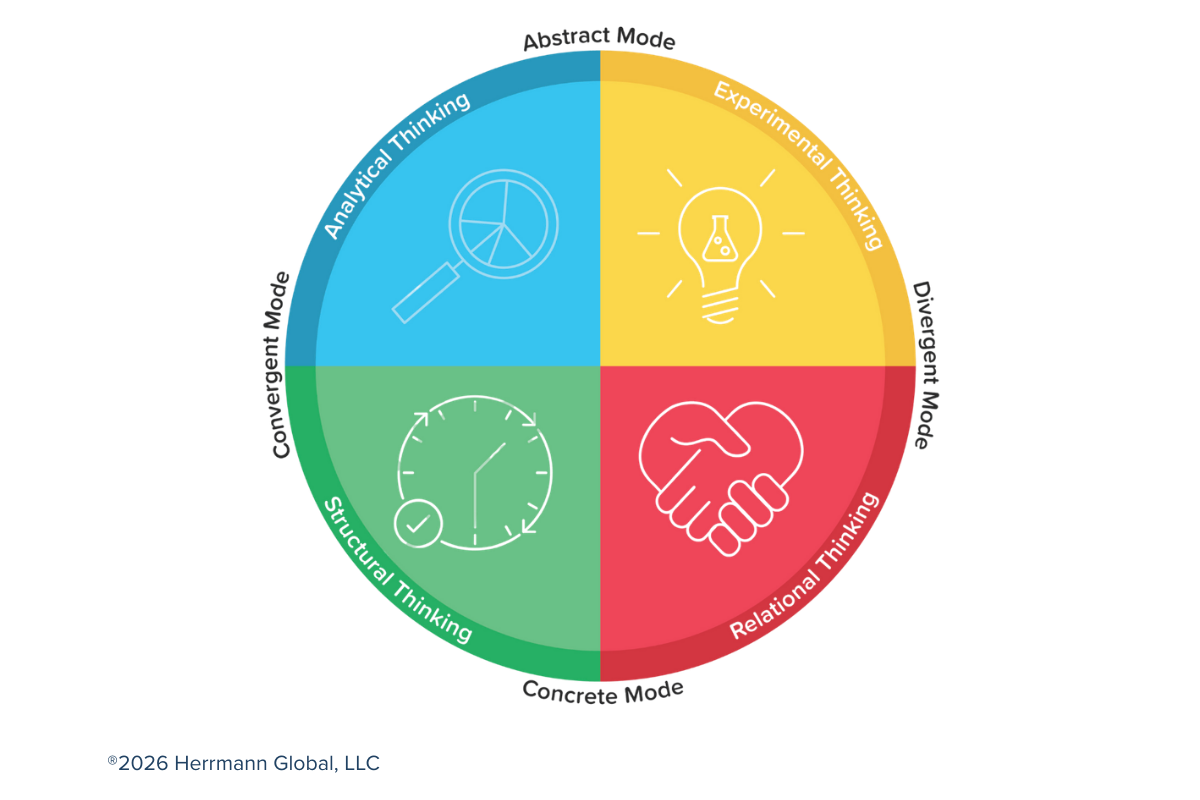
How the Four Thinking Quadrants Respond to AI Adoption
Analytical thinkers (A quadrant) want data. They'll ask: What does the evidence say about ROI? What are the error rates? These team members will adopt AI readily if you show them the numbers, but they may undervalue the relational concerns of colleagues.
Practical thinkers (B quadrant) want a plan. Their question is: How does this fit our current process? What's the timeline? They may resist adoption if the implementation feels rushed or the plan lacks detail.
Relational thinkers (C quadrant) want to know: Who is affected? Will people lose autonomy or status? They tend to signal early when trust is eroding, making them a useful early-warning system for rollout risks that data alone won't surface.
Experimental thinkers (D quadrant) want to explore. They'll ask: What else could we do with this? They're often the earliest adopters but may lose interest once the novelty fades, unless the rollout connects AI to bigger strategic possibilities.
Why Cognitive Diversity Determines Rollout Success or Failure
When a rollout team is dominated by one or two thinking preferences, predictable blind spots form. A team heavy on Analytical and Practical thinkers might build a technically sound AI implementation strategy that ignores the trust and communication gaps that cause adoption to stall at the team level.
Herrmann's own analysis of client rollouts suggests that organizations bringing a wider range of thinking preferences into AI adoption planning are roughly 20 times more likely to implement it successfully. That gap deserves precision, because it also marks the edge of what Whole Brain® Thinking can do here. It cannot tell you whether your rollout will succeed on its own, and it doesn't measure technical skill or capability. What it does is show you where your rollout team's thinking already clusters and where it doesn't, so a blind spot surfaces on paper before it surfaces as a stalled rollout. A team's footprint can flag that trust-building and long-term vision are underweighted; it cannot build that trust for you. The assessment tells you where to look. The work of looking, and the work of change, still belongs to the people running the rollout.
The Adoption Equation: Naming the Gap Before It Stalls Your Rollout
A useful assessment doesn't just flag that a rollout is at risk. It names which specific gap is producing that risk. Herrmann's Adoption Equation puts a name to what a working rollout needs to hold at once: Fluency (Analytical), Integration (Practical), Humanity (Relational), and Reimagination (Experimental). Skip any one, and a predictable failure mode shows up. It's Herrmann's own framework, drawn from patterns across client engagements rather than a single external study:
| What's missing | Failure mode |
|---|---|
| Fluency (Analytical) | Fumbling -- confident output nobody checks |
| Integration (Practical) | Evaporation -- enthusiasm with no process to hold it |
| Humanity (Relational) | Sabotage -- quiet resistance, workaround culture |
| Reimagination (Experimental) | Stagnation -- adoption stalls at "good enough" |
Each failure mode gives you an early warning sign to watch for: fumbling shows up as AI output nobody double-checks, evaporation as enthusiasm with no process to hold it, sabotage as quiet workarounds and disengagement, and stagnation as a rollout that plateaus at "good enough." Catching the sign early is what turns a name for the gap into a fix for it.
How to Build an AI Adoption Assessment for Your Organization
Before you assemble your assessment, name what you're measuring. A good AI adoption assessment doesn't produce a single readiness score. It maps specific gaps across technical, cultural, cognitive, and process dimensions so you can prioritize your next moves.
Step 1: Define the Scope and Stakeholders
Identify which business unit, function, or team the assessment covers. Map the stakeholders who will be affected by the AI rollout: executives, middle managers, frontline workers, IT, and any external partners.
Each stakeholder group brings a different set of concerns. Your assessment should surface those concerns early, before they become resistance.
Step 2: Assess Technical Infrastructure
Evaluate your data quality, integration architecture, security posture, and computing resources. Use a checklist format, but don't stop at pass/fail scoring. For each item, ask: If this is a gap, what's the cost of closing it, and who owns the fix?
Document dependencies between systems. AI rollouts rarely affect a single tool or platform. They ripple across your technology ecosystem, and gaps in one system can block adoption in another.
Step 3: Map Your Team's Thinking Preferences
Use the HBDI® (Herrmann Brain Dominance Instrument) to map the thinking preferences of your rollout team, key sponsors, and affected end users. The HBDI® generates an individual and team thinking preferences footprint that shows where cognitive clusters and gaps exist.
The HBDI® measures thinking preference, not competence. It won't tell you who is most technically skilled or best qualified to lead the rollout. It tells you how people are likely to approach the change, which is a different and complementary question, and one most technical assessments never ask.
This data tells you where your rollout plan is strong and where it has blind spots. If your team footprint skews heavily toward Analytical and Practical thinking, your plan likely underweights communication, trust-building, and long-term vision.
Individual contributors who want to put their own profile to work before the full team assessment wraps can start with Herrmann's Whole Brain® AI Playbook, which turns a single HBDI® profile into a personalized roadmap for using AI in a way that fits that person's own thinking style.
Step 4: Evaluate Leadership Readiness
Diagnosis question: "When your team expresses concern about AI, do your managers treat it as feedback or as resistance to overcome?"
If the answer is the latter, your leadership development approach needs to shift before the rollout begins. Managers who dismiss concern create an environment where honest signals go underground, and your assessment data becomes unreliable.
Step 5: Map Workflow Integration Points
For each workflow where AI will be introduced, document the current process, the intended AI-augmented process, and the specific changes each human participant will experience. Rate the complexity of each change on a scale from minor adjustment to full redesign.
The workflows requiring full redesign are where your cognitive and cultural readiness becomes most important.

Step 6: Score, Prioritize, and Build Your Roadmap
Score each dimension on a maturity scale (emerging, developing, established, advanced). Don't average the scores into a single number. Instead, use the gap pattern to build a prioritized roadmap. A high technical score combined with a low cultural readiness score is a specific pattern that calls for a specific response, not a "medium overall" rating.
Once you've scored your gaps, turn each finding into a specific, owned action rather than a general intention. Assign each gap a named owner, a concrete next step, and a deadline. "Improve culture" is not a roadmap item; "get the rollout team's manager to run a 15-minute AI Q&A at next week's standup" is.
Common Failure Modes in Enterprise AI Assessments
Before you finalize your assessment, it helps to name the predictable failure modes that derail enterprise AI rollouts. Each one traces to a gap that a well-designed assessment can surface early.
The Technical-Only Trap
The Technical-Only Trap is the most common failure mode in enterprise AI assessments. Your technical infrastructure checks every box, but adoption stalls because your teams don't trust the tools, your managers don't model usage, or your workflows weren't redesigned to accommodate AI-augmented decisions.
The fix is to build people and process dimensions into your assessment with equal weight. A technical readiness score of 9/10 means little if your cultural readiness score is 3/10.
The Training Trap
Your organization invests heavily in AI training programs. Completion rates are high. But tool usage plateaus after a few weeks because training taught people how to push buttons, not how to think differently about their work.
Herrmann's Whole Brain® Blended Learning approach addresses this gap by embedding cognitive resilience and thinking-preference awareness into the learning experience. The goal isn't just skill acquisition; it's building the cognitive agility to adapt as AI tools evolve.
The Consensus Trap
Your leadership team agrees that AI is a priority. But agreement at the top doesn't mean alignment in execution. When middle managers receive conflicting signals about priorities, timelines, or expected outcomes, they default to protecting their teams rather than driving adoption.
Your assessment should include a diagnostic layer that surfaces alignment gaps between executive sponsors, middle managers, and frontline teams.
The Measurement Trap
You measure what's easy to count: logins, feature usage, training completions. These metrics track activity, not outcomes. An AI adoption assessment should define the business outcomes AI is expected to produce and build backward from there.
Ask: What decisions will AI improve? What processes will run faster or with fewer errors? What new capabilities will your team have that they don't have now? Measurement that starts with outcomes keeps your assessment connected to business value.
How Whole Brain® Thinking Strengthens AI Adoption Assessments
Generic readiness frameworks assess what your organization has. Whole Brain® Thinking assesses how your organization thinks. That distinction determines whether your rollout plan accounts for the full range of human responses to change. It also marks the edge of what the framework can do: Whole Brain® Thinking maps how your team is likely to engage with change; it doesn't replace the stakeholder work, the plan, or the trust-building itself.
The Herrmann Platform gives you real-time visibility into your team's collective cognitive footprint. You can see where thinking preferences cluster, where gaps exist, and where your rollout plan needs deliberate reinforcement.
For example, if your rollout team's footprint shows sparse Relational (C quadrant) representation, you know that trust-building and communication planning are likely underweighted. You can address that gap before it surfaces as resistance three months into the rollout.
Key Metrics for Measuring AI Adoption Assessment Effectiveness
Your assessment is only as good as the metrics you use to evaluate its accuracy and impact over time. Track these categories:
Leading Metrics for Cognitive and Cultural Readiness
Track manager encouragement behaviors, team psychological safety scores, and the diversity of thinking preferences represented in rollout planning committees. These signal how likely adoption is to hold before you measure actual usage.
Lagging Metrics for Business Impact
Track decision quality improvements, process cycle time reductions, error rate changes, and new capability development. Connect each metric to a specific AI-augmented workflow so you can trace outcomes to the assessment dimensions that predicted them.
Avoid the temptation to report only aggregate metrics. Break results down by team, business unit, and thinking-preference composition so you can identify which conditions produce the strongest outcomes and replicate them.
Feedback Loops for Ongoing Assessment
Build quarterly reassessment cycles that revisit each dimension of your original evaluation. Cognitive and cultural readiness shifts over time, especially as teams gain experience with AI tools. A static, one-time assessment misses these shifts and leaves your rollout plan operating on outdated assumptions.
In Conclusion: How to Build an AI Adoption Assessment That Holds
The gap between AI deployment and AI-driven business results traces to assessment models that overweight technical readiness and underweight how people think, communicate, and adapt. Closing that gap starts with mapping the full landscape: infrastructure, culture, thinking preferences, leadership behavior, and workflow design.
Before you finalize your next enterprise AI assessment, map your team's thinking preferences with the HBDI®. The data will show you where your rollout plan is strong and where blind spots are forming. That is how you build an assessment that doesn't just score readiness but actually predicts results.
Individual team members who want a personal starting point rather than waiting on the full rollout can begin with Herrmann's Whole Brain® AI Playbook, which builds a personalized AI roadmap from one person's HBDI® profile.
FAQs About AI Adoption Assessments for Enterprise Rollouts
What should an AI adoption assessment include?
An AI adoption assessment should cover five dimensions: technical infrastructure, workforce capability, leadership alignment, organizational culture, and workflow integration. Evaluating only the technical dimension produces an incomplete readiness picture.
How does cognitive diversity affect AI rollout success?
Cognitive diversity determines whether your rollout plan accounts for all four thinking preferences -- Analytical, Practical, Relational, and Experimental -- in how people respond to change. Herrmann's Whole Brain® Thinking framework maps these preferences, helping you spot blind spots before they stall adoption, though the framework surfaces the gap rather than closing it for you.
Why do enterprise AI rollouts fail despite high training completion rates?
Training teaches button-pushing, not thinking agility. Herrmann's Whole Brain® Blended Learning goes deeper by embedding cognitive flexibility into the learning process, so your team adapts as AI tools evolve rather than plateauing after initial training.
How do you measure whether an AI adoption assessment is working?
Track leading metrics like manager encouragement and team cognitive diversity alongside lagging metrics like decision quality and process cycle times. Herrmann's HBDI® assessment gives you the baseline data to connect cognitive readiness to business outcomes.
What role do managers play in enterprise AI adoption?
Manager behavior is one of the clearest predictors of team AI adoption success. Managers who model AI usage, create space for experimentation, and treat team concerns as feedback rather than resistance tend to see faster adoption.
HBDI® and Whole Brain® are registered trademarks of Herrmann Global, LLC.
Share