

![Copy of [HG] FeaturedImage_Image_Template_Arrows (2)-1](https://www.thinkherrmann.com/hs-fs/hubfs/Copy%20of%20%5BHG%5D%20FeaturedImage_Image_Template_Arrows%20(2)-1.png?width=1200&name=Copy%20of%20%5BHG%5D%20FeaturedImage_Image_Template_Arrows%20(2)-1.png "Copy of [HG] FeaturedImage_Image_Template_Arrows (2)-1")
Most leadership assessments tell you what kind of leader someone is. Few reveal how that leader thinks when stakes are highest—and that gap is where strategic blind spots live.
Executive cognitive mapping offers a different approach: instead of categorizing leaders into fixed types, it makes the invisible thinking patterns behind strategic decisions visible, measurable, and actionable. This article explains what executive cognitive mapping is, why it matters for leadership development, and how it connects to measurable business outcomes.
Key Takeaways: Executive Cognitive Mapping in Leadership
- Executive cognitive mapping reveals the thinking preferences that shape how leaders make strategic decisions and where blind spots form.
- Leadership blind spots are not character flaws; they are predictable patterns that emerge when certain cognitive preferences dominate unchecked.
- Mapping thinking preferences across four dimensions provides a more actionable view than personality-type frameworks alone.
- Herrmann's HBDI® assessment provides a validated method for mapping individual and team cognitive preferences at scale.
- Organizations that surface cognitive gaps early in the strategy process reduce the risk of groupthink and poor execution.
What Is Executive Cognitive Mapping?
Executive cognitive mapping is a structured method for identifying and visualizing how senior leaders process information, weigh options, and reach strategic decisions. It focuses on thinking preferences, not personality traits, which means it captures the cognitive filters that shape what leaders pay attention to and what they overlook.
Traditional leadership models often describe behavioral tendencies: whether a leader is decisive or consultative, extroverted or reserved. Cognitive mapping goes deeper. It examines the reasoning structures behind those behaviors, revealing which types of data a leader gravitates toward, which risks feel invisible, and which perspectives are consistently absent from the decision-making table.
According to a 2025 study published in Administrative Sciences, cognitive biases such as illusion of control and overconfidence are among the most persistent distortions affecting strategic leadership decisions. Mapping these patterns proactively gives organizations a diagnostic baseline for addressing them.
Why Leadership Blind Spots Form in Strategic Decision-Making
Every leader has cognitive preferences that serve them well in familiar situations. An analytically dominant leader will naturally interrogate the data behind a proposal. A leader who leans relational will focus on stakeholder alignment and team readiness. Both are valuable orientations. Neither is complete.
Blind spots form when a leader's dominant thinking preference systematically excludes other cognitive dimensions. The analytically focused executive may dismiss emotional signals from the team. The relational leader may underweight financial risk. These are not failures of intelligence; they are the predictable output of an unbalanced cognitive footprint—the pattern of thinking preferences that shapes strategic behavior.
The cost is concrete. Teams led by cognitively similar leaders tend to converge on the same types of solutions, missing alternative approaches that a more cognitively diverse group would surface naturally.
How Executive Cognitive Mapping Differs from Personality Assessments
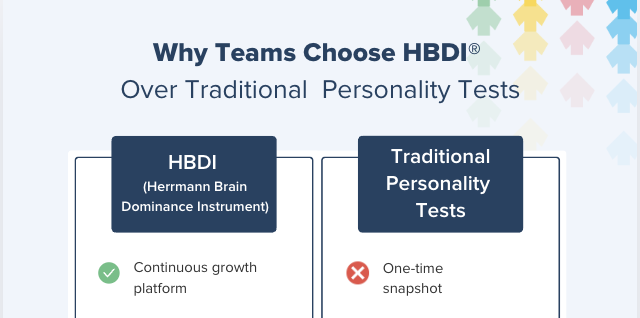
Personality assessments categorize leaders into fixed types. You get a label (introvert, achiever, influencer) and a set of behavioral predictions built around that label. These tools do useful work in self-awareness and team communication.
Where they fall short is in the domain of strategic decision-making. Personality types do not shift based on context. Your MBTI type is the same whether you are reviewing a budget, running a brainstorm, or navigating a crisis. Cognitive mapping, by contrast, measures preferences that are flexible and developable, capturing how someone thinks rather than who they are.
Herrmann's Whole Brain® Thinking model draws this distinction clearly. Rather than sorting leaders into a fixed type, the HBDI® assessment measures thinking preferences across four dimensions: Analytical, Practical, Relational, and Experimental. These preferences are not static labels. They represent tendencies that leaders can deliberately stretch once they become visible.
The Four Dimensions of Executive Cognitive Mapping
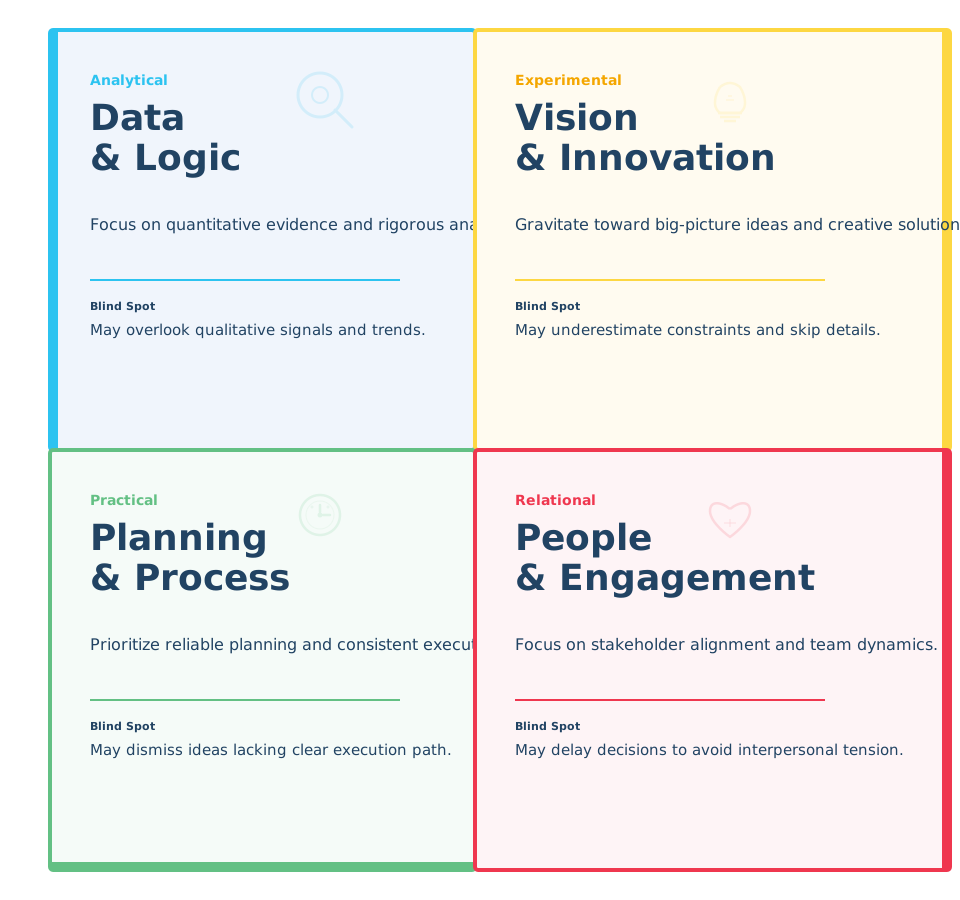
The Whole Brain® Thinking framework organizes cognitive preferences into four quadrants, each with distinct implications for strategic leadership.
Analytical Thinking (Blue Quadrant)
Leaders with a strong Analytical preference focus on data, logic, and quantitative evidence. The blind spot: they may undervalue qualitative signals or emerging trends that lack hard numbers.
Practical Thinking (Green Quadrant)
Practically oriented leaders prioritize planning, process, and execution reliability. They ensure strategies translate into operational reality. The blind spot: they may dismiss ideas that lack a clear implementation path.
Relational Thinking (Red Quadrant)
Relationally oriented leaders focus on people, communication, and stakeholder engagement. They read organizational dynamics effectively. The blind spot: they may delay decisions to avoid interpersonal tension.
Experimental Thinking (Yellow Quadrant)
Experimentally oriented leaders gravitate toward big-picture vision and creative problem-solving. The blind spot: they may underestimate operational constraints or skip implementation details.
How to Apply Executive Cognitive Mapping in Your Organization
Implementing executive cognitive mapping starts with a validated assessment of your leadership team's thinking preferences. The HBDI® provides this baseline by profiling individual leaders and then overlaying those profiles to reveal the team's collective cognitive footprint.
Once your leadership team's cognitive map is visible, three patterns typically emerge. First, you can identify concentration risk: areas where the team's thinking clusters heavily and where strategic perspectives are underrepresented. Second, you can pinpoint the decision-making gaps that contribute to recurring strategic failures. Third, you can design targeted development plans that build thinking agility across the team.
Herrmann's database of more than 4.5 million thinking-preference profiles provides benchmarking context for these assessments, so your team's cognitive map is not analyzed in isolation but against validated patterns across industries and leadership roles.
The Measurable Impact of Cognitive Mapping on Business Outcomes
Making thinking preferences visible does not just improve self-awareness. It changes how teams operate. Research on cognitive diversity in leadership shows that organizations bringing a wider range of thinking preferences into strategic processes are significantly more likely to implement initiatives successfully and adopt changes faster.¹
The mechanism is straightforward. When leaders see which cognitive dimensions their team over-indexes on, they can deliberately seek input from underrepresented perspectives before committing to a strategic direction. This is not consensus-building for its own sake. It is a structured method for reducing the risk that a critical variable goes unconsidered.
Manager encouragement of cognitive diversity drives measurable performance increases.² That multiplier reflects what happens when leaders move from acknowledging thinking differences to actively designing processes around them.
In Conclusion: How Executive Cognitive Mapping Strengthens Strategic Leadership
Leadership blind spots are not mysteries. They are the predictable result of unexamined cognitive preferences operating without counterbalance. Executive cognitive mapping gives you a structured, validated way to surface those preferences, diagnose where strategic thinking is concentrated, and build the cognitive diversity your leadership team needs to make better decisions.
If you want to see how your leadership team's thinking preferences compare against validated benchmarks, the HBDI® assessment maps individual and team cognitive profiles to the Whole Brain® Thinking framework, providing a concrete diagnostic starting point for addressing strategic blind spots.
FAQs About Executive Cognitive Mapping
What is executive cognitive mapping in leadership?
Executive cognitive mapping is a method for identifying and visualizing how leaders process information and make strategic decisions. It focuses on thinking preferences rather than personality traits. Herrmann uses the HBDI® assessment to map these preferences across four cognitive dimensions.
How does cognitive mapping help identify leadership blind spots?
Cognitive mapping reveals which thinking preferences dominate a leader's decision-making and which are underrepresented. When certain dimensions are consistently absent, specific types of strategic risks become invisible. Herrmann's Whole Brain® Thinking framework makes these gaps visible and actionable.
What is the difference between cognitive mapping and personality testing?
Personality tests assign fixed type labels. Cognitive mapping measures thinking preferences that are flexible and developable. The HBDI® measures how you think, not who you are, which makes the results directly applicable to strategic decision-making.
Can executive cognitive mapping be applied to entire leadership teams?
Yes. The HBDI® generates individual profiles that overlay into a team-level cognitive map. This team view reveals concentration risks and decision-making gaps that individual profiles alone cannot show. The Herrmann Platform supports real-time team analysis for ongoing leadership development.
How does Herrmann's approach to cognitive mapping differ from other assessments?
Herrmann measures thinking preferences across four validated dimensions using the HBDI®, which has been taken by more than 4 million people across 60 countries. Unlike personality-type tools, the Whole Brain® Thinking model treats preferences as developable, connecting them directly to strategic outcomes and team performance.
Share