

If your leadership team is currently meeting the "AI revolution" with a heavy, cautious stillness, they aren't being prudent. They are experiencing Change Paralysis.
Resilience in the workplace has always been a high-stakes requirement, but the nature of the pressure has shifted. In 2026, we are moving beyond the era where it meant simply enduring a temporary setback. When complexity scales exponentially, endurance is no longer a strategy. True resilience is now a specialized Thinking Agility: the ability to quickly and comfortably stretch beyond your default thinking preferences to adapt to new, often random, circumstances
The "Anticipation Machine" and Workplace Resilience
Your brain is essentially an "anticipation machine," constantly trying to predict the future. When the outcome doesn’t fit your mind’s predictive models, it creates a disconcerting feeling: Uncertainty.
Neuroscience research demonstrates that facing this uncertainty can feel scarier than actual physical pain. To cope, our brains employ "cognitive heuristics"—mental shortcuts that save energy but sub-optimize our ability to adapt during a crisis. We retreat into our most comfortable thinking "defaults" at the exact moment when leadership needs to be most agile.
Building an Agile Stance for Resilience in the Workplace
To foster genuine stability, leaders must adopt an Agile Stance—the mental equivalent of a tennis player swaying to be ready for a ball from any direction, at any speed. This requires a deliberate orchestration of four distinct cognitive perspectives.
The Whole Brain® Thinking methodology provides the framework to make these perspectives visible. It categorizes our thinking into four "Quadrants"—Analytical (A), Practical (B), Relational (C), and Experimental (D)—allowing us to map how an entire organization processes change:
-
Navigating the Analytical Gap: Resilience here requires moving beyond perfect data to achieve clarity of goals and stress-testing logic.
-
Overcoming the Practical Hurdle: Stability is regained through just-in-time planning and focusing on critical competencies to reduce noise.
-
Managing the Relational Strain: Resilient leaders must proactively address the interpersonal anxiety that surfaces when mental models are disrupted.
-
Clearing the Imaginative Fog: Break the need for knowing by embracing an experimental mindset—finding strategic opportunities in the unknown rather than fighting it.
/Infographics/Infographics_02-16-2024-03.png?width=1941&height=1676&name=Infographics_02-16-2024-03.png)
The Cognitive Resilience Compass: Your 10-Minute Cognitive Stand-up
Do you want to move the needle right now? While building long-term agility is essential, sometimes leadership requires an immediate shift in perspective to break a stalemate. Think of the Resilience Compass not as a heavy manual, but as a cognitive stand-up. It is a tactical map designed for ad-hoc stretches—providing twenty immediate actions to pull teams out of a 'cognitive comfort zone' in real-time.
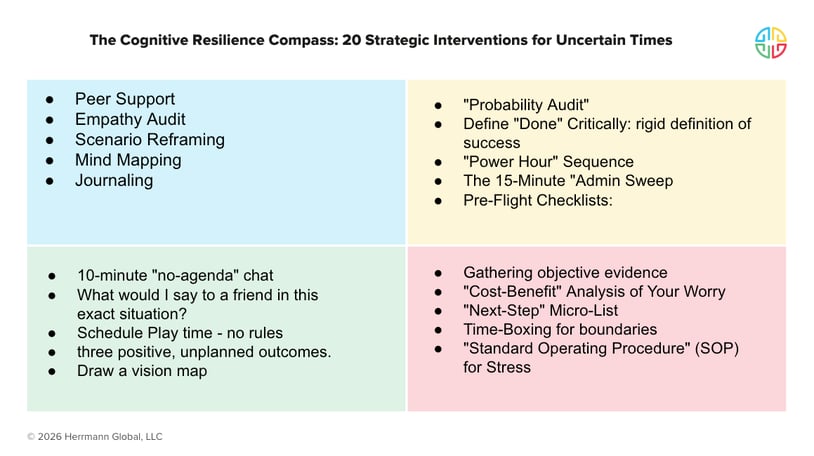
While every situation is unique, the highest-impact lever for shifting an organization out of a cognitive stall is stretching beyond our preferred thinking styles. These "antidotes" from the compass are designed to pull teams out of their comfort zones as a stand-up and help getting an ad-hoc stretch:
- For the Analytical (A Quadrant): Break the cycle of data-looping by using, for example, Journaling, Mind Mapping, or Cognitive Reframing to process the "unseen" variables and personal impact of a crisis.
- For the Practical (B Quadrant): Soften rigid processes with a 10-minute "no-agenda" chat, Scheduled Play time, or a Vision Map to address the interpersonal anxiety that surfaces when plans change.
-
For the Relational (C Quadrant): Stabilize emotional turbulence by Gathering Objective Evidence, creating a "Standard Operating Procedure" (SOP) for Stress, or using a Cost-Benefit Analysis of Your Worry.
-
For the Experimental (D Quadrant): Anchor big-picture ideas with a "Probability Audit", Pre-Flight Checklists, or a "Power Hour" Sequence to ensure that "what’s next" is actually grounded in a rigid definition of success.
These tactics are the practical application of Thinking Agility. They allow a leader to override the "auto-pilot" default and consciously move into a mindset that is ready for the future.
From Reactive Stretching to Strategic Orchestration
"Stretching" your thinking requires significant mental energy. If your leaders are constantly forcing themselves into non-dominant thinking modes just to survive the week, they will eventually face cognitive overload. You simply cannot manage what you cannot see.
To build sustainable resilience in the workplace, you must move beyond individual effort and begin leveraging the Cognitive Diversity already present in your talent pool.
The HBDI® (Herrmann Brain Dominance Instrument®) provides the opportunity to turn these internal differences into a strategic advantage. By gaining a precise diagnostic of the thinking preferences within your organization, you uncover the "hidden barriers" to your transformation. Often, a stall in momentum is a collective blind spot caused by single-mindedness at the top.
Is your leadership team optimized for the uncertainty of 2026? It is time to move beyond managing stress and start mastering thought. By fostering Thinking Agility, you give your organization the blueprint to not just endure change, but to thrive within it.
Take the Next Step
Stop the "auto-pilot" response to complexity. Equip your leaders with the cognitive tools to transform uncertainty into a competitive advantage.
Join Herrmann CEO Karim Morgan Nehdi for a live Power Hour to close your organization’s AI adoption gap. You’ll walk away with the practical knowledge and the complete Whole Brain® AI Toolkit to move your team from "Change Paralysis" to strategic orchestration.
Attend live and receive:
- Whole Brain® AI Playbook: A personalized roadmap for your thinking style.
- Ned.ai Meeting Decoder: A tool to decode communication patterns in real-time.
- Free HBDI® Assessment: A map of your own cognitive "operating system."
Date: Thursday, Apr 23, 2026 | Time: 12:00 PM EDT
Share