


To lead effectively in a landscape of constant disruption, a leader's most valuable asset is no longer their past experience, but their cognitive intelligence. While IQ is often viewed as a static measure of mental capacity, cognitive intelligence in leadership is dynamic. It is the deliberate ability to consciously shift how your leaders process information to match the complexity of the challenge at hand.
This is where the distinction between raw brainpower and applied intelligence becomes clear. While IQ measures the "engine," tools like the HBDI® (Herrmann Brain Dominance Instrument®) define the "operating system"—revealing a leader’s unique thinking style. Cognitive intelligence isn't about being "smarter"; it is about the awareness of one’s mental preferences and the agility to stretch beyond them. For HR and L&D architects, the goal is to move the leadership tier away from "cognitive entrenchment"—the habit of solving every problem with the same mental shortcuts—and toward a state of systemic Thinking Agility.
The Imperative: Why Cognitive Intelligence Matters Now
The shift toward cognitive-first leadership is driven by the increasing complexity of organizational life, exacerbated by the rapid adoption of AI. Strategic success is no longer about having the right answers—which AI can often provide—but about having the right thinking process to validate, direct, and integrate those answers. As traditional leadership skills are disrupted by structural changes, the primary differentiator for executive success becomes "Information Synthesis"—the capacity to pull fragmented, machine-generated data into a cohesive, human-centered strategic direction.
Leaders who can navigate multiple mental models significantly reduce the risk of "singular perspective bias," allowing them to identify market shifts and cultural frictions before they become entrenched crises. Ultimately, strategic change fails when leadership is cognitively rigid; Thinking Agility ensures that leaders can pivot their approach when the old roadmap—or the latest algorithm—no longer serves the objective.
Architecting Decisions: The Whole Brain® Walkaround
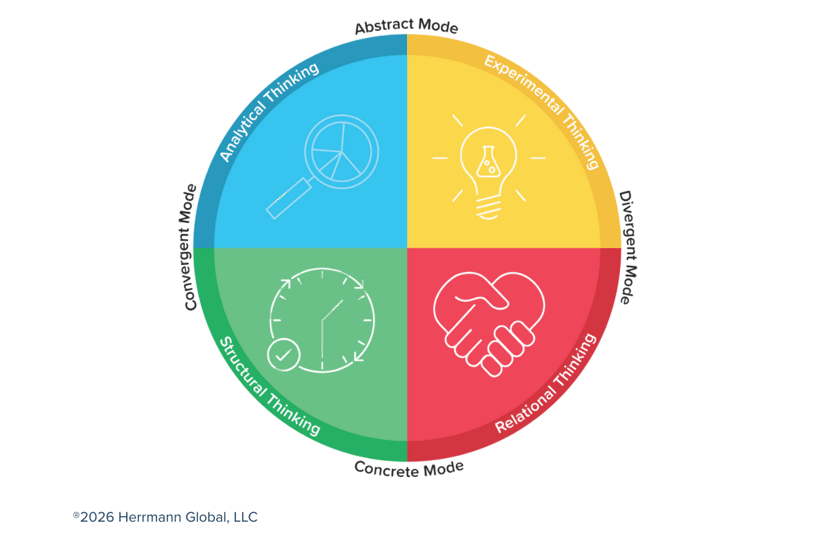
At its core, cognitive intelligence is about metacognition: the ability for leaders to think about how they are thinking. To make this manageable, the Whole Brain® Thinking framework categorizes our cognitive "operating system" into four functional quadrants: analytical, practical, relational, and experimental. High-stakes leadership requires a Cognitive Walkaround—a deliberate movement through these quadrants to ensure every strategic blind spot is addressed. By using the HBDI® to make these preferences visible, leaders can consciously "flex" their style to meet the specific demands of a challenge:
- Analytical (Logic & Data): Validating the objective "why" and data-backed reality to ensure logical buy-in.
- Practical (Form & Execution): Translating vision into a roadmap that provides tactical stability and structural integrity.
- Relational (People & Trust): Protecting the human element and maintaining cultural cohesion—the emotional resonance AI cannot replicate.
- Experimental (Strategy & Vision): Synthesizing emerging trends to ensure long-term, non-linear innovation and future-proofing.
In an era of AI, this walkaround acts as the essential human filter, ensuring that efficiency-driven data is balanced with ethical, practical, and visionary considerations.
Dismantling Strategic Thinking Traps
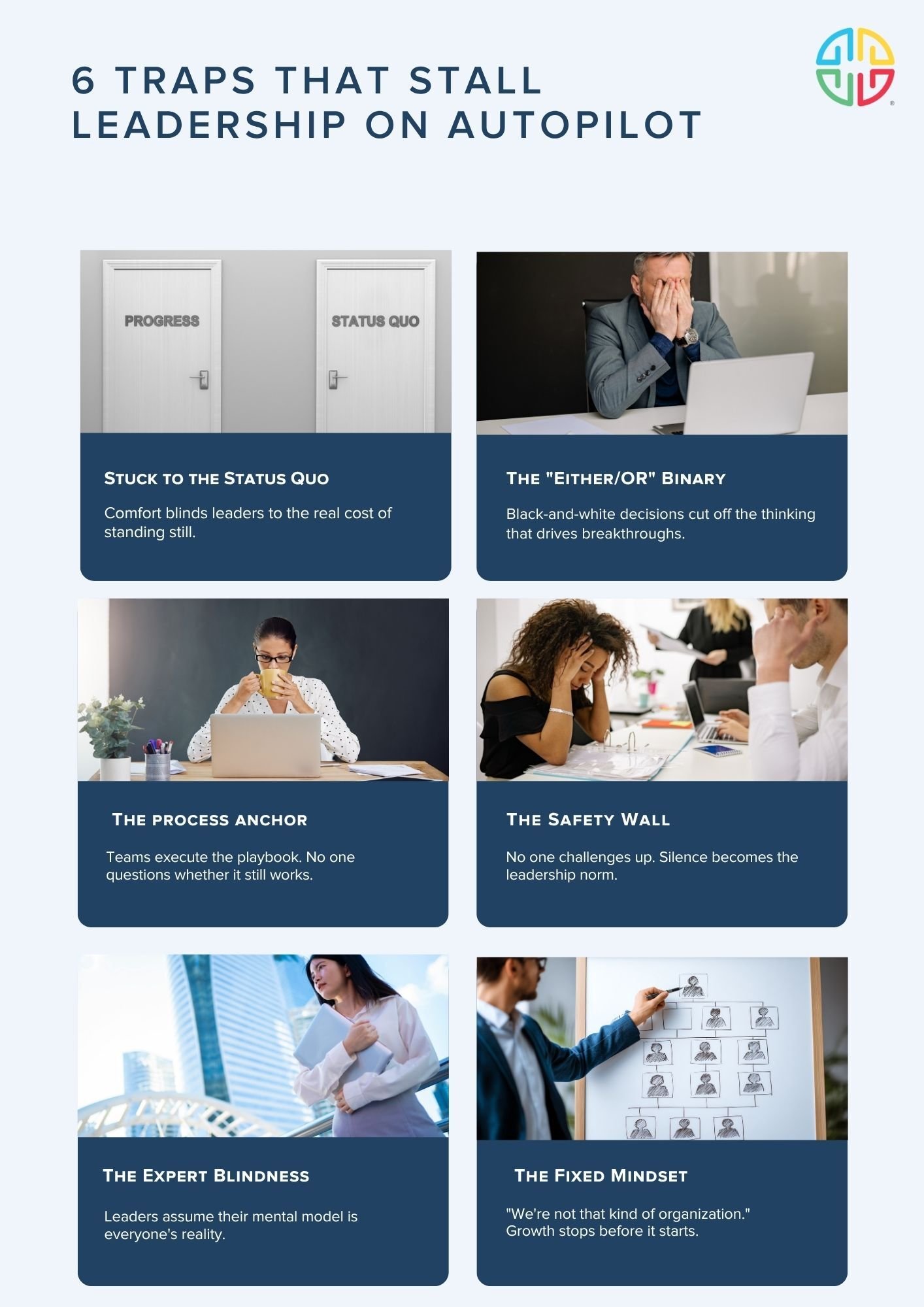
Cognitive intelligence is the primary tool for recognizing the Thinking Traps that keep leadership teams on "autopilot." These are systemic habits that limit a leader's ability to see the full picture:
- Stuck to the Status Quo: Structural comfort blinds leadership to the logical cost of stagnation.
- The "Either/Or" Binary: Falling into the trap of false choices—such as speed versus quality—instead of seeking an experimental synthesis.
- The Process Anchor: Relying on current practices and checklists without questioning if they still serve the objective.
- The Safety Wall: A state of cognitive silence or reluctance to speak up, often reinforced by "how we've always done it."
- Expert Blindness: Assuming a strategy is self-explanatory and failing to translate it for those with different thinking styles.
- The Fixed Mindset: Believing the organization’s identity is static, which shuts down growth before curiosity can even engage.
Bridging the AI Adoption Gap
Recognizing these traps is the first step. The real work is establishing a shared language to navigate them. While trillions are spent on technology, we rarely invest in the cognitive intelligence required to manage the "operating system" behind it.
Success depends on how well people understand the way they—and the AI they use—think, communicate, and make decisions. Making that cognitive intelligence visible provides the common language teams need for even the most advanced tools to gain real traction.
Join Herrmann CEO Karim Morgan Nehdi for a live "Power Hour" to get the complete toolkit for mastering this challenge. You will gain the critical knowledge needed to close the AI adoption gap, plus a $100+ suite of tools to make cognitive intelligence visible in your organization.
Attend live and receive:
- Whole Brain® AI Playbook: A personalized roadmap for your thinking style.
- Ned.ai Meeting Decoder: A tool to decode communication patterns in your room.
- Free HBDI® Assessment: A map of your own cognitive "operating system."
Date: Thursday, Apr 23, 2026 | Time: 12:00 PM EDT
Share