

.png?width=1200&name=Featured%20(1).png "two women sitting down and talking to each other, smiling.")
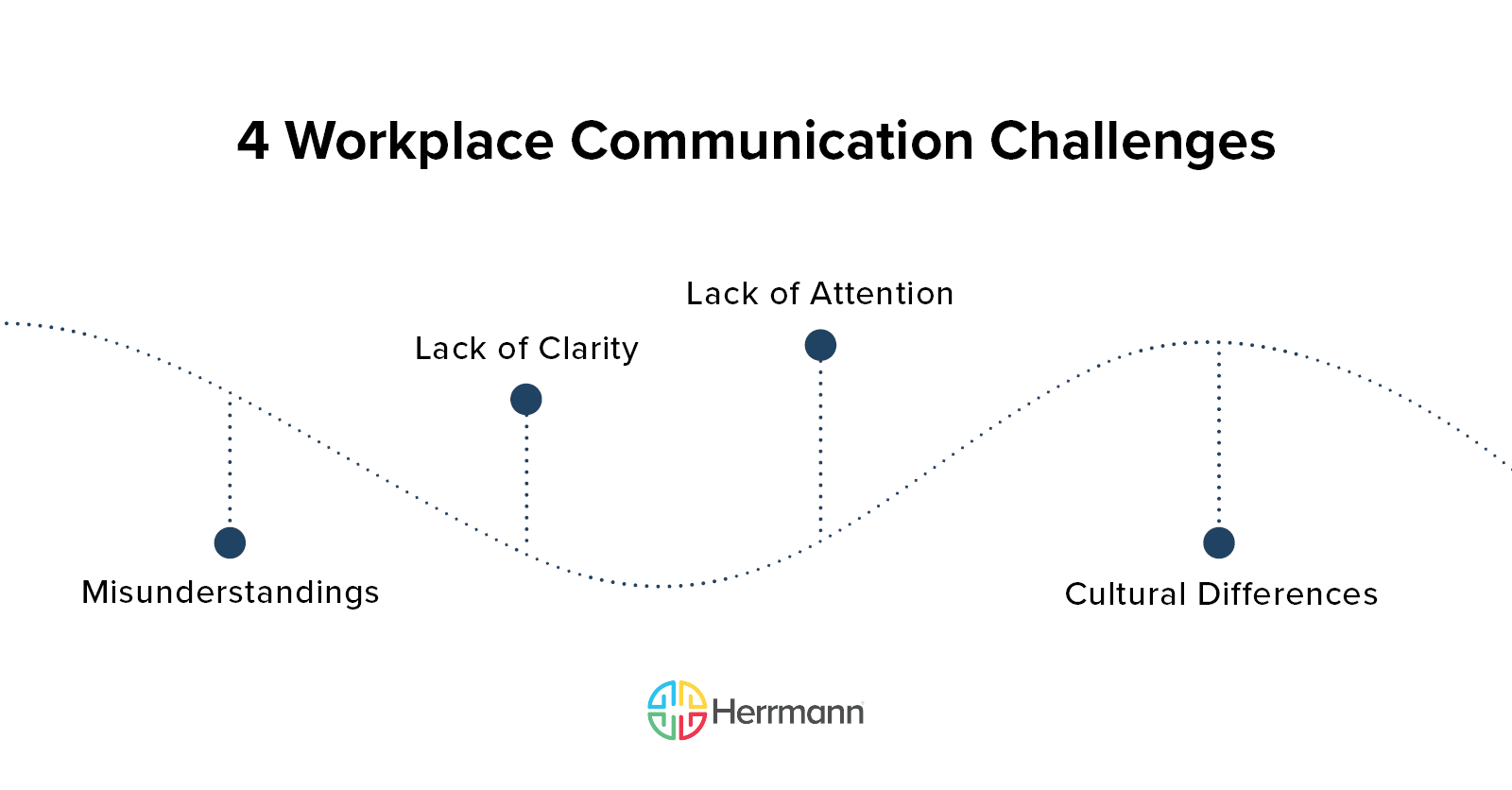
Communication challenges in the workplace are breakdowns that occur when colleagues process and express information in different ways. The four most common are persistent misunderstandings, unclear expectations, inattention, and cultural difference. Each has a cognitive cause rather than an effort cause, which is why general advice rarely resolves them. The fix begins with diagnosis: identifying which of the four thinking preferences described by the Whole Brain® Thinking model are mismatched, then adapting the message to reach all four.
Gallup finds that only 7% of U.S. workers feel strongly that communication in their workplace is accurate and open. That number has been stubborn for years, and the reason is that most organizations treat communication as an information problem. Send more updates, hold more meetings, write clearer emails. Herrmann’s database of more than two million thinking profiles, spanning over 800 job families, points somewhere else. The friction is rarely in how much information moves. It is in how differently people prefer to receive it.
Treat communication as a translation problem rather than an information problem and the four challenges below stop looking like separate issues. They become four symptoms of one underlying mismatch, and each one becomes fixable.
What Are the Most Common Communication Challenges in the Workplace?
Miscommunication is rarely a failure of effort. It is usually a mismatch between the way one person prefers to think and the way another does.
1. Persistent Misunderstandings: Misunderstandings persist when two people are working from different assumptions about what matters. Someone with a strong Analytical preference opens with the data and the reasoning. Someone with a strong Relational preference opens with who is affected and how they are likely to react. Both are communicating well by their own standard, and both come away feeling unheard. Technical jargon accelerates this, but it is not the cause. A preference is what a person reaches for first, not what they are capable of, so the resolution is not to change anyone. It is to make the missing half explicit: the Analytical thinker states the impact on people, the Relational thinker states the reasoning.
2. Lack of Clarity and Specificity: Confusion arises when expectations are pitched at the wrong altitude for the listener. A message that gives the vision without the steps satisfies an Experimental preference and leaves a Practical thinker with nothing to act on. A message that gives the steps without the reason satisfies the Practical preference and leaves the Experimental thinker unable to see why the work matters. Feedback then becomes difficult, because neither party can point to what was actually agreed. The resolution is to state both: what we are doing, and what it is in service of.
3. The Attention Gap: When people stop paying attention, they miss details and workflows loop back on themselves. In high-risk environments the consequences are more serious than rework. Attention is also where trust is built, which is why this gap damages relationships as well as output. What gets read as disengagement is often a preference mismatch in disguise. A long verbal briefing loses the Practical thinker who needs it written down. A dense written document loses the Relational thinker who needs to talk it through. The resolution is to deliver the same message in more than one form, rather than louder in one.
4. Cultural and Normative Differences: Background shapes what a person considers normal, direct or polite. Some teams and cultures value saying the thing plainly. Others treat that as abrasive and communicate through context and nonverbal cues. Neither is correct, and cross-functional work puts both in the same room. Thinking preferences sit on top of culture rather than replacing it, so the resolution is the same in both cases: name the norm out loud instead of assuming it is shared.
Why Generic Communication Advice Does Not Fix Any of This
“Listen more” and “communicate clearly” are not wrong. They are unactionable, because they do not tell anyone what is currently missing from their message. Advice that works has to be specific to the mismatch, and specificity requires diagnosis. That is what the Whole Brain® Thinking model is for. It turns a vague sense that “we are not communicating well” into a named gap that a person can close in the next email they write.
How Do You Fix Communication Problems at Work? 7 Effective Tips
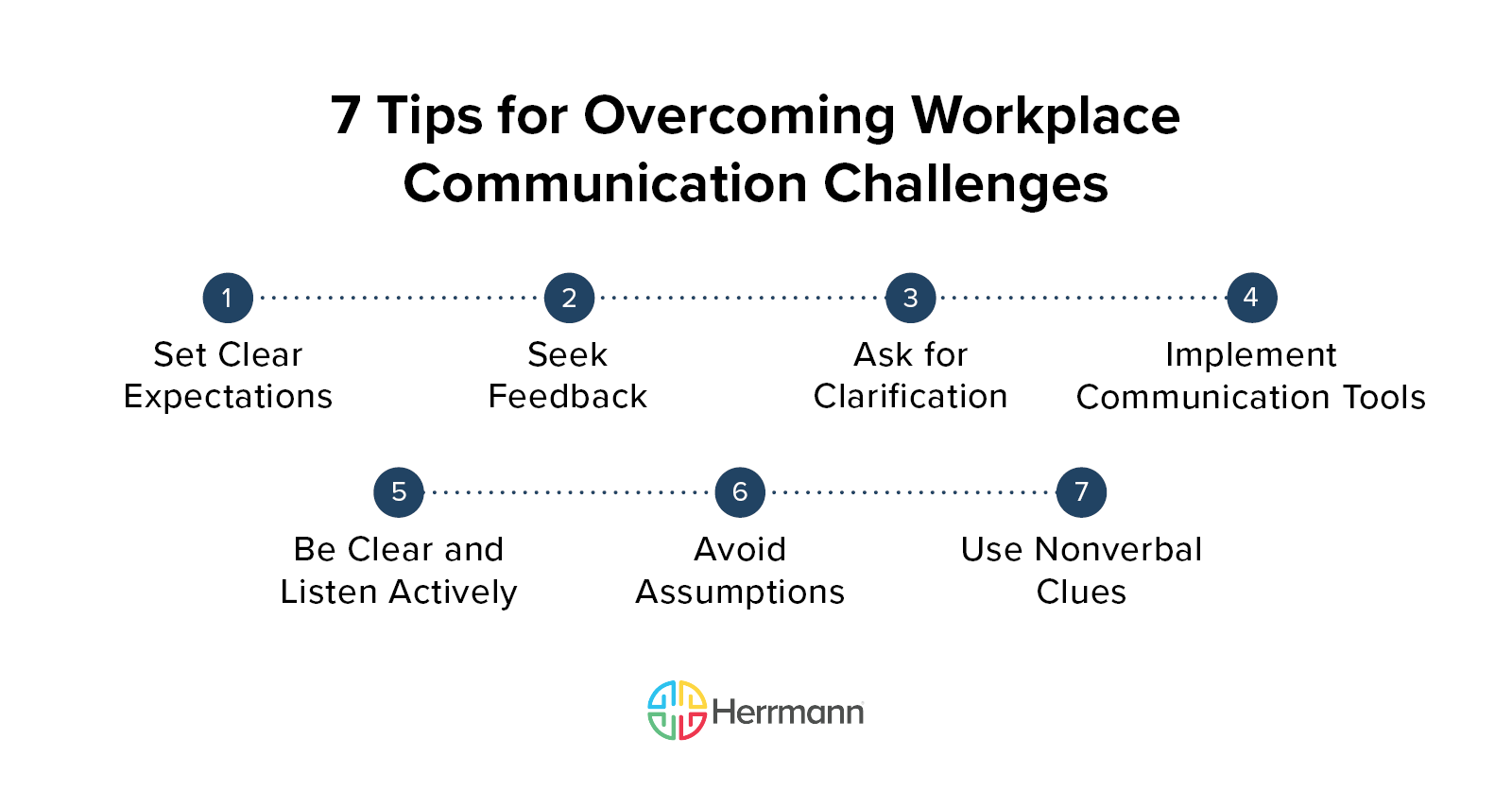
Seven shifts, ordered by how much they change. The first two are diagnostic and do most of the work. The remaining five are habits that hold the gains.
- Set Expectations Using Thinking Preferences, Not Job Titles: When people know how their colleagues prefer to take in information, they stop guessing. Sharing Whole Brain® Thinking preferences across a team creates a shared baseline: this person wants the numbers first, this one wants to know who is affected, this one wants the plan, this one wants the possibility. The HBDI® (Herrmann Brain Dominance Instrument®) gives that baseline a validated form rather than leaving it to impression, which matters most on teams that are new, remote or newly merged.
- Run a Walk-around Before Anything Important Goes Out: The Whole Brain® “Walk-around” is four questions asked of your own draft before you send it. What are the facts and the reasoning behind this? What is the plan, and who does what by when? Who is affected, and how will this feel to them? What is the bigger picture this connects to? A message that answers all four reaches the whole room. Most messages answer one, the one the sender prefers, which is exactly why they get read as unclear by three quarters of the audience.
- Ask for Clarification, and Make It Safe To: Build a culture where a question costs less than a wrong assumption. Managers should treat reduced engagement or a drop in output as a signal of confusion rather than of attitude, and should ask directly which part of the message did not arrive.
- Match the Tool to the Preference, Not to the Habit: Project management software gives structure. Video calls give connection. A shared document gives people space to think before responding. A whiteboard session gives room to explore. Each suits a different preference, and defaulting to one channel for everything guarantees that part of the team is always working uphill. Where HBDI® data exists, use it to choose the channel for the audience rather than for the sender.
- Listen for What Is Missing, Not Only for What Is Said: Active listening is usually taught as attention. It is more useful as diagnosis. If a colleague has given you the plan but not the reasoning, ask for the reasoning. If they have given you the vision but not the steps, ask for the steps. The gap tells you their preference, and it tells you what to supply next time.
- Replace Assumption With Curiosity: Everyone has quadrants they use less often, and those are where assumptions go unchallenged. Choosing to ask rather than to conclude is how a person works outside their own preference without pretending to have changed it.
- Read Nonverbal Cues, Including Your Own: Body language and tone carry as much as the words, and they are read most closely by colleagues with a strong Relational preference. Watch how your own cues are being received, particularly in the moments when you are most certain you were clear.
How to Tell Which Challenge Is Yours
The four challenges above look similar from the inside. They all feel like “we keep talking past each other.” They have different causes and different fixes, so the useful question is not how to communicate better in general, but which mismatch is costing you the most right now.
That is what a thinking preferences profile answers. An HBDI® profile shows an individual where their own defaults sit. A team profile shows where a group is collectively thin, which is usually the quadrant nobody in the room prefers and therefore the one that never gets covered in a meeting.
The Key to Communication That Works
Communication is not a problem that gets solved once. It is a standing condition of working with other people. The organizations that handle it well are not the ones that talk more. They are the ones where people understand how their colleagues think, and adjust for it without being asked.
Ready to communicate with every thinker?
Download Your Guide to Better Communication
Share