

Our creativity doesn’t disappear as we grow up. We’ve just learned to bury it.
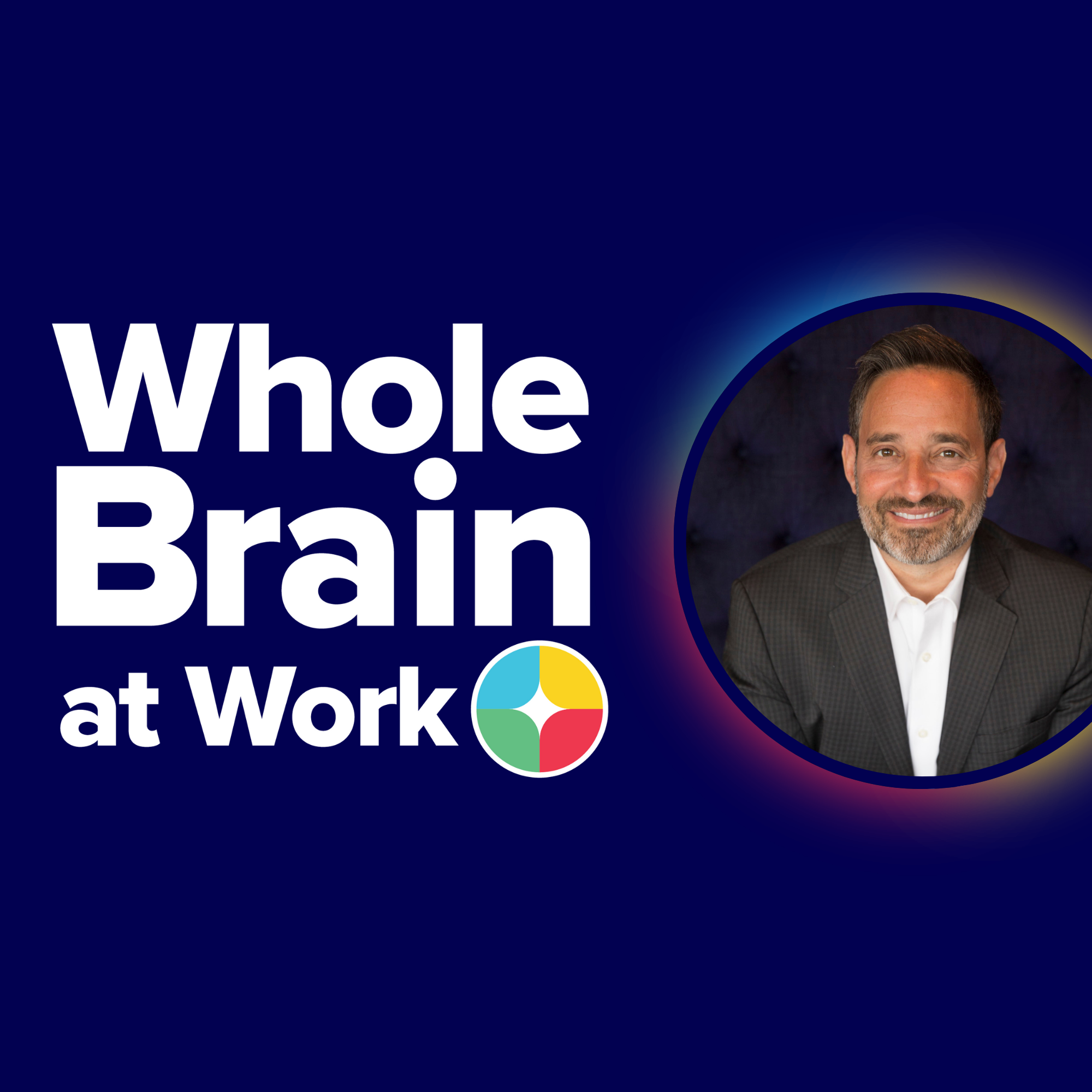
In this episode of the Whole Brain® at Work podcast, hosts Karim Morgan Nehdi and Ann Herrmann-Nehdi are joined by Josh Linkner, entrepreneur, bestselling author, and venture capitalist at Mudita Venture Partners.
They dig into why so many people mistakenly believe they aren’t creative, how fear quietly shuts down innovation, and the simple rituals leaders can use to help their teams generate more original ideas every day.
Why Fear Is the Enemy of Creativity
Have you ever caught yourself thinking, “I’m not a painter, musician, or illustrator. I’m not creative”? If so, you’ve absorbed the idea that creativity belongs to a select few. Josh categorically rejects that. “All human beings, and I mean all of us, we are built to be creative,” he says.
As we age, we’re conditioned to suppress that instinct through subtle punishment and fear of judgment. We stop coloring outside the lines and start playing it safe. But creativity shows up in everyday choices — how you solve a customer problem, redesign a process, or even arrange your living room — not just in traditionally “creative” jobs.
For Josh, the real barrier isn’t talent. It’s fear. When the environment feels unsafe, people shut down and stop sharing their best ideas. “Fear and creativity cannot coexist.”
When bold ideas are welcomed and smart failures are treated as learning, creativity starts to surface on its own.
Practical Ways to Bring Creativity to Life
Creativity doesn’t grow out of slogans or generic encouragement. It requires structure, ritual, and intentional practice. As a leader, part of your job is to signal that trying new things is expected, not risky.
Josh shares examples like “F-Up Fridays,” where team members talk openly about what they tried, what went wrong, and what they learned. It sends the message that “part of your job is to push the boundaries, that we have your back in both success and failure, that we understand there’s going to be some stumbles in order to unlock innovation.”
He also encourages replacing traditional brainstorming with rollstorming — generating ideas in character as someone else, from Steve Jobs to Yoda — to lower the fear of judgment and open up bolder thinking.
Another practical way to build a creative culture is through micro-innovations: small, frequent improvements that build creative muscle and stack up to meaningful gains over time. As Josh puts it, “These baby ones are much easier to get to. They build skill, they’re less risky, and they’re accessible to everybody in the organization.”
When you consistently reward responsible risks and small experiments, you make creativity feel accessible to everyone, every day.
Innovation Is a Team Sport
Innovation rarely comes from a lone genius. It most often emerges from collaboration, cognitive diversity, and the interplay of different perspectives.
Josh’s venture capital work reinforces this perspective. When evaluating startups, he looks less at the initial idea and more at the team’s adaptability and creative chemistry. “It’s the idea that leads to the idea that leads to another idea,” he explains, stressing that the capacity to evolve together matters more than a single starting concept.
Cognitive diversity is central to that process, and Josh points to practices like imbizo groups that bring together people with wildly different backgrounds and thinking preferences, so one perspective can spark another and solutions emerge collaboratively. “You put enough diversity in a safe environment, attacking a single problem, different lenses come into place, and ideas start to flow.”
Resources
Transcript
Transcript
Josh Linkner:
The number one blocker of creative output is not natural talent, it's fear. Fear is the poisonous force that robs us of our most profound ideas. And it's right, I'm simply put, fear and creativity cannot coexist. And so, I think it's a primary role of leaders today to be able to create environments that are safe, where all ideas are celebrated, the good, bad, the ugly.
Karim Morgan Nehdi:
Hi everyone, welcome to another episode of "The Whole Brain at Work Podcast." I'm Karim Morgan Nehdi. I'm a CEO, entrepreneur, investor, and scientist focused on how thinking impacts organizations and teamwork. And so, in my work leading Herman and also in building a new startup, Ned.ai, and also in working with thousands of leaders and teams around the world, I've gone pretty deep in understanding the interplay between how we think, how we work together, how we use technology, and especially as it relates to creativity.
As always, I'm joined by my co-host Anne Herman Netty, who is Herman's chief thought leader and chairwoman, and who for decades has worked with some of the most incredible leadership teams in the world to help them unlock their creative potential. And creativity is where we're going to focus today. Our guest today is Josh Linkner. He's a five-time entrepreneur whose companies have collectively generated hundreds of millions of dollars in value. He's the New York Times best-selling author of four books on creativity and leadership, a venture capitalist who's invested more than 100 early-stage startups, and perhaps most exciting to be a professional jazz guitarist. His work spans business, the arts, and philanthropy, all anchored by a deep commitment to unlocking human potential. Josh, thank you so much for joining us today.
Josh Linkner:
Thanks so much. Great to be with you both.
Karim Morgan Nehdi:
So, Josh, you said that everyone has untapped creativity regardless of role or background. What do you think helps people discover that spark for themselves?
Josh Linkner:
You and I share this passion for human creativity and I've been researching this for decades. The research is crystal clear that all human beings, and I mean all of us, we are built to be creative. Some might even say that's our calling, why we're even on the planet. I mean, the first instinct is to create more humans. I mean, that's a creative process. So, the thing about it is that many of us have unlearned that skill rather than developed the skill. It's been said that kids enter kindergarten with a full set of colorful crayons and graduate high school with a single blue ballpoint pen. It's not teacher's fault, by the way, teachers are heroes, but we have this dormant capacity, this natural part of who we are. We're hardwired to be creative, but we've been trained to suppress it.
We've been trained to think that wrongly. It only applies in certain roles or certain areas of life. The truth is it can apply everywhere. Every box on an org chart can apply in your family, in your community, with your kids, et cetera. There's room for creative expression. When you sit down and have a conversation with a friend, that's a creative act. When you are trying to reimagine where to put the couch in the living room, that's a creative act.
So, I really believe that we can all step into this notion that we're all artists. That doesn't have to be smug like wearing a beret and painting on a canvas, but the idea is artists challenge conventional wisdom rather than blindly comply with it, that they're willing to add an artistic or creative bent to things. I really believe that if we can bring that capacity out, unlock that dormant creative capacity, the world's a better place. So, I really feel like I'm on a bit of a mission or a calling to help people do that. There's eight billion people on the planet with dormant creative capacity, me included, by the way, and the more that we can help extract that, bring it to the surface and put it into use, there's a lot of challenges in the world, and I think we can solve many of them with this capacity.
Karim Morgan Nehdi:
That's so interesting, and it reminds me of a story that one of our clients at Pfizer told on a webinar we did with them not long ago, and this was within their supply chain part of their business, right? And in any pharmaceutical company, the supply chain unit, their job is to make sure that medicine gets from the factory to the patient without any quality issues whatsoever, right? So not what you think of as a typical creative field, right? And this was at a moment, not the current CEO, but a previous CEO did what so many CEOs, probably myself included, do, and they say from on high, thou shalt innovate, right? And so, the head of the supply chain group sort of said, okay, well, what the hell does this mean for us, right?
And had to start to figure that out, and they had been using our tools and whole brain thinking as a part of, you know, some of their work as an organization, and they used it to design what they called the innovator in you, which basically gave everyone within that supply chain unit from the person who's putting the medicine into the protective seal so that it gets from point A to point B safely to those who were really helping to manage some of the processes. It gave them the right, it gave them safety to be able to be an innovator and to find what innovation meant for them and to contribute ideas.
And so, they established change agents and created different activities, different environments, you could call them test kitchens within a pharmaceutical factory, at least, that were conducive to innovation. And within a very short period, they had unlocked millions in value just by saying, you're allowed to do this. So, it says to me that, you know, as Amy Edmondson and many others' research shows, psychological safety is so important about unlocking that creative potential.
Josh Linkner:
You're exactly right. So, the number one blocker of creative output is not natural talent. It's fear. Fear is the poisonous force that robs us of our most profound ideas. And it's right, I'm simply put, fear and creativity cannot coexist. And so, I think it's a primary role of leaders today to be able to create environments that are safe, where all ideas are celebrated, the good, bad, the ugly. Now, it's not throwing judgment to the wind. You're not going to do something inappropriate in real life, but it's willing to consider what's possible and provide that breathing space for your team.
And when you put people in the right conditions, because this is a natural thing, it blossoms naturally, kind of like a greenhouse. So, if your greenhouse is all toxic and has no sunlight or humidity, plants will die. You have a beautiful greenhouse that's equipped properly, plants will grow. Same thing for creativity. So that's, to me, one of the most crucial roles of leaders today is to create kind of that greenhouse that is conducive. Fear is removed, psychological safety is there, there's some space and time to apply creativity, and that will start to blossom naturally in a very beautiful way.
Ann Herrmann-Nehdi:
We all talk about, okay, take away the fear, you know, just go for it. But we know that enterprise cultures, that's kind of, that's really hard to actually create. So, I'm curious, from your experience, as you look at the leaders that you've worked with, the places that you've explored, you know, what are the things that leaders can actually do, like practically do, to get rid of that block? Because so many people come in with that built in, as like having grown up with it, right? And so, you know, they've got that baggage, so there's that unlearning that has to happen. So, what have you seen that really works practically for leaders? What can they do?
Josh Linkner:
You're so right. And by the way, cliches, I know you're recommending this, but you know, just go for it, you know, come up with ideas that never works, like that's a terrible approach. So, what is a good approach? Putting structure, tactics, and rituals around it. And I get, you know, we spend hours talking about it, but you know, I can give you one example. One of the people I interviewed in my most recent book, "Big Little Breakthroughs," is really, you know, incredible social entrepreneur, and he had this cool thing, and he's humming really well. I asked him at the end of my interview, how do you keep your team motivated? Like, how do you keep them creative once something's already working? He said, yeah, and without hesitation, he said, well, every Friday, we have something we call F-Up Fridays.
And he said, you know, he said the whole word, I'll be polite today, but what we described is that he brings the whole team together, and one by one, during a brown bag lunch, they each have to stand up and proudly share what they F'd up that week, and what they learned from it. Inevitably, you get to somebody that didn't F something up, and everybody's like, well, why not? What are you going to try next week? And so, this simple zero-cost ritual, think about the message that it's sending, that part of your job is to push the boundaries, that we have your back in both success and failure, that we understand there's going to be some stumbles in order to unlock innovation, we have a tolerance for it. So, it's sending all these great messages. Now, people have to do that exact thing, but I've been able to work with companies that have done corporate get-out-of-jail-free cards, encouraging people to take responsible risks, and you know, there's failure of the year awards that I've been a part of, and so, I think it's setting up rituals and rewards, even at a tactical level, you know, because that's such a good question, I just want to, you know, dig a little deeper. Brainstorming, which is generally the mechanism that people use to generate ideas, sucks. It's a out-of-date, flawed system to yield mediocrity. When you share an idea in a normal brainstorm session, you're like responsible for the idea.
So, if I share an idea, everyone else in the room becomes the self-appointed idea police, telling me why it's wrong, it's not going to work, the PowerPoint won't, you know, and then I'm sitting here, well, what if it doesn't work? What if I look foolish? What if I upset my boss? So, in brainstorming, you know, it just depletes the energy in the room. I've developed a whole series of techniques, I don't have time for them all, but one of my favorites is a technique called rollstorming, R-O-L-L-E. So, rollstorming is brainstorming in character. So, in this case, instead of you being, and like, imagine you're playing the role of Steve Jobs. Now, you're taking a real-world business issue, but no one's going to laugh at Steve for coming up with a big idea. They might laugh at Steve for coming up with a small idea. So, in this example, you are liberated to say anything you want with no fear of retribution.
And so, the way it's so simple, I love getting those little hello my name is stickers, and everyone can, I'm Ernest Hemingway, I'm a supermodel, I'm an athlete, I'm an alien from the future, I'm a villain, you know, but then you stay in character. I know it sounds really weird, but you will be blown away how effective this is. I did this once with a group of executives at Sony Japan. I met this man, he was the stiffest human being I'd ever met in my life. Dark suit, white shirt, his tie is strangling him. Anyway, we got him rollstorming as Yoda. And I've never seen personal transformation like this. This dude's jacket's off, his tie's undone, he's leaping around the room, and the whiteboards were filled with ideas. The truth is, I didn't teach him to be creative. He had that inside, as we all do. But the role he was in forbid it, and you put a little bit of structure around it, and he was able to take the lid off, and the ideas really started to fly.
Karim Morgan Nehdi:
I love that, and it mirrors so much of what we've seen around needing structured approaches to engage all the different types of thinking in ideation or, you know, what we traditionally call brainstorming. On your point about brainstorming suck, brainstorming sucking, I guess. You know, I think one of the things that's really interesting is that Alex Osborne's original rules for brainstorming are often ignored. Things like deferring judgment and going for quantity, all those go out the window, and you kind of get into a brainstorming, right? But we do the same thing where we try and use specific, often more brain writing techniques, where you're kind of doing individual ideation first, but where you're channeling different quadrants of thinking, different ways of thinking. So, you know, for the analytical type of thinking, how do you start to elicit and think through problem definition frameworks, right?
On the sort of the practical side of things, implementation and time boxing and some of those tools, as you said, in the relational side, empathy mapping, role playing, user journey thinking, some of those components. And of course, you know, there's the component of sort of the experimental big picture thinking, right? The what if sort of scenarios, but that's just one piece of it, right? And actually, Ned Herman, our founder, always liked to say that innovation is creativity with a job to do, right? And so, you know, all of those components come together to really make for successful innovation. And I know, Josh, you talk a lot about systematic creativity. Are there other routines or tools that you use to make creativity more a part of everyday work?
Josh Linkner:
Yeah, by the way, just a quick comment. I love that phrase. Innovation is creativity with a job to do. And that's exactly right. You know, creativity is just the expression of any net new idea. But to me, innovation, the difference is that there's some utility in that idea. So, I couldn't agree more. Yeah, you know, I think one thing that's helpful is just to frame it. So often people think of this word innovation as this gigantic, overwhelming thing with some minimum threshold. Like if my idea isn't worth a billion dollars, it's not innovative. And I think about it in a few different flavors. So, all capital letters, that word, all capital letters, that's the big stuff. Inventing penicillin or the internet. Awesome. And that's what gets all the headlines, but that's not the only flavor. So, then I think about that word just with a capital I and the rest of the word lowercase. Capital I innovations to me are the two or three a year that anyone might land on that maybe don't make a documentary about you and they don't make history, but they create a outcome.
And then my favorite is the all-lowercase version of that, which is the two or three a day instead of two or three a year. And so, I think about these as micro innovations. As mentioned, my most recent book was called "Big Little Breakthrough," same kind of thing. But the idea is that these baby ones are much easier to get to. They build skill, they're less risky, and they're accessible to everybody in the organization. So, my suggestion, you're asking about like, you know, what are some rituals? I don't suggest people say, how can I change the entire unit and galaxy with one big idea? You'd be scratching your head for a long time. The best way I like doing is chipping away at stuff with little ideas. And you're talking to building skill.
And so like, instead of saying, how can I solve this massive problem? How can I solve environmental change globally with one idea? Good luck. On the other hand, if you're like, could I think of 15 little teeny baby ideas that might make some teeny little small impact in environmental quality? That's a much easier problem to solve. So, the thing I like to do is take the stakes down. And then you start to create rituals around how can I come up with a higher volume of little baby innovations, rather than taking the weight of the world on your shoulders to come up with something gigantic.
Karim Morgan Nehdi:
Josh, I'm just curious, do you have any daily creativity habits?
Josh Linkner:
I do. Yeah, I actually narrowed it down. I spend literally two minutes a day, two minutes a day every morning. First minute, I consume the creativity of others. I'm a jazz musician.
So, I might listen to a Coltrane song. I might start a painting, read a poem out loud. Look at a cool business, by the way, doesn't have to be, you know, traditional arts, but I just sort of gets me anchored, and I'm getting in the zone, getting in the flow. And then the other minute, I do basically like creative jumping jacks. I take on an unrelated problem that has nothing to do with me personally, I don't have a stake in the outcome. And I just say the same thing, how can I chip away at it? So, for example, I know that traffic in Atlanta in rush hour is pretty bad. I don't live in Atlanta, you know, I have no stake in the outcome. So, my one minute might be, what are some ways that I could help reduce traffic in Atlanta in rush hour? Not solve it, reduce it. And so, by or like, how can I recruit the Olympics to hold the next event in the city of Detroit? Or you know, how can I improve the flow at a at a TSA line in an airport?
And so, what it's doing is not so much outcome focus, it's more practice focus is doing jumping jacks for creativity. And I literally spent two minutes a day took me longer than two days to explain it. But you do that for 30 days, blown away, you'll be blown away at the impact that creates.
Ann Herrmann-Nehdi:
I love that. It's just like a muscle, right? I mean, you really, really need to work it out. You know, I love "Big Little Breakthroughs," by the way, that was one of my one of my little feed the creative part of who I am by reading it, and getting so much validation of what we teach, but I am this idea of micro ideas, you're not just the moonshots. Again, people carry this baggage around, you know, oh, it can't be I can't have value unless it's big. What inspired that for you? And I, you know, how do you get everybody truly bought in where they're not just sitting there going like, oh, no, this is not, this doesn't have that much value. Nobody's going to think this is important, et cetera. Like, how do you get others totally bought into that? Because it's true. And I think, again, so many people are afraid to bring something up that might seem too small, or not really brilliant, et cetera. I'm curious how you help leaders kind of get to a place where they create that space where that actually happens.
Josh Linkner:
One of the things that really shocked me is that people didn't identify as creative, like even the companies that I was building, you know, some of the most incredibly creative, talented people, I'd be like, oh, you're so innovative. Oh, no, I'm not. I'm not a creative person. What do you mean? Oh, the creative set up on the third floor? What? What are you talking about? Like, like, you just solve this problem for a client? What do you mean? Oh, that's not creativity.
So, this is weird thing. And I was observing that people were sort of opting out of this label for some reason. And they tended to be really wildly creative people. And so, I started thinking that people had such a narrow definition of what is creativity, what's the minimum threshold, all that kind of stuff. And I said, well, you just did this, like, oh, you'd call that creative, but that didn't make a billion dollars. That's not exhibited in art museum. Yeah, but it was still creative, nonetheless. So, I just kind of came on that through observing brilliant creativity, and people not taking any credit for it. In terms of how you can drive that thinking in organizations. I think obviously, you know, if there's directive, or, you know, enthusiasm from leadership, that certainly helps, but doesn't always have to be top down. It can actually be bottom up.
You know, if someone is thinking like, I'm at the water cooler, my boss doesn't understand me, this darn company, they use the word they a lot, if they would only do this, and they would only do this. So, they're pushing away ownership. They may not have the authority to make a billion-dollar investment. True. But could they make a $5 investment in 10 minutes? And so, it actually is not only good for the organization, but it's good for the human being. Because now you're like, wow, I get to have leave my fingerprints on this, I get to have a voice. And so, the ideal situation comes from both top and bottom, and they sort of meet in the middle.
But a lot of it is stepping into new identity, which again, leaders can help and organizations like yours help a lot, which is that, yeah, you know what, I'm an artist. I can't paint, I don't do interpretive dance, I don't, you know, spoken word poetry, but I'm an artist. I'm a finance artist, I'm a customer service artist, I'm a sales artist. And so, the more that people can say, I can sort of own my ability to be creative, and then start deploying those skills, even in little baby ways, just the little steps, that it starts to build momentum, this natural groundswell happens.
I was, I made a comment in the book that Da Vinci's first painting wasn't the Mona Lisa. You know, and we think, oh, he just sat down and whipped out the Mona Lisa. Yeah, you know, years of learning to paint, and painting lousy things and making mistakes, and you know, little, and over time, you develop the skill to create the Mona Lisa. You don't start there. You start with those little baby ones and start to learn to paint and make it a habit. And so, the more that leaders can encourage that type of thinking, the more this beautiful gift will start to unfold naturally.
Karim Morgan Nehdi:
Josh, I'm curious, you know, I've seen studies that the majority of economic growth comes from incremental innovation, right, 77%. And I'm curious how you think about ROI as it relates specifically to innovation, like returns on innovation, if you want to replace the I, how do you think about that equation?
Josh Linkner:
Great question. There are some things that you can model directly, but there's also some of it's nonlinear, which is hard for the, I don't remember which color it is, but people who are super, you know, analytical and more literal to understand. But, you know, think about if you just bought a set of paint brushes for $11 and some paint for 38 bucks and a blank canvas for $86, and then, but that would be the incremental cost, you'd add it up, what's the total? Yeah, but if Picasso painted that, it'd be worth $150 million. So, there's a nonlinear jump when innovation or creativity is unlocked. You start to get to help convince people, you say, well, what's the risk of not doing that? Irrelevance, mediocrity, like how's Pan Am Airlines doing these days?
How are things at Oldsmobile? So, I think it's important to weigh the real risk of standing still, that's the trap that most people fall into, which is that they falsely believe that the status quo is safe, and it turns out often that's the riskiest move of all. And so the ROI calculation can come from something like, okay, I mean, you probably do this all the time, you might say, hey, if we generated 100 ideas in a company over a 12-month period, and they're focused ideas and properly bottled out and such, and let's say you group with them, let's say 50 of them worth zero, and then you got 50 left, and let's say you say, 30 of them, of the remainder are going to be micro, things that are practical, but not have a huge return, five are medium, and then five are really big. What's the, in a big company, what's the ROI assumption for a really big idea, a medium one and a small one? And then you can map it out and say, okay, our innovation investment this year was X, but even in these ratios, it turns out to be 30X. So, you can start to make a case pretty quickly, and then see if folks can get their arms around.
But I always like modeling just this bottoms-up thing. Like, okay, what if you can have a high volume of little stuff? And if you can make the case there, then you actually have optionality on the big stuff. Like if you never had a big idea, so what? There's still an ROI in the little stuff. And by the way, wow, what if one of those is a medium one? What if one of those is a big one? And then the finance people start to get their arms around it.
Karim Morgan Nehdi:
I'm hearing a little of the venture capitalists come out in here right now. You, Josh, that's interesting. But the notion of a portfolio of innovations, right, and those being big and small innovations routinely works better, right, than the one big move shot, right? So, I think there's a lot of weight behind what you're saying.
Josh Linkner:
It comes out not only in the direct revenue or profit from a particular thing, like a product, but there's also an internal ROI, because people are, you know, study after study, more engaged, more likely to stay at the job, more product, more productive. It's a great recruiting mechanism, it's a great retention mechanism, great morale mechanism. So, one of the things we have to consider is that the just mere expression of human creativity, because that's who we're built to be, validates people and gets them like a stake in the outcome, and they can leave their fingerprints on it. And so that is a big ancillary benefit on productivity, morale, engagement, et cetera.
Karim Morgan Nehdi:
So how does innovation and approaches to innovation, how does that influence the way you think about the startups that you invest in?
Josh Linkner:
Pretty deeply, actually, you know, our fund is called as I run a venture fund for that I was not as familiar with it, it's not huge about $165 million, where we invest in early-stage tech companies. It's called Mudita Venture Partners. Mudita is a Sanskrit term, which means taking joy in other people's success. So, by the way, when I look at the work that you've done, it fills me with joy. I'm not jealous, I'm just happy and proud for you. Like, it's awesome.
Karim Morgan Nehdi:
Yeah.
Josh Linkner:
So many venture funds are very ruthless and cutthroat, and we decided to do the opposite, which is, we're outcome focused, we're not soft, but like, we're doing it in a way of compassion and kindness and generosity as a force multiplier. And so, our fund, we first of all look at, you know, is there, if the company scales, is there going to be a positive impact on the world? And that's an important thing for us, you know, and if not, we're not really a good investor. But then we start to say, you know, how novel is the initial idea? But more importantly than that, how creative is the team? Because an initial idea, in my experience, is often wrong, it's short shelf life.
And that real growth often comes from taking an idea, and then like, it's the idea that leads to the idea that leads to another idea, and it's the ability to adapt innovatively over time, rather than just some giant lightning bolt from the heavens. And so, while we do evaluate initial business models and such, I'm really looking carefully at like, how is this team going to be able to co-create the future? How are they going to be able to adjust? Can they get into a state of collaborative flow? And so, I'm actually more evaluating the team than the idea.
Karim Morgan Nehdi:
Which makes a lot of sense. And especially when you think about the secret sauce in so many creative breakthroughs and innovations, it's not the result of just one person, right? Again, creativity, innovation, those are team sports, and having the right team together can bring out all the different nuances, all of the different small or micro innovations that are required to ultimately result in, you know, a larger breakthrough innovation.
So, I'm totally behind you on that. In fact, you know, our sort of philosophy with our new venture that I'm building at med.ai is in many ways actually a result of what you've got to refer to as the test kitchen approach that came out of years of working with Herman. And over the years, you know, we've done all this experimentation about how we might think differently about measuring the different ways that people think, right? And then how do we take little innovations in the way that we measure the differences in the way that we think and weave those differently into people's daily workflows to unlock more creativity or better results in this area, or that area. So, while we're on the test kitchen philosophy, I'd love to hear some of your favorite examples of how leaders have created sort of the right environments for low-risk creative experiments.
Josh Linkner:
Well, that is the notion of a test kitchen for anyone that hadn't read the book, which is that, you know, restaurants don't come up with a new menu item on a busy Saturday night. They have a separate space with some ingredients and equipment, and they sort of tinker. It's a tinkering lab in a safe, controlled environment where there's psychological safety, which we talked about earlier, et cetera. And that's what I find to be the best, you know, sort of rigorous sort of step-by-step path to innovation. It's not trying to solve some giant thing with perfection. It's what can you experiment? And it's just this notion of being a constant experimenter. I've learned that the best leaders are the best experimenters. The best innovators are the best experimenters. The best artists are the best experimenters.
And so, one of the things that I'll share that is a practical thing, Anne asked earlier about, you know, practical ideas. We all have a to-do list. I recommend, hopefully everyone after listening today keeps a second running list. Why not keep a to-test list? And the to-test list, any time an idea pops in your head, big, weird, small, half-baked, no judgment, stick it on the list. Here's the fun part. The mere existence of the list will boost your ability to be creative, because it's like a ongoing reminder. But then periodically, once a week or so, grab your crew. What am I going to test this week? You might test five things, and four automatically going to fail. Okay, so these are small, crude, cheap, fast experiments. You know, 20 hours and 20 minutes kind of stuff. If something shows promise, don't go wild. Just expand the size of the experiment. If it still looks good, expand the size of that experiment. And by the time you bring something to life, you've taken a massive amount of risk off the table. And it's just this very easy, safe way to bring things forward.
Just to share personally, I have, I mentioned my venture fund. I have a to-test list. I also am, you know, a writer, and I speak a lot. And so, I have a to-test list for that. I practice. I have investments in over 30 startups, active startups. I keep a second, a separate to-test list for each of them. I keep a to-test list for my home. I keep a to-test list for my marriage. I keep a to-test list for my family and kids. And so again, I'm always thinking like, oh, I could be in the car. What can I contest with this? I'll try to do this for bedtime with my kids or whatever. And it's just, for me, it's been liberating. I've been doing it for a couple years, actually several years now. And it's just a great way to bring ideas out of the ether and put them into action.
Ann Herrmann-Nehdi:
You know, one of the things that we focus on is bringing together the collision of different thinking preferences to create new thinking, right? And it's really that, and it often creates a bit of contention in a conversation, but it's also the beauty of difference coming together. And I guess one of the, you know, one of the things that we've always advocated is, you know, again, creating the openness to hearing something that is so totally foreign to how you think that you can actually take it in and do something with it. And of course, when you're in a group where everybody thinks the same way, that just leads you down a very specific path. So, I guess, you know, when you look at the examples that you've seen, how have you seen those differences? And you were talking about the importance of the team, and I'm right there with you. It's, that's the secret sauce is what's coming out of that team. It's rarely just one solo entrepreneur who's going to do this brilliantly on their own. And they often need different perspectives to actually make the venture successful. So, what in your experience, you know, how have you seen those different perspectives come together in a team and really work well to drive the kind of innovation that you want to have happen?
Josh Linkner:
You're touching on a topic that's really near and dear to my heart. And it's actually the topic of my next book. I'm just beginning. I don't even have a title yet, but the idea behind the book is, I'm sure you've studied flow state, which is this notion of really being in a creative state of flow. And by the way, that's not an on-off switch. That can be a continuum. So, you could be a little in flow, but what the idea is, you know, you're really getting creative. But so, I'm going to write a book. My forthcoming book is going to be about creative collaboration, collaborative creativity, or co-flow. You might say we are getting into a state of flow with others and really often, not always, but this notion of a lone genius is the source of innovation is more rare than you might think. Usually, it's a collaborative effort. You know, it's sort of like a band, even though there might be a lead singer that's on the cover of the album, it's really the band that came up with the ideas together and is bouncing ideas in this collaborative state of creativity. So, I think that is by way more powerful and more needed approach, especially as the stakes get higher with AI and competition and everything else. So, I'm really excited to get to bring that to life coming like in two or three years to a bookstore near you, maybe four, I don't know. We'll see a lot of research to do, but to answer your question, I've seen a lot of cool examples. One of them I've loved is I wrote about this in my first book, which is called Discipline Dreaming. It's a technique that was developed in tribal groups in Africa called an Imbizo group. What happened was historically, if they were trying to solve a problem in a particular tribe, they'd go to the chief and whoever had the most authority, you know, that would solve the problem, but didn't mean it was the best answer. So, they started doing the opposite. They would assemble this weird, diverse mix of people. They might ask a kid to join. They might ask a neighboring village person to join. They might ask someone who knows nothing about the problem to join. And the goal wasn't that one person would solve it. It's that one idea and perspective might lead to something else, it might lead to something else, and then the problem will be solved collaboratively. And so, the idea is, because you're exactly right, diversity drives innovation, full stop. And not only, I mean, all types of diversity, gender diversity, ethnic diversity, age diversity, racial diversity, education diversity, idea diversity, all diversity. And so, when I've done this, I do this for companies sometimes, we'll form an imbizo group. So, let's say you're working for a rental car company. Your first thing would be get a bunch of business people that rent cars and tell us what you need. In an imbizo group, you might get someone who's never been in a car. And then you might add a poet, and then you might add an industrial engineer, and you might add a, you know, a neuroscientist. And so again, it's the idea of you put enough different perspectives together, and in that cauldron, like in the martini shaker and start shaking, it's wild what comes out. And so that's one, you know, practical, that can be done very, you know, simply, by the way, but it's simply putting you put enough diversity in a safe environment, attacking a single problem, different lenses come into place, and ideas start to flow.
Karim Morgan Nehdi:
Well, I mentioned, I'm a big music fan, jazz in particular, I'm curious, tell me a little bit about how your musical background influences your approach to innovation and creativity.
Josh Linkner:
So, I started a company at age 20. I'd never taken a business course, didn't know anything about business. But I knew jazz, and jazz became an incredible business teacher for me, an entrepreneurial teacher. And it's just, I still am so passionate about the art form. I know not everyone loves listening to it, by the way, it's an acquired taste. I'm glad that you do. I heard a funny one recently that a country musician plays three chords to 100,000 people in the audience. Jazz musician plays 100,000 chords to three people in the audience. So, I get it. But jazz as an art form is exactly what we're being called to do in business. I mean, if you put the musical instruments off for a second, what is playing jazz? It's navigating ambiguity, uncertainty. It's situational awareness and active listening. It's getting into a collaborative state of creativity. It's passing the baton of leadership back and forth in real time. It's improvising to deliver the best possible outcomes. It's recovering quickly from setbacks. And that's exactly how leaders are being called to lead right now. And I'll also say that I think there's actually a fundamental shift happening right now in the world, probably because of AI, and there's other factors too. But in the past, great leaders were often great classical musicians. And I'm at the disparaging of classical music. I love classical music, but the world, many, not all, many classical musicians is to play the notes exactly as Mozart intended. So, they're wonderful technicians and they're following the process and they're doing the checklist and they're essentially performing somebody else's art. But now we don't have the luxury of sheet music. We're being called to perform at our best without all the notes in front of us. And so, we're on some random team with new people and we have to figure it out. And that's what jazz is all about. And so, I think that where people have relied on that, their training and the checklist in the past, that may not be enough to really soar in this current and future era. So again, I almost feel like there's this groundswell, like we have to become jazz musician leaders or business artists to meet the challenges of the day.
Ann Herrmann-Nehdi:
You know, it's interesting. Some years ago, I saw an ad posted that said, jazz piano lessons, a step-by-step approach to improvisation. And I think a lot of people want that step-by-step thing, right? And in today's environment, there's so much uncertainty. I mean, every leader that I work with is just overwhelmed by the degree of uncertainty. And you talk about that comfort with navigating the uncertainty, not having a sheet music. What can leaders do? How do they create a space where you can thrive in the uncertainty rather than having it shut you down? Because it's just another piece of the fear equation in my view. And I think it's one of those things that is creeping in to our world more and more every day. And even if somebody is pretty comfortable with new thinking, the uncertainty stuff just creeps in. So, what are your thoughts on that and how leaders can help there?
Josh Linkner:
Yeah, I mean, there can be rituals and rewards around it. I've seen people say that your bonus partly is tied to what you produced, achieved, but partly tied to how you failed. And say that, you know, he took some responsible risks. You can't just say, like, I tried something stupid. Like, you know, obviously, you have to have some good judgment in it. But people are rewarded for having, you know, thoughtful, good ideas. Their numbers made sense. They went for it, didn't work out. And so, rewarding that actually can create the sense that you're describing. You know, also, I think part of it is just this mindset shift that it really is incumbent on leaders to try to cultivate, where it's saying, okay, I want you to feel in a safe kind of jazz environment. And that's what's required for us to win. So, part of my job as a leader is to help you build the skills that are required for us all to win.
Karim Morgan Nehdi:
Thank you so much for taking the time today, Josh. It's been a great conversation. And for our audience, we'll make sure to link to Josh's book and website in the show notes and some of the great work that he's done, along with some of the different references that we talked about today. Thanks, everybody, for joining us for another great episode. And have a wonderful day to Josh and the rest of our team.
Josh Linkner:
Thank you so much.
Karim Morgan Nehdi:
Thanks, everybody, for tuning in. Catch you next time.
Mark Smith:
There is so much creativity in everybody's mind, you have to release it, and you will not release it if you have hour after hour of meetings, particularly at certain points in your life as well. If you have children, or grandchildren, in my case as well, you haven't even got the breathing space in the evenings or at weekends to think, it disappears. And you need that in work, you need time, and that's the thing we're losing.
Karim Morgan Nehdi:
Hi, everyone. Welcome to The Whole Brain At Work Podcast. I'm Karim Morgan Nehdi. I'm a CEO, entrepreneur, investor, and cognitive scientist focused on how thinking impacts management and organizations. In my work leading Herrmann and building a new AI startup, Ned.ai, and in working with thousands of leaders and teams around the world, I've become deeply invested in understanding the interplay between how we think, how we work together, and how emerging technologies are reshaping both. So that's what this podcast is all about
Ann Herrmann-Nehdi:
And I'm Ann Herrmann-Nehdi. Today, we're diving into a topic that I think triggers instant PTSD for most knowledge workers today, and that is the topic of meetings.
Karim Morgan Nehdi:
That's right, we're talking about the $37 billion productivity crisis that's hiding in your everyday calendar.
Ann Herrmann-Nehdi:
Dr. Mark Smith is the founder of Meeting Canary, an AI-powered tool that tracks participation patterns, calculates real-time meeting costs, and nudges teams towards better collaboration. Mark, welcome to Whole Brain At Work.
Mark Smith:
Thank you, Ann. Thank you, Karim.
Karim Morgan Nehdi:
So Mark, tell us a little bit about Meeting Canary. What is it?
Mark Smith:
Meeting Canary is an app you can download from the Teams App Store. It provides physical presence inside your meetings in the form of a canary. The canary displays various animations depending on what it's seeing and hearing in a meeting, and we also provide a sidebar as well, which shows who's contributing, who isn't, how much a meeting is costing, and measures such as focus, energy, inclusion and respect, and those sorts of things. After the meeting's closed, we produce summarizations and action points, which end up in the chat of the Teams Tenant, so nice and secure, and a very comprehensive report about what happened in that meeting and who said what to whom, and there's various things which help make your meetings better.
Karim Morgan Nehdi:
And tell us, how did you come up with the idea for Meeting Canary?
Mark Smith:
It has all sorts of advantages with it, but it's basically a career's worth of irritation about the increase in the amount of meetings that have occurred and the impact that's had on creativity, innovation, and progress. So it's a reaction to declining productivity, that's what it truly is.
Karim Morgan Nehdi:
Let's start with the big picture, Mark. You've built a technology that holds up a mirror to our meeting culture. When you see organizations seeing that data about how much time and money they're spending in meetings, 23 hours a week in meetings, 70% rating them as unproductive, $8 million lost per 1,000 employees, what's their reaction? Do they laugh? Do they cry? Do they go into denial?
Mark Smith:
I think mostly they're horrified. People often arrive horrified, having worked out the size and scale of the problem they face. I think what we can do is also quantify that problem for them as well. All of us experience the same problem with online meetings. Everyone feels the problem is huge, but unlike so many other parts of business, no one knows exactly how big that problem is. The analytics are not there. Initially, it's either horror at what we show them is the problem, or recovering from the horror they already know, and then want something that can solve that problem. And that's where we come in, because you can't manage what you don't measure. This world has been in an unmeasurable context for many years, and what we're trying to do is simply analyze and present. We're the messenger, if you like, of the problem.
Ann Herrmann-Nehdi:
Oh, I love that analytical, very precise response to such a visceral problem, Mark. From a whole-brain perspective, though, I imagine different people react differently to that data, so if you're more analytical, it's like, "Oh, finally somebody's got some numbers to explain what I've known to be true," right? Have you noticed any patterns in how different types of leaders or team members you've talked to about this respond to that data?
Mark Smith:
I think the most quantitative individuals I work with, and bear in mind I've been running software firms most of my life, they tend to be, broadly speaking, in that area. They are relieved to recognize what the problem is, and then sometimes jump a little bit further forwards than one might hope they would. I'll give you a very specific example. One of the things we try to do with Meeting Canary is have a whole bunch of metrics that we group together in things like focus, energy, respect, inclusion, and those sorts of words. There are all sorts of different measures that we put together and weight accordingly to give scores.
Now, one of the things we noticed early on, it's not fair to start measuring focus until such time as a meeting has started. Small talk occurs at the start of meetings, so we make this very human attempt to learn something about each other in order to have a better or happier experience. Now, you can get different types of answers to what you should do with that information. At the extreme end, you'll get the brilliant, "Let's never do small talk ever again, because they can save us 10% of all meeting time." That's not great. But equally, you have people at the other end thinking that it's perfectly okay to have small talk and then perhaps return to those subjects at the end. The types of thinkers affects the interpretation of the data, which is itself fascinating.
Karim Morgan Nehdi:
I want to dig into a little bit of how we got here. I've heard you talk about work from home, and many have mentioned that work from home is the inevitable way forward, but that's created some unique challenges for meeting culture. Pre-pandemic, we had natural friction. We had to book a room, and there was travel time between meetings and physical movement that created some sort of a boundary. How has the shift to click a link and you're in another meeting change things?
Mark Smith:
I think there is a challenge with the working from home culture. I, however, think that it's not a coincidence that in many advanced economies there has been a steady decline in productivity over the last 20 years or so. I don't think it's coincidental during that period, there has been a dramatic rise in the availability of collaboration tools. I don't think you can absolutely prove it, but instinct says if you are taking up three-quarters of my available time by talking at me in lengthy meetings, that is going to have a significant impact on productivity. My personal motive is to give people their time back so that they can think.
I was likening my career to a week, so measured between Monday and Friday. Now, bear in mind I'm about Friday morning. That's where I am in my career if a week is an entire career. So what I've noticed back on Tuesday or so, there was quite a lot more time in business. And work is not just about the grind, it's about the pause and the thinking and the talking to individuals. And I think working from home is brilliant. I've done it all my life, I love it. But not if the working from home is filled with unnecessary meetings. Excessive meetings are reducing productivity and kiboshing innovation, in my opinion.
Karim Morgan Nehdi:
So what you're describing in economic terms is effectively a transaction cost for meetings that has risen dramatically post-pandemic.
Mark Smith:
Absolutely. It's crazy. As I look back on last Tuesday when I was early career, to set up a meeting was a proper pain. I mean, you had to speak to a chairperson, you had to get agendas together, you had to get notes before a meeting, you had to write to people. Now that's gone.
Ann Herrmann-Nehdi:
This concept of transaction costs is really fascinating. Let's take away the natural barriers. Have you seen differences in meeting patterns between startups versus large corporations? I'm imagining that startups might typically have totally chaotic, everyone and everything kind of meetings that work great for those experimental thinkers that we know about, but that absolutely torture the more practical, processor types who need some structure. What have you seen?
Mark Smith:
I think there is a massive cultural difference in the way people engage in startups, and I find that the most exhilarating part of business. When you have so many unknowns, you have so many challenges to overcome, it's just exciting and your mind fizzes with all the possibilities, but also all the hurdles that you have to overcome. So I think it is a little bit more chaotic. I think in larger organizations, you get a lot more rules and regulations, and a lot more unionization as well. So we're working with companies in Europe where the attitude towards the workers' council or the union may stop us from being able to do what we're doing, because, "Hold on, you are monitoring us."
I still think in both cases, too many meetings happen, and that reduces the amount of time you have to literally think. There is so much creativity in everybody's mind. You have to release it. And you will not release it if you have hour after hour of meetings, particularly at certain eight points in your life as well. If you have children, or grandchildren in my case as well, you haven't even got the breathing space in the evenings or at weekends to think. It disappears. And you need that in work, you need time, and that's the thing we're losing.
Karim Morgan Nehdi:
So you've observed, as have I, that many organizations have consciously or not, optimized their meeting culture for actually less-effective thinking. I remember reading some research from Microsoft that shows there are interruptions every two minutes or so. I feel it myself, the urge to jump in with an idea or contribute a thought, sometimes to the point where it interrupts my ability to actually process what's being said. And Stanford says that it takes 25 minutes to recover from each interruption.
Mark Smith:
Yep.
Karim Morgan Nehdi:
How do you think this constant cognitive fragmentation is impacting our brains?
Mark Smith:
The very fact that you are advised now to get your ideas across in under 10 seconds on certain social media platforms troubles me. On a serious note, I started work quite a while ago, so burnout wasn't a phrase that was used very much. I don't doubt that it existed, but it didn't seem to exist in any way near the levels it does today. And I do put that down to the constant bombardment. Just remembering the channel through which someone communicated with you these days is a challenge, right? I don't believe that's an age thing. It's become very complicated and it's not doing us any good. I don't think we are having the breakthroughs that we would have if we weren't doing this nonsense.
Ann Herrmann-Nehdi:
I think it'd be interesting to dive into what Meeting Canary actually reveals, that your technology tracks speaking patterns, interruptions, interaction dynamics. I've seen Karen Snyder's research from her original 2014 study showing men interrupt women 33% more than other men. I've experienced that myself. And that women speak only 25% of the time in mixed-gendered meetings, yet are perceived as dominating at just 38% of participation. So what patterns have surprised you most in looking at your data?
Mark Smith:
Patterns that have surprised me? I'll return to small talk. Small talks are interesting, because for the first time, I suspect ever, we can show small talks' duration as impacted on by late arrival. Will have experienced it this week where you are in a meeting. Someone said to me, "Oh, we've just got to wait for Paula to join the meeting." So, small talk goes on. And that's surprising, no. Proving the cost of that really interesting, because you can actually quantify the impact of late arrival. So you can actually say, "The impact of this across a company that employs 10,000 people is X million dollars a year." The surprising outcome may well be to encourage people towards better behavior because it's better for the company. That's one thing that's surprised me.
Video usage puzzles the hell out of me. I cannot understand why people with the wonder of the technology available to us are simply refusing to shut their faces. And there's a deeply cultural things there it seems as well. We have a lot of users in Southeast Asia and the use of video is very rare. That, video off and just listening, well, it's no different from 40 years ago. It was a collaboration. So it was really odd, actually. So, lots of little patterns of data which are intriguing us.
Ann Herrmann-Nehdi:
Fascinating.
Karim Morgan Nehdi:
That's really fascinating, Mark. And you've done some really interesting research on different meeting types as well. I'm curious how you've seen different meeting types impact participation patterns?
Mark Smith:
There's enormous research into the types of meetings that occur. There was a lovely piece of work done by, I think it's Lucid. He may be of Lucidcharts fame, who've come up with this wonderful matrix. 16 meeting times they've picked out. I think that's too many, it's too complicated. But for us, certainly the measures that we're making are dependent on the type of meeting that's occurring. For example, if you have a brainstorming meeting and you have 10 people in that meeting, you would expect, you would hope, there will be a contribution from everybody. Now, if you had a meeting where someone was presenting, you would hear a lot more of a single voice and very little of other voices. So in the context of measuring things like participation and inclusion, the latter example needs to be weighted differently from the former example, because you would expect to have one person dominant. In the first one, the brainstorming, you shouldn't, perhaps. But in the second one where it's a presentation, you should.
So we are cognizant of the meeting type and can make certain adjustments. If somebody is presenting, we change the way that we make certain calculations because that is a pretty clear indication it's going to be one voice followed up by other voices later. But what we need to do, and we're not there yet, is we should be divining from what's been entered, what meeting type it is to begin with, and that's going to affect the metrics you make. So that's meeting types. Now, hybrid meetings, that is a challenge, and I think your psychology background is going to be a lot more useful than mine. I can only give you a technical reason why that's so difficult. The explosion in the ability for us to do what we do is the consequence of the opening up of APIs and products like Teams and Zoom, which only happened relatively recently. You combine that with the quality of transcription services, and then you have this dream ability to take the individual streams of audio that are coming in from Mark or Ann or what have you.
And you can quite accurately attribute the words said by Mark, the words said by Ann, and you can also see where those words clash. When you have a hybrid meeting where one of the squares is four or five people, you then have the challenge of interpreting who they are, because it might just say Conference Room One. And the sorts of ways of doing that, voice signatures, asking people to say their name, it's possible to do it. We've got quite a lot of work at the moment. Now, where we have nothing to contribute yet is the psychology of those outside the room versus those inside the room. So I can only ever speak on that on a sort of anecdotal basis, where my experience is when you have a group of people in the room and there's a handful elsewhere, you tend to forget them. It's really easy to just ignore unless they're the CEO. It's quite easy to forget those people outside the room.
Ann Herrmann-Nehdi:
From a whole brain perspective, I'm curious if you see meetings favoring more verbal processors, for example, over visual thinkers, or quick responders over more deliberate processors, sort of styles over collaborative ones. Are we systematically excluding certain types of cognitive diversity in the way meetings happen? What have you seen so far?
Mark Smith:
My instinct is yes. I think there are behaviors that happen in online meetings which had pretty much died out in face-to-face meetings. I'm a reasonably big chap and have chaired lots of meetings in the past. A raised eyebrow to a colleague if they're behaving in a way that I think is inappropriate was often all that was necessary to keep people on the straight and narrow. That's an extreme example. But that's gone. Likewise, in face-to-face meetings, someone just starting to type on their computer or pick up their phone and do something, that genuinely does happen in loads and loads of meetings you see online. Would never happen to face-to-face. So I think there's a lot happening online which is creeping back into things that should really have become extinct.
The introvert versus the extrovert is a huge challenge. I have several colleagues that I've worked with over the years. There's one in particular. He's called Matt. And my answer with Matt is always, "Whatever he says, do that." Because I learnt, whatever he says, just do it. His contribution however, is very slight. He listens, he absorbs, he's clearly concentrating, but he says hardly anything and he speaks at the end, and what he often says at the end has normally blown up everything that's said beforehand. But, and this is where technology may help, we can detect energy, so words per minute and a number of other measures that we make, it is possible to see those quiet contributions leading to a rise in the graph on energy.
Again, it's a longitudinal thing. You need more data to be certain it can happen. But my instinct is that there'll be a way of showing those people whose contributions are slight, but whose resulting energy levels in a meeting increase. And I think that should be powerful and insightful to the person that's supposed to be chairing the meeting as well.
Karim Morgan Nehdi:
Here's what I find fascinating, when people can see these analytics in real-time, does awareness actually change behavior in the same way that that raised eyebrow would in a face-to-face meeting? Your tool and the data it provides is so powerful because it makes the visible visible. If you show someone that they've been speaking for two minutes straight or display the meeting costs ticking up in real-time, what happens? Does it create lasting change or just temporary adjustment?
Mark Smith:
We're seeing a decline in the length of meetings since we introduced the Canary, our cartoon character that sits in the meeting and has little roller blinds it pulls down every so often telling you how much money you've spent. What's the collective participation time? There's 10 people spoken for an hour and there's 10 hours, that sort of thing. It may be anecdotal and the data will show it, but we are seeing a slight reduction in meeting length, and I wonder whether it's a consequence of those cues.
Karim Morgan Nehdi:
This brings us to a fascinating concept from Cal Newport's work, attention as currency. He found that knowledge workers have maybe four hours of daily deep work capacity, but if you're in meetings for 5, 6, 8 hours a day, when does innovation happen? How might meetings and even our days evolve, if we measured attention and cognitive load rather than just time and value?
Mark Smith:
It's got to be better. I can't prove this, but innovation happens at the extremes of the bell curve, right? Innovation is not average. So I keep coming back to the wonders of AI. It's just average. It's always just average. Excitement in innovation is either ends of these. Now, where does that come from? Sometimes it comes from group work, but oftentimes it's that light bulb moment from an individual. So, taking that four hours that you described when you are at your best and freeing up half of that, or three-quarters of that to allow people to do the extraordinary things that our brains can do and AI can't, I can't prove that productivity declines are related to collaboration software enhancements. But I'm fairly sure that I and others are less innovative as a consequence of having our time stolen from us. And it is a form of theft, because it's so easy to do and the consequences are so slight. So yes, it can't not be better.
Karim Morgan Nehdi:
I'm thinking about leaders who genuinely believe that more meetings equals more collaboration, equals more innovation. But what you're suggesting is there's actually sort of an inverse correlation. So what's your response to those leaders?
Mark Smith:
Analyze your data, see what's actually happening, work out what's happening across your organization and where the reality is, and then try if you can, to quantify innovation. I think giving people time back instinctively should improve the amount of innovation that's occurring. But I do go back to the additional thinking that so many exciting innovations come from tiny teams. The Android operating system was two people. Google Maps was four people. That's where they came from. I think you have to acknowledge the problem, quantify it first, acknowledge it, and then create measures that show improvements in productivity. You can't manage what you don't measure, so measure it.
Ann Herrmann-Nehdi:
All right, Mark, here's an interesting question. If you could rebuild workplace collaboration from scratch, no baggage, no legacy systems, would meetings even exist, or would we default to asynchronous interaction?
Mark Smith:
It's an interesting one, actually. If I had to describe a workplace that works best for me and most of the people I know, it's probably 75% of time away from an office, and then a collaboration where you are taking the thoughts you've had, which may have been embellished via asynchronous interactions. The meeting together, the human condition, is such that those are the moments where your breakthroughs are enhanced. So I think four days a week away from people and one day with them, because there's nothing that quite beats the pint after work. At the end of the meeting, the conversation that happens where pressure's off, people are thinking about what they've heard, often that's where some of the really interesting come from. It's when you're away from stage, almost.
Karim Morgan Nehdi:
It's interesting that you say that, because as we've been building a new team for the Ned.ai venture, we've been very intentional in designing our work so that it is around 75% asynchronous work from home and 25% co-located innovation sprints. So we gather from all different parts of the world once a month for a week to really dive deep together. And of course, there are meetings in between where we connect and line up on things, but we keep those pretty limited and really make the most of the time together face-to-face to do some of that in-depth innovation work that really moves the needle in terms of progress, especially for a new venture, a new idea, a new product that's getting built. And one of the things that I've seen in the course of that work and more broadly, is using different formats of meetings or gatherings for different purposes. Stanford showed that walking meetings boost creativity by 60%. So now with each of our leadership team off-sites, we do a walking component. How do we match meeting format, especially with virtual meetings, to purpose and to potentially cognitive or other needs?
Mark Smith:
If you're going to have a meeting, be respectful of the time that you're taking from other people and make it absolutely clear the purpose in that meeting, and if you can, the role that you expect the person to fulfill. I'm not talking about some kind of fascistic imposition of, "Thou shalt do this," but I think treating meetings with the respect they used to have is absolutely key. And I think there is a definite gap in corporate ability around chairing as well. There's all sorts of societal differences between people that need some proper thinking and proper acceptance. And [inaudible 00:25:46] your comment about men interrupting women more than women interrupt men, it's just true. Hepeating, which was a word invented by, I think it was an American physicist, as I recall, a woman, and hepeating is the notion that a woman says an idea, it's largely ignored, a man repeats it, and everyone goes nuts. "That's a great idea, John." Right?
I've seen that several times in my career and it's an outrage, and you need to have the skills, the person chairing or organizing the meeting needs to be aware that these things happen and try to the metaphorical eyebrow raise when that sort of thing happens, or at least return the origin of the idea back to its owner, that sort of thing. I think we have lost a skill that we had not that long ago and we need to go back to that and be respectful of time. Because if I'm championing the idea of fewer meetings, the ones that are left need to be much better than they are today, and that's all about organizing and being respectful of people.
Ann Herrmann-Nehdi:
One of the things that brings to mind for me is building in cognitive inclusion by design. For example, multiple modalities for different kinds of learning styles, visual boards, verbal discussion, hands-on kinds of things that you do, AI facilitators ensuring that there is speaking equity. Is this the future? Do you think that's where we're headed?
Mark Smith:
I'm not sure. I think whatever we do, I keep on going back to the idea of nudging. I think there is a danger that you might be shoving rather than nudging if you go too quickly. What's disturbed me, the kickback from DE&I in recent times is deeply depressing. And I think we have to not allow the kinds of behaviors that I saw on Tuesday and Wednesday of my career, reappearing on Thursday or Friday of my career. But it's all about progress and change and improvement.
Karim Morgan Nehdi:
So as Meeting Canary evolves, do you see Meeting Canary being a force for nudging? I guess, thinking about your evolution, what's your north star? What does success look like?
Mark Smith:
Yes, I hope so. There are a little examples of this in the recent past where, for instance, someone getting medical results speaking to an avatar, an AI, a machine, most people are more comfortable with that than they are speaking to another human being. So I think if we get it right, are gently improving, we can look back over a year or two years or three years and say, "We're now having 10% or 20% fewer leasings. Your inclusion rates are going up. You always say you're an equal opportunities employer, but you used to not listen at all to your Indian developers. Now you are. There is more representation at the board level from these kinds of people." I'd like to fight for that to happen tomorrow.
Karim Morgan Nehdi:
Aligned with my own vision for meetings, which is that we can reduce the amount of time spent in meetings, but I believe that meetings will be a part of work for the foreseeable future. What I dream of is that people actually want to attend those meetings because they're energizing rather than draining, becoming more pull than push. How do we get there from where we are today?
Mark Smith:
Well, for me as a scientist, it's evidence, not instinct. So it's data. It's always data, and it's enough data. I don't know yet how Meeting Canary will impact the large companies. We have large companies using Meeting Canary, but we do not have the tens of thousands of pieces of evidence that we need. You have to work on the basis of evidence because that's the only way you can show. That comment I made before about equal opportunities employers, right? Prove it. Prove you're an equal opportunities employer. Just because you've got loads of whatever group of people you decide to say in a certain role in a company, doesn't mean you are equal. And so, Meeting Canary needs to be used by 100,000 companies and then we can say what we've done, and hopefully we've shifted the world a little bit towards being more good.
Karim Morgan Nehdi:
As you started to understand the different needs and preferences of the people that you're meeting with, how has it changed how you design meetings?
Mark Smith:
I think that I'm much more aware of those that haven't made contributions, and this comes with time and relationships and knowing people. Also, I'm really interested in drawing people in who have contributions that they might feel less willing to give normally. I think that's something I've always done. I think that the thing that I haven't always done is realize that I can be quite dominant in meetings as well. I've always been a leader in companies. Small companies, so it's always pretentious to say that. So I've had this sort of privilege of being the one that people are almost forced to listen to, but I think that is a privilege you shouldn't take lightly. But I know where the clever people hide, and trying to draw them in is helpful, because collectively you've got a better outcome from that.
Karim Morgan Nehdi:
Well, I think at its core, and this is, to your point, really what we're focused on in our collaboration with Meeting Canary and Herrmann, is acknowledging that meetings can be different for different cognitive styles. So how do we design meetings where no one spends the whole time suffering or thinking in a quadrant of thinking by themselves? And it starts with the awareness that we are unconsciously designing for our own thinking preferences, right? We're designing for what we prefer.
Mark Smith:
Yeah, I mean, I'm faced personally with something difficult this weekend. I'm going to the wedding of a friend of mine who's a guy I mentored for many years. He's young. And I'm going to be presented with about 100 people I don't know. This is horrific for me. I absolutely hate it. And fortunately, I have a wife who's at the other end of the EQ spectrum. So, you're right, if I applied that hating that thing, it means that when I set things up, I'm setting up to what I like. I need that. In the same way that you can see that you've spoken too much and you haven't spoken to John, I think some kind of advice and guidance as to how other people might feel, "Mark, it's not just about you," would be terribly helpful, actually.
Karim Morgan Nehdi:
Yeah, what if our calendars showed us not just agenda topics, but also the cognitive demands associated with them? We're going into a strategic planning meeting. Here's how you need to go into it, and here are the people you need to bring in to have the right conversation. Then people could balance their days, prep appropriately, even decline meetings that don't match their thinking, their strengths or preferences. Teams could ensure the right cognitive diversity. No more engineering meetings with zero representation of what the customer actually wants, and then wondering why adoption fails.
Mark Smith:
I think making it acceptable to say no to go into meetings is a really useful way forward. I used to just click everything, "I'm invited, oh, I'll go, I'll go." And then actually, it's a bit like going to the theater. If you sit down for 10 minutes at the front row, you can't really just get out and walk out, right? It's a bit rude. So yes, I think giving people the right to say either, "I'm not going," or at the end of the meeting on the stair is saying, "I thought this was pointless, I'm not coming again." And the organizers are not feeling bad about that, but recognizing the fact they shouldn't have invited them in the first place. And these are all deeply challenging psychological things. I've never felt comfortable just refusing point-blank to go to things. Not really.
Ann Herrmann-Nehdi:
This could be so liberating. It feels like the future of work, designing collaboration around how brains actually function, rather than forcing brains to adapt to some systems that are terribly broken. I feel like we've optimized everything except how we think together. What a huge opportunity.
Mark Smith:
Oh, absolutely. And going back to the mixed team thing, I was always struck, and not for one moment suggesting that I was as good as this. But we used to rent offices, the last company I ran in Bletchley Park, which is not far from here. The code breaking, it's just about 10 miles over there, and there's a building about four houses over there which is a substation for Bletchley Park as well. But the team that was set up to break the Enigma Codes was a combination of DevOps, software engineering, linguists, mechanical engineers, and men and women, and getting together that group of thinkers solved that almost impossible challenge.
That's a lesson that every company should learn. If you are a company in the world of engineering, just employing engineers is not going to push you as far forward as if you had a more diverse way of thinking. It's like a captain choosing a team, isn't it? If you can pluck out the players not based on their qualifications, but based on the way they think, and you know that outcome is going to be more productive and better and you can prove it, then isn't that what we need?
Karim Morgan Nehdi:
Mark, this has been a delight and very fun as always. Any final thoughts for our listeners who are drowning in meeting culture right now? Where should they start?
Mark Smith:
Stop it. Just stop it. We all know it's mad. We've all just got to collectively say so. We've got to give ourselves time back to think. We are an extraordinary species that can do extraordinary things, but not if we're sitting in front of a computer hours on end doing nothing other than meeting.
Ann Herrmann-Nehdi:
That's great. Well, Dr. Mark Smith, Founder of Meeting Canary, thank you so much for joining us on Whole Brain At Work.
Mark Smith:
Been an absolute pleasure. Thank you both.
Karim Morgan Nehdi:
Thanks everyone for listening to Whole Brain At Work. If you enjoyed this episode, please subscribe and leave a review. We'll also make sure to link to Meeting Canary in the show notes. I highly encourage you to download it. It's available on the Microsoft Teams App Store and provides immediate value for those who want to find themselves drowning less and enjoying more of the meetings that they have every day. Until next time, I'm Karim Nehdi.
Ann Herrmann-Nedhi:
And I'm Ann Herrmann-Nedhi, reminding you that better thinking starts with understanding how you think.