
What’s inside the Pair Report
Profiles side-by-side
-
Each Thinker’s profile with a brief narrative based on their Generic Profile Code.
-
Optional page with typical occupations aligned to the code (context, not prescription).
Where are we most in sync?
-
Quadrant-by-quadrant comparison from most similar → least similar, shown overall and Under Pressure.
Our typical process flows compared
-
Visual “flow” through the quadrants (normal and Under Pressure) so pairs can see how approaches align or diverge.
How we see ourselves (Key Descriptors)
-
Side-by-side descriptors to surface shared language and differences at a glance.
Adjective Pairs comparison
-
Quick view of “forced-choice” tendencies—useful prompts for communication and decision-making discussions.
Comparisons Under Pressure
-
Plots choices on the profile to reveal how each person shifts in high-pressure situations.
How our thinking changes Under Pressure
-
Clear illustration of shift ranges (slight → dramatic) to build awareness and empathy.
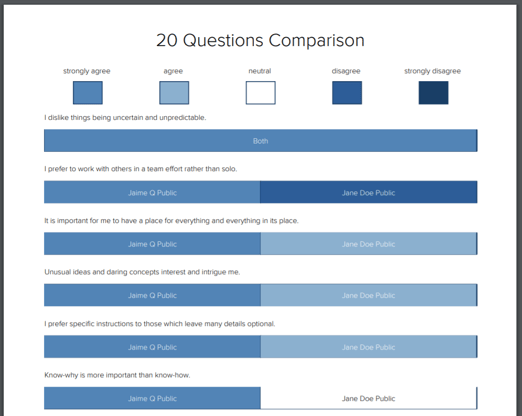
Twenty Questions (two pages)
-
Split 10/10 for readability; color-coded responses per Thinker, with “both” flagged when aligned.
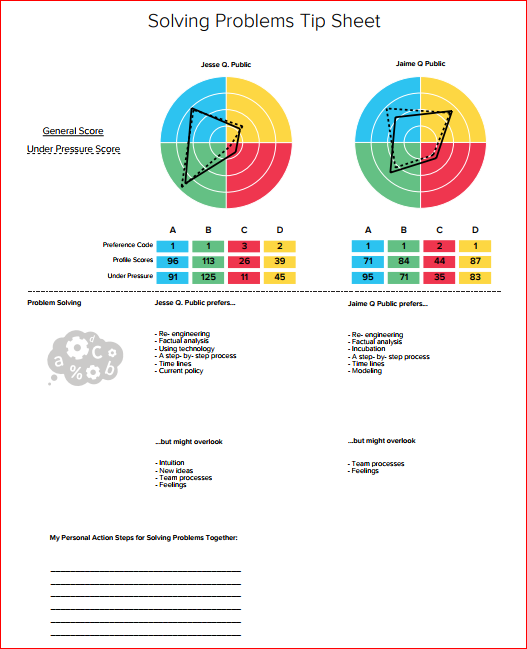
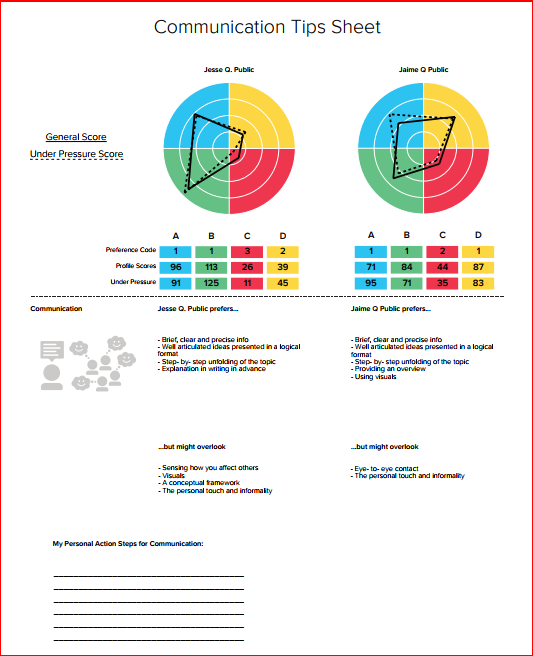
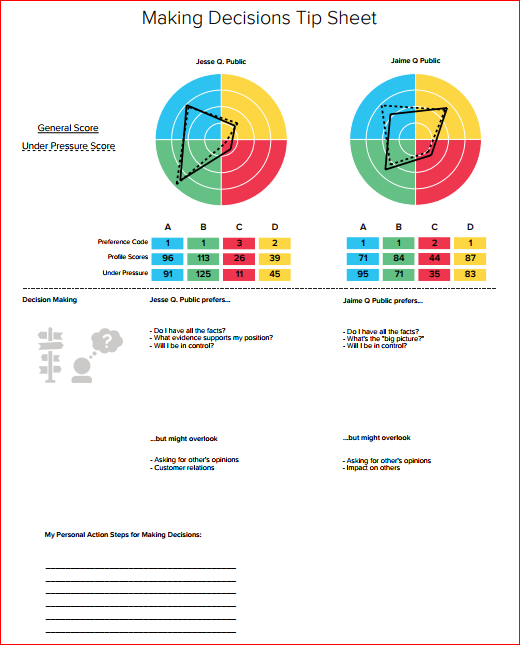
Tip sheets: Problem Solving / Communication / Decision-making
-
Practical do’s & don’ts based on each person’s preferences, plus space to capture action items.
How to facilitate with the Pair Report (quick path)
-
Start with the big picture
-
Profiles side-by-side → “Where we’re in sync” → process flows. Confirm shared goals for the conversation.
-
-
Explore language & signals
-
Key Descriptors + Adjective Pairs: identify triggers, preferences, and blind spots.
-
-
Examine pressure moments
-
Under Pressure pages: ask, “What situations trigger these shifts? What support helps each of us?”
-
-
Turn insight into practice
-
Use the Tip Sheets to agree on two or three concrete tweaks (e.g., meeting prep, decision roles, feedback norms).
-
-
Capture commitments
-
Write action items and a check-in date (e.g., 30 days).
-
Pro tips
-
Use real scenarios (a decision due this week) to make insights actionable.
-
Normalize differences: “preferences, not abilities.”
-
Revisit Under Pressure before deadlines or change events.
Related articles:
Need help? Please submit a ticket.